By Farvenzo Times · Published 29 October 2026
Creator Economy / Practical guide
YouTube Paid Promotion: Do Free Products Need a Disclosure?
Free products can create a relationship viewers need to know about. Check YouTube’s branded-content rules and the law that applies to your audience; its paid-promotion label is one part of disclosure, not a complete compliance plan.

Licensed photograph of a recording setup. Illustrative creator-workflow context; not evidence of a sponsorship or an endorsement.
Photo: Jakub Żerdzicki · Camera on tripod with microphones in background / source · Unsplash License.
Cropped to landscape, resized and encoded as WebP and JPEG. No content edits.
Start with what the audience would otherwise miss
A review can sound independent even when the creator received a product, payment or another benefit from the brand. The US Federal Trade Commission calls relevant relationships material connections. Its influencer guidance includes free or discounted products, as well as financial, employment, family and personal relationships. Disclosure helps a viewer assess the recommendation with that context.
The FTC guidance also makes clear that receiving a free product can matter even when the brand did not explicitly request a mention. This is US guidance, not a declaration that every country has identical rules. Creators and brands should check the requirements in the jurisdictions relevant to their work and audience.
What YouTube currently asks creators to do
YouTube says creators featuring branded content, sponsorships, endorsements or other commercial relationships must use its paid-promotion setting in the video details. Selecting it adds a disclosure at the beginning. Its help page separately explains that creators and their partners remain responsible for applicable legal requirements and platform policies.
- 01 / Record the relationshipPayment, products and other benefits need review.
- 02 / Disclose clearlyPut a truthful explanation with the recommendation.
- 03 / Check both layersPlatform controls and applicable rules both matter.
Conceptual sequence, not measured data. View the static graphic.
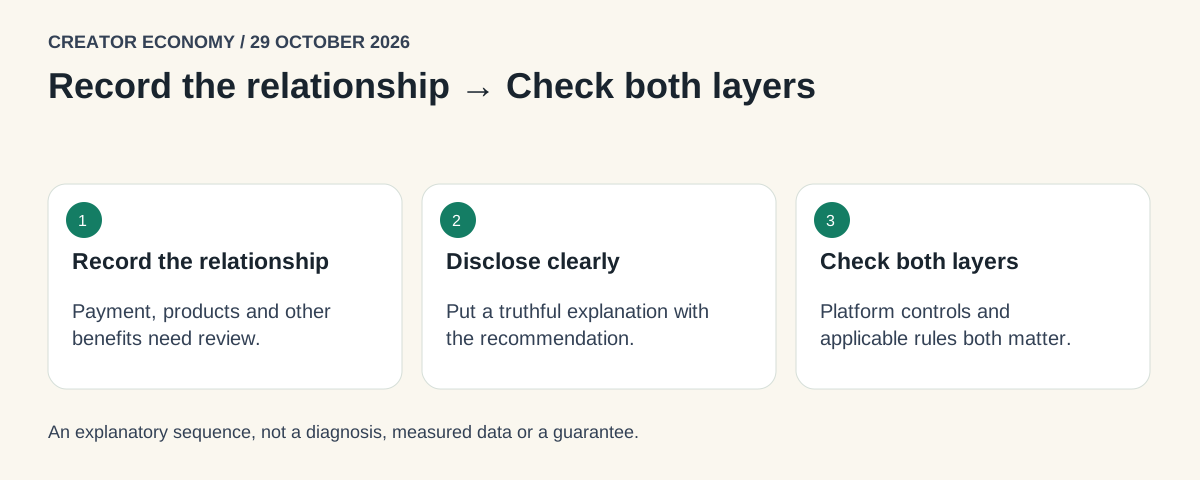
The practical consequence is to check two layers: the platform setting and the disclosure within the content. Completing the checkbox does not establish that the wording, placement and visibility of the explanation meet every applicable rule. A brand’s preferred caption is not a substitute for the creator understanding what the viewer will actually see.
Put the relationship beside the recommendation
The FTC advises making disclosures clear and hard to miss, placing them with the endorsement rather than hiding them in a profile or behind extra clicks. For video, its guidance says the disclosure should be in the video, not merely in the description; audio and visual disclosure together are more likely to be noticed. Avoid assuming that followers already know the commercial relationship.
A useful drafting exercise is to remove the brand name and describe the arrangement plainly. For example: “The brand sent me this product free; it did not pay for this video.” Use that sentence only if it is true, and add any other relevant relationship. It is an illustrative wording exercise, not a legally approved script for every campaign.
Four arrangements worth checking before recording
A cash sponsorship is the obvious case. A free product, a discounted service, an affiliate arrangement or a continuing brand relationship can also change what a viewer needs to know. Treat these as questions to check against the platform rules and applicable guidance; the absence of a cash invoice does not answer the disclosure question by itself.
For a hypothetical desk review, the creator might buy the laptop personally but receive a monitor free and earn commission from a keyboard link. “I bought this setup” would leave out part of the arrangement. A better preparation note records each item, who supplied it, whether it must be returned, what payment or commission is possible, and where the disclosure will appear.
Build disclosure into the brief
Before accepting a campaign, write a short relationship record and ask who approves factual product claims. Keep the agreement, the actual disclosure wording and a copy of the published version. If the agreement requires a misleading claim or prevents a necessary disclosure, resolve that before filming rather than hoping a small label will fix it later.
Separate commercial approval from editorial independence. If a sponsor can approve the script, that fact may matter to the description of the arrangement. Do not claim “no influence” merely because the sponsor did not choose the camera angle. Describe what happened in terms you could support with the agreement and correspondence.
A final viewer check
Watch the video once as someone who has never visited the channel. Can that viewer understand the relationship when the recommendation appears, on a small screen and without opening the description? Check that the saved platform setting and the rendered content agree with the real arrangement. Disclosure earns its place by making a recommendation easier to judge; it is not a guarantee of revenue, audience trust or immunity from enforcement.
This article explains public guidance for general education. It is not legal advice. Rules and product controls can change; consult the linked official pages and seek qualified advice for a particular campaign.
Sources
Keep exploring
- Why Two Creator Brand Deals With the Same Views Can Have Different Value →
Compare creator campaigns by the measurement definition, business objective and permitted use of the content—not the view count alone.
- Affiliate Marketing Economics: From Clicks to Collected Commission →
An affiliate click is not income. The business result depends on qualifying purchases, commission terms, reversals, payment timing and the cost of creating useful content.
- YouTube Content ID Claim or Copyright Strike? Check Before You Act →
A Content ID claim is different from a copyright strike. Check the claim, your rights and the revenue rules before choosing a response.