Global business & economics
Affiliate Marketing Economics: From Clicks to Collected Commission
An affiliate click is not income. The business result depends on qualifying purchases, commission terms, reversals, payment timing and the cost of creating useful content.
By Farvenzo Explained · Published · Sources checked 24 October 2026 · 2 min read
Map the path from recommendation to payment
A reader sees a recommendation, follows a tracked link and may make a purchase. The merchant or affiliate programme then decides whether the transaction qualifies under its terms. Only after validation and payment does the creator have collected income.
Before joining a programme, inspect its attribution window, qualifying products, exclusions, return handling, payment threshold and schedule. These are contract-specific questions. A headline commission percentage cannot answer them, and terms from one merchant should not be assumed to apply to another.
Calculate a small funnel
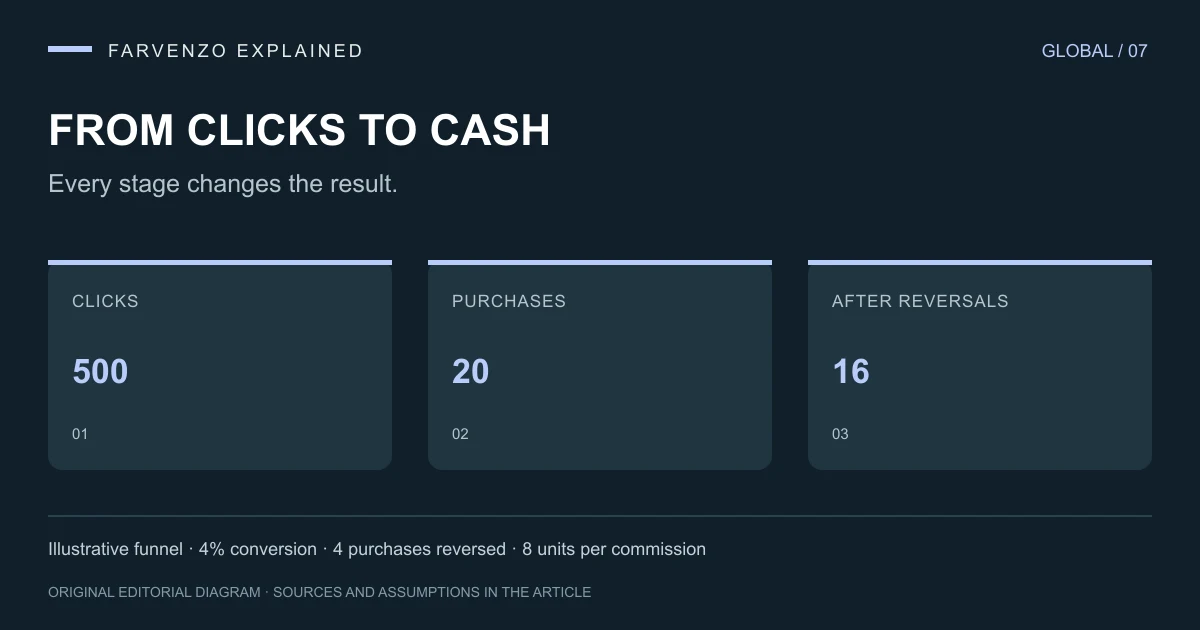
Imagine 10,000 article visits, with 5% clicking an affiliate link. That produces 500 clicks. If 4% of those clicks lead to qualifying purchases, there are 20 purchases. At an illustrative commission of 8 units each, the provisional commission is 160 units.
If four purchases are later reversed under the programme’s terms, the remaining commission is 128. If producing and maintaining the article costs 100 units, the contribution before shared overhead and taxes is 28. Every figure here is fictional. The example shows why visits, clicks, sales and collected earnings belong in separate columns.
Small changes compound through the funnel
Holding everything else fixed, doubling traffic doubles the example’s provisional commission. But traffic quality can change at the same time: a broader audience may click or buy at a lower rate. More visits therefore do not guarantee proportional revenue.
The same caution applies to commission rates. A higher rate on a poorly matched product can earn less than a lower rate on something readers actually need. Compare product fit, support burden and reader outcomes. Avoid presenting a recommendation as independent if payment helped determine its placement.
Make the commercial relationship understandable
The US Federal Trade Commission says material connections behind endorsements should be disclosed clearly. That is US guidance, not a substitute for the rules applicable in every country where a creator operates or reaches consumers. For a global audience, identify the relevant jurisdictions and platform requirements.
As an editorial practice, explain the financial relationship near the recommendation in ordinary language. Keep evidence about the product separate from the commission arrangement. Record when terms and product details were checked, and revisit older articles. A useful affiliate business depends on recommendations remaining useful after the first click.
Keep exploring
Why a Profitable Creator Can Still Run Short of Cash · Why Oil Prices and Your Fuel Bill Don’t Move Together
Sources
Keep exploring
- Why a Profitable Creator Can Still Run Short of Cash →
A sponsorship can look profitable before its payment arrives. Separating work completed, invoices, payment dates and cash commitments exposes the gap.
- Why Oil Prices and Your Fuel Bill Don’t Move Together →
A falling oil benchmark does not translate directly into the same percentage saving at the pump. The route from crude oil to a local fuel bill has several separate costs.