Global business & economics
Why Oil Prices and Your Fuel Bill Don’t Move Together
A falling oil benchmark does not translate directly into the same percentage saving at the pump. The route from crude oil to a local fuel bill has several separate costs.
By Farvenzo Explained · Published · Sources checked 24 October 2026 · 2 min read
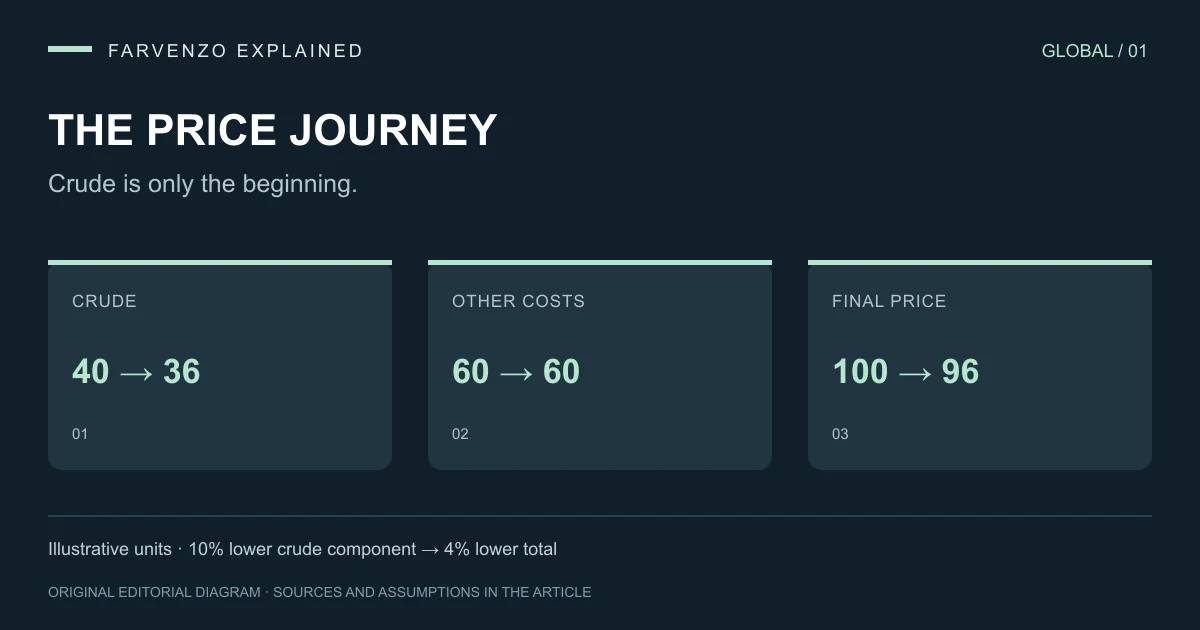
The headline measures one input
Brent and West Texas Intermediate are crude-oil benchmarks. A driver buys a refined product delivered to a particular location. Refining, transport, storage, retail costs and taxes sit between those two prices. The US Energy Information Administration identifies these components in its explanation of gasoline prices. Their shares change over time; a national average is not a universal recipe.
That distinction matters when reading a headline such as “oil falls 10%”. It describes a market price over a chosen period. It does not establish that a filling station’s total cost fell 10%, or that every fuel grade faced the same movement.
A simple cost-stack example
Imagine a fictional fuel price of 100 units: 40 linked to the crude input and 60 covering everything else. If the crude-linked part falls 10% and every other component stays fixed, the total becomes 96. The consumer saving is 4%, not 10%. These are illustrative units, not measured cost shares or a prediction.
Now suppose delivery and refining costs rise by three units at the same time. The total becomes 99. Two apparently contradictory headlines—cheaper crude and almost unchanged pump prices—can both be accurate. Actual pricing is more complicated, especially where taxes depend on the selling price.
Currency and local conditions change the journey
Australia’s competition regulator, the ACCC, highlights international refined-fuel benchmarks and the Australian-dollar/US-dollar exchange rate. A weaker local currency can offset a lower dollar-denominated fuel price. This is a documented Australian example of a mechanism relevant to many importing markets, not a claim that every country uses identical pricing rules.
Inventories and supply contracts also mean today’s delivered fuel may reflect earlier purchasing conditions. Refinery disruption or transport constraints can affect refined products differently from crude. Regulated prices, subsidies and local competition add further country-specific differences. There is no single worldwide pass-through timetable.
Read the comparison before drawing a conclusion
Compare the same fuel grade, location and time interval. Check whether the headline concerns crude, wholesale refined fuel or the final retail price. Then look at the local exchange rate, tax changes and official supply information. A one-day benchmark change cannot settle a question about a month of household expenses.
For a small business, separate price from consumption. A delivery firm’s bill can rise even when fuel per litre falls if its vehicles travel farther. Recording both units purchased and price per unit makes the cause visible and avoids treating every increase as a market-price story.
Keep exploring
Do YouTube Shorts Watch Hours Count Toward Monetization? · Beyond Ad Revenue: What Creator Income Diversification Really Changes
Sources
Keep exploring
- Do YouTube Shorts Watch Hours Count Toward Monetization? →
Watch hours from the Shorts Feed do not count toward YouTube’s 4,000-hour long-form eligibility threshold. Shorts have a separate qualifying-views route.
- Beyond Ad Revenue: What Creator Income Diversification Really Changes →
Adding memberships, sponsorships or products can reduce dependence on one income source. It can also add costs, deadlines and new forms of dependence.