Global business & economics
Beyond Ad Revenue: What Creator Income Diversification Really Changes
Adding memberships, sponsorships or products can reduce dependence on one income source. It can also add costs, deadlines and new forms of dependence.
By Farvenzo Explained · Published · Sources checked 24 October 2026 · 2 min read

The Life Wide Open podcast studio, photographed in 2022. Context for creator production; no claim is made about the depicted programme’s revenue or business arrangements.
Photo: Ebagan · Life Wide Open Podcast Studio.jpg / source · CC BY-SA 4.0.
Resized and converted to WebP; full frame retained. No filters, overlays or content edits by Farvenzo. Article-list thumbnails use a display crop. Farvenzo’s photographic renditions are available under the same CC BY-SA 4.0 licence.
Count dependencies as well as revenue streams
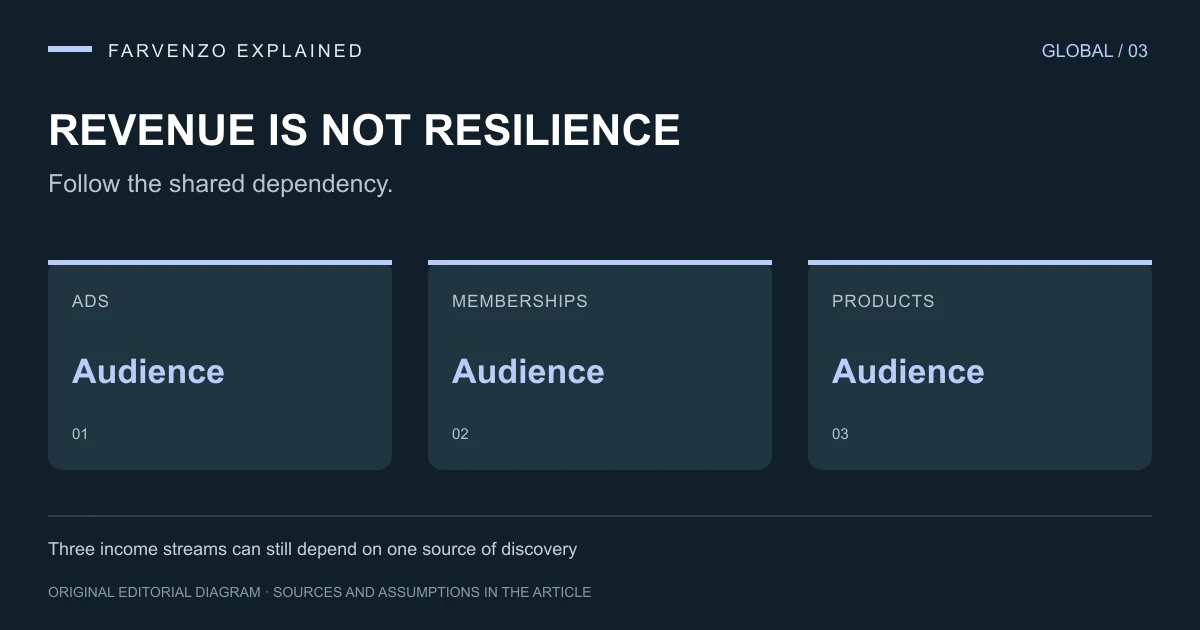
A creator can have four lines of income and still depend on one platform for every customer. If recommendations slow down, advertisements, affiliate clicks, membership sign-ups and product sales might all weaken together. Counting the lines on a spreadsheet misses that shared exposure.
Draw two columns: who pays, and how that person finds you. Then add a third for who controls access. An advertiser, a member and a customer are different payers, but their arrival may depend on the same feed. Diversification is more useful when the underlying risks differ.
Each model creates a different obligation
Advertising depends on eligible monetized activity and platform conditions. Memberships create recurring expectations. Sponsorships create deliverables and approval schedules. Products require fulfilment, maintenance or support. Affiliate recommendations depend on merchant terms and qualifying transactions.
YouTube’s revenue documentation shows why its RPM metric does not capture every creator business activity: merchandise, most outside brand deals and indirect services income are outside that measure. Treat the platform dashboard as one part of the business accounts, not the entire income statement.
Stress-test a small example
Consider a fictional creator earning 2,000 units from ads and 1,000 from workshops, before costs. If ad income falls by 30% while workshops hold steady, total revenue falls from 3,000 to 2,400: a 20% decline. This shows the arithmetic of different exposures, not an earnings forecast.
But suppose workshops require 900 units of delivery costs. They contribute only 100 before shared overhead and the creator’s own time. A revenue mix that looks balanced may leave most of the financial contribution exposed to advertising. Compare contribution after direct costs, delivery hours and payment timing as well as sales.
Add one experiment with a stopping rule
Choose a product or service that answers a recurring audience question. Define the smallest useful version, the hours available and the amount you can afford to lose. Record demand before committing to a long schedule. A waiting list is a signal of interest, not proof that people will pay.
After the trial, ask whether customers received the promised value, whether the work fits the channel, and whether the income justified the full effort. Keep a clear editorial boundary around sponsored recommendations. More revenue sources are valuable when they improve the business without eroding the trust that created the audience.
Keep exploring
Why GDP Growth Can Coexist With a Household Squeeze · YouTube RPM vs CPM: Why the Bigger Number Is Not Your Pay
Sources
Keep exploring
- Why GDP Growth Can Coexist With a Household Squeeze →
An economy can produce more while many households still struggle. Output, income distribution, living costs and debt payments measure different parts of the experience.
- YouTube RPM vs CPM: Why the Bigger Number Is Not Your Pay →
CPM describes advertiser spending per thousand ad impressions. RPM describes creator revenue per thousand relevant views. Their different denominators make direct comparisons misleading.