Global business & economics
YouTube RPM vs CPM: Why the Bigger Number Is Not Your Pay
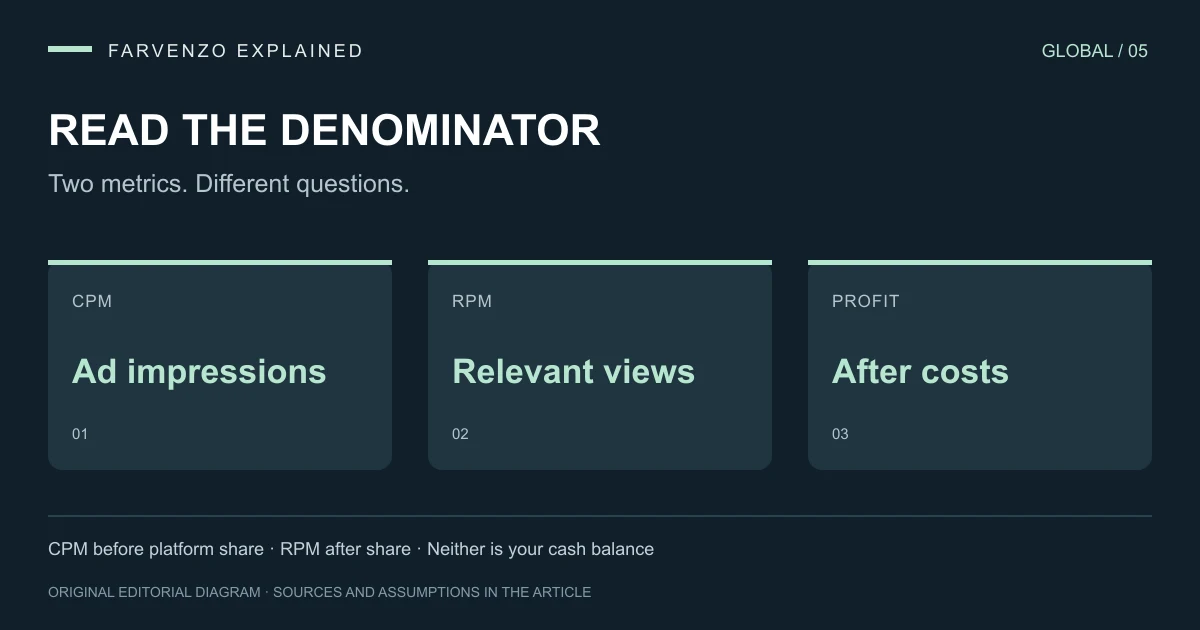
CPM describes advertiser spending per thousand ad impressions. RPM describes creator revenue per thousand relevant views. Their different denominators make direct comparisons misleading.
By Farvenzo Explained · Published · Sources checked 24 October 2026 · 2 min read
An HP-12C financial calculator photographed in 2024. Context for comparing revenue measures and denominators; no product endorsement.
Photo: Pittigrilli · Financial Calculator Hewlett-Packard HP-12C built from 1981, this item was produced in 1988.jpg / source · CC0.
Resized and converted to WebP; full frame retained. No filters, overlays or content edits by Farvenzo. Article-list thumbnails use a display crop.
Start with what each number divides by
YouTube defines CPM before its revenue share and RPM after its revenue share. RPM includes several reported revenue sources, while the CPM metric concerns ad impressions. For Shorts, the RPM denominator uses engaged views; for videos, it uses views. Read the label before comparing formats.
The distinction is easiest to understand as two questions: what did advertisers pay for advertising exposure, and what revenue did the creator earn relative to viewing? The numbers can differ without either being wrong.
A worked example without an earnings promise
Suppose a fictional video receives 100,000 views and the creator’s relevant revenue is 300 currency units. RPM is 300 divided by 100,000, multiplied by 1,000: 3 units. This example explains the calculation; it is not a typical YouTube rate.
Now imagine an advertiser CPM of 12 units. Multiplying 12 by every thousand video views would not calculate creator income. Not every video view is an ad impression, and the advertiser metric is measured before the platform’s revenue share. One viewing session may also involve more than one advertisement.
A falling rate can accompany rising revenue
In month one, a fictional creator earns 300 units from 100,000 relevant views, giving RPM of 3. In month two, the creator earns 500 from 200,000 views, giving RPM of 2.50. The rate fell while total revenue rose by 200 units.
That is why a rate should be read beside its numerator and denominator. A low rate alone cannot tell you whether the business is improving. Changes in audience mix, format and monetized activity can change the comparison. Use a consistent date range and avoid treating a short-lived spike as a permanent earning level.
Build a report that answers a decision
Keep separate rows for views, relevant revenue, RPM and the cost of producing the content. Compare like formats over a meaningful period. If one video takes twice as long to produce, a higher RPM may still leave it with a weaker return on the creator’s time.
Finally, reconcile platform estimates with finalized payment records and the wider business accounts. Revenue is not profit, and a platform’s analytics metric is not a cash balance. The useful report helps you decide what to make and what you can afford, rather than encouraging you to chase the largest number on the screen.
Keep exploring
Why Falling Inflation Does Not Mean Prices Are Falling · Affiliate Marketing Economics: From Clicks to Collected Commission
Sources
Keep exploring
- Why Falling Inflation Does Not Mean Prices Are Falling →
Inflation measures the pace of price increases. When that pace slows but stays positive, the price level keeps rising—and earlier increases remain in the shopping basket.
- Affiliate Marketing Economics: From Clicks to Collected Commission →
An affiliate click is not income. The business result depends on qualifying purchases, commission terms, reversals, payment timing and the cost of creating useful content.