Global business & economics
Why Falling Inflation Does Not Mean Prices Are Falling
Inflation measures the pace of price increases. When that pace slows but stays positive, the price level keeps rising—and earlier increases remain in the shopping basket.
By Farvenzo Explained · Published · Sources checked 24 October 2026 · 2 min read
Separate the rate from the level
Think of a price level as the amount on a receipt and inflation as how quickly that amount changes. Slower positive inflation is often called disinflation. A broad fall in the price level is deflation. The terms describe different movements.
The Bank of England’s explanation uses price changes over time to describe inflation. A national index combines many goods and services; it does not require every individual item to move in the same direction. A cheaper television and a higher restaurant bill can coexist within one positive headline rate.
Follow the arithmetic over two years
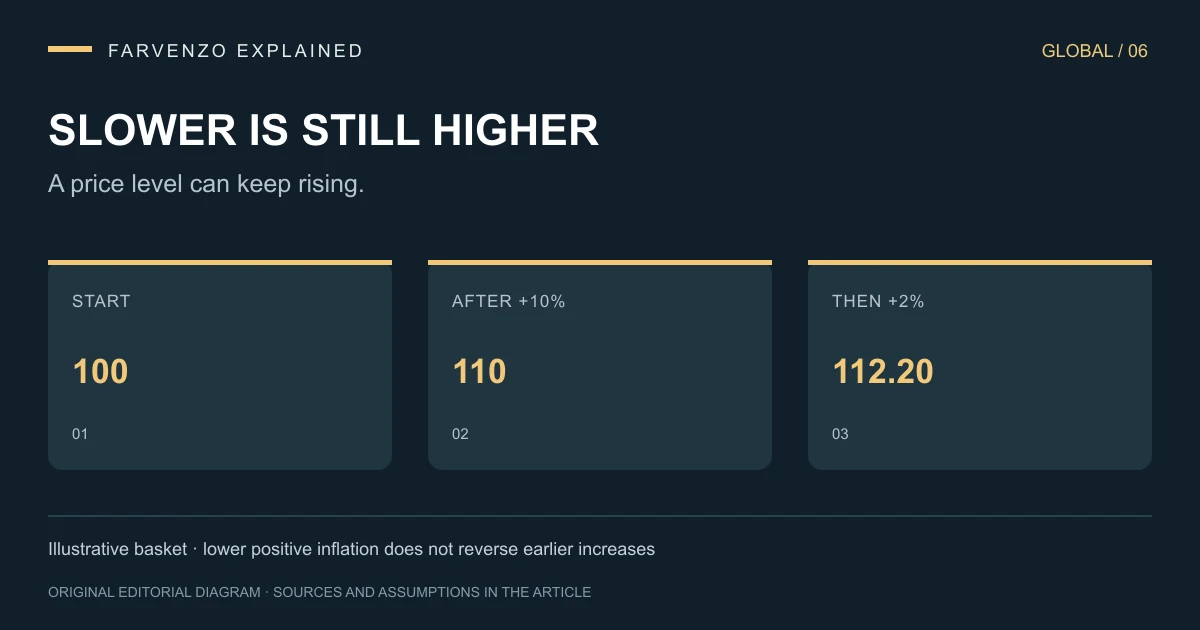
Take a fictional basket costing 100 units. After 10% inflation it costs 110. If inflation slows to 2% the following year, the basket costs 112.20. The rate fell by eight percentage points, but the basket became another 2.20 units more expensive.
Returning from 110 to 100 would require a decline of about 9.09%, not 10%. Percentage changes use the starting value of each period. This is why adding or subtracting annual rates casually can give the wrong answer about the cumulative change in a household’s costs.
Income decides whether affordability improves
Suppose the basket costs 112.20 while income has risen from 100 to 115. Purchasing power relative to this simplified basket improves. If income rises only to 108, it worsens. Both households could read the same inflation headline and have different financial experiences.
This is an illustration, not a household inflation estimate. Real budgets include changing quantities, substitutions and costs not captured by a single personal basket. Still, recording the same essential items over time can help explain why your own experience differs from a national average.
Compare the same interval and the same measure
A monthly change and a year-on-year change answer different questions. Prices might fall this month while remaining above their level a year earlier. Likewise, one category may become cheaper while the broader basket grows more expensive.
When a headline says inflation has cooled, check the period, the price index and whether the rate is still positive. Then compare your income and recurring commitments over the same interval. This provides a clearer picture of affordability than waiting for a lower inflation rate to undo every previous price increase.
Keep exploring
Affiliate Marketing Economics: From Clicks to Collected Commission · Why a Profitable Creator Can Still Run Short of Cash
Sources
Keep exploring
- Affiliate Marketing Economics: From Clicks to Collected Commission →
An affiliate click is not income. The business result depends on qualifying purchases, commission terms, reversals, payment timing and the cost of creating useful content.
- Why a Profitable Creator Can Still Run Short of Cash →
A sponsorship can look profitable before its payment arrives. Separating work completed, invoices, payment dates and cash commitments exposes the gap.