By Farvenzo Times · Published 31 October 2026
Creator Economy / Platform rules
YouTube Monetization Requirements 2027: What Changes on 1 February and Who It Affects
From 1 February 2027, new YouTube Partner Program applicants need 8,000 public watch hours or 20 million Shorts views, double today's bar. Existing partners keep their status but face new terms, an activity rule and a Shorts revenue threshold. Here is who is affected and what to do now.

What YouTube announced
On 10 August 2026 YouTube published the biggest change to its Partner Program entry rules in years. For channels that apply on or after 1 February 2027, the bar to share in ad and Premium revenue doubles. The 1,000-subscriber requirement stays the same. The watch-time route rises from 4,000 to 8,000 qualified public watch hours in the past 365 days, and the Shorts route rises from 10 million to 20 million qualified Shorts views in the past 90 days.
YouTube says existing partners are not affected by the higher entry thresholds. They do not have to requalify. But the same update adds rules that do apply to them, and those are the part most creators are missing.
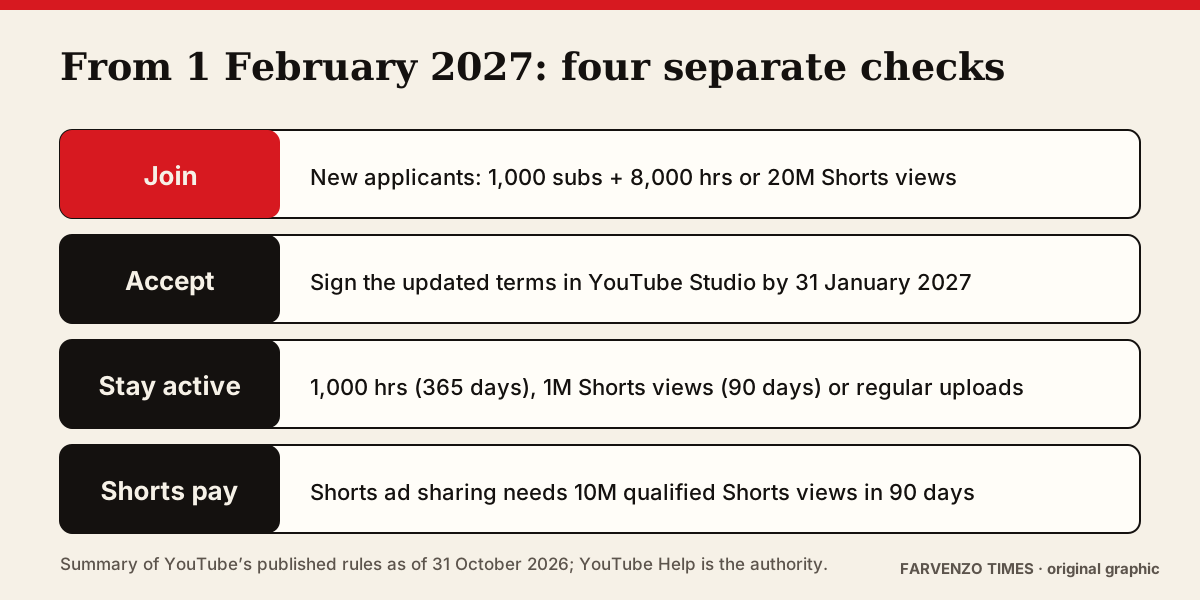
The four checks that apply from 1 February 2027
- Joining: New applicants need 1,000 subscribers plus 8,000 qualified watch hours (365 days) or 20 million qualified Shorts views (90 days).
- Accepting the new terms: YouTube Help asks partners to review and accept the updated terms in YouTube Studio by 31 January 2027 to keep fully monetising. Creators who have not accepted the Commerce Product Module by then stop earning from the related features on 1 February.
- Staying active: A channel counts as active with 1,000 qualified watch hours in the past 365 days, or 1 million qualified Shorts views in the past 90 days, or by uploading 2 long-form videos or 5 Shorts every 90 days. Channels that fall short get an extended 90-day window to recover, but only through the watch-hour or Shorts-view routes.
- Getting paid for Shorts: Ads and subscription revenue sharing on Shorts will require 10 million qualified Shorts views over the past 90 days. Channels below that stay in the program and keep long-form earnings, and Shorts sharing resumes automatically when the channel crosses the threshold again.
- 01 / Subscribers1,000 now and 1,000 from 1 February 2027
- 02 / Long-form route4,000 watch hours now; 8,000 from 1 February 2027
- 03 / Shorts route10M Shorts views now; 20M from 1 February 2027
Conceptual sequence, not measured data. View the static graphic.
What 8,000 hours means in practice
Spread evenly, 4,000 hours a year is about 11 hours of viewing a day. 8,000 hours is about 22 hours a day, every day, for a year. For a channel whose videos hold viewers for an average of four minutes, that is roughly 120,000 fully counted views a year under the new rule, against 60,000 under the old one.
The Shorts route scales the same way: 20 million views in 90 days is about 222,000 qualified views a day. Shorts views also do not count as watch hours. A channel cannot mix the two routes; it qualifies through one or the other. We explain that split in more detail in why Shorts views do not count as watch hours.
Only public long-form videos count towards watch hours. Private, unlisted and deleted videos do not, and neither do views of YouTube Shorts or ads. If your Studio dashboard shows a higher figure than the eligibility page, the eligibility page is the one that matters.
Why YouTube says it is doing this
In its announcement, YouTube said the program now has more than 3 million creators, Shorts get more than 200 billion views a day and viewers watch more than a billion hours on TV screens daily. It framed the change as directing more revenue to channels with established audiences while adding new income sources: bonuses for YouTube Shopping, incentives for brand deals and earnings boosts for starting and growing trends, with details still to come.
It also changed how Premium money is split. YouTube Premium Lite is expanding to every country where Premium is offered, with 60% of net Premium Lite subscription revenue going into the creator pool, compared with 30% for full Premium. That pool is distributed by member watch time and views, with creators receiving 55% for long-form and 45% for Shorts. YouTube says partners on average earned more from a Premium signup than from ads in 2026.
Who is most affected
Channels between 4,000 and 8,000 hours. If you meet the current requirements but have not applied, you are in the group with the most to lose by waiting. YouTube's review usually takes about a month, so an application made in November or early December leaves time for a decision before 1 February. YouTube has not published a rule for applications still pending on that date, so earlier is safer.
Shorts-first partners below 10 million views a quarter. They keep their partner status but may stop earning Shorts ad revenue. For many small Shorts channels that revenue is modest, as our guide to RPM versus CPM shows, but a channel that relies on it should check the Shorts views figure in Studio now.
Inactive partners. A channel that has stopped posting and lost most of its viewing may fall outside the activity rule. Two long-form uploads or five Shorts every 90 days is the simplest way to stay inside it.
A checklist for the next three months
- Open YouTube Studio's Earn tab and record your current qualified watch hours, Shorts views and subscriber count.
- If you meet today's 1,000 subscribers and 4,000 hours or 10 million Shorts views, apply now rather than in late January.
- If you are already a partner, accept the updated terms and Commerce Product Module before 31 January 2027.
- Put a recurring 90-day reminder in your calendar to check the activity rule and Shorts revenue threshold.
- If you are far from 8,000 hours, aim for the fan-funding tier first and treat sponsorships and other income as the main plan. Our piece on creator income diversification covers why.
Sources
Keep exploring
- Do YouTube Shorts Watch Hours Count Toward Monetization? →
Watch hours from the Shorts Feed do not count toward YouTube’s 4,000-hour long-form eligibility threshold. Shorts have a separate qualifying-views route.
- YouTube RPM vs CPM: Why the Bigger Number Is Not Your Pay →
CPM describes advertiser spending per thousand ad impressions. RPM describes creator revenue per thousand relevant views. Their different denominators make direct comparisons misleading.
- Beyond Ad Revenue: What Creator Income Diversification Really Changes →
Adding memberships, sponsorships or products can reduce dependence on one income source. It can also add costs, deadlines and new forms of dependence.