By Farvenzo Times · Published 28 October 2026 · 3 min read
Esports & Gaming / News explained
Before a Child Joins an Esports Team, Who Is Responsible for Their Safety?
A new Save the Children report says youth esports needs clearer safeguards and accountability. For families, the practical question is who protects a young player when competition, contracts and public attention overlap.

A gaming keyboard photographed in 2018. Illustrative equipment context; this image does not document a youth team, abuse or any incident discussed in the report.
Photo: Aidan Granberry · Black gaming keyboard / source · Unsplash License.
Resized and re-encoded as WebP and JPEG; full frame retained. Share image adds neutral padding. No content edits.
The report behind the warning
Protecting Child Rights in Esports, published by Save the Children International and Save the Children Sweden, examines competitive gaming through a child-rights framework. Its resource-centre summary describes a review of academic literature and consultations across the sector. It identifies challenges involving safeguarding, education, health, inclusion, exploitation and professional pathways. This is a synthesis and consultation report, not a new clinical trial establishing that esports causes a particular illness.
Euronews reported the findings on 27 October, highlighting fragmented protections and concerns about sleep, physical strain, online abuse and competitive pressure. Its account also notes that the picture is not uniformly negative: some players and organisations adopt healthy practices. The question is whether those protections are dependable and accountable, rather than left to an individual coach’s good intentions.
A tournament rulebook is only part of the answer
A rulebook can specify how a match is won without explaining what happens when a young player is harassed in a team chat. A parent may know the practice schedule but not who can contact their child privately. A coach may be responsible for performance without being the person authorised to handle a safeguarding complaint. Those gaps deserve answers before a team commitment becomes routine.
- 01 / AskName the safeguarding contact and escalation route.
- 02 / CheckRead schedules, chat rules and supervision plans.
- 03 / AgreeUnderstand obligations and hear the child’s views.
Conceptual sequence, not measured data. View the static graphic.
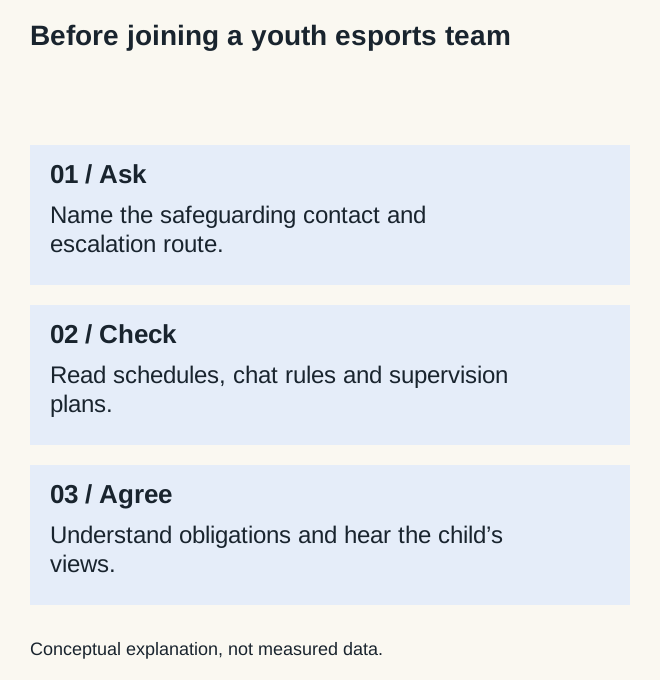
The strongest first question is concrete: name the responsible adult and the route for reporting a concern. Then ask what happens if the concern involves that adult. A reporting address that returns every complaint to the same person offers little independence. This is an editorial checklist for evaluating arrangements, not a certification system or a substitute for local safeguarding requirements.
Ask for the ordinary week, not only the final
Before agreeing to join, request the expected schedule, break arrangements, travel supervision and rules for communication outside sessions. Ask how school commitments and family responsibilities are handled when a tournament runs late. A polished event can still sit on top of an unclear weekly routine. Put the routine in writing so that the family and organisation are discussing the same expectations.
Public-facing activities need their own questions. Will matches be livestreamed? Who moderates chat? Can a child decline an interview or an appearance? Which adults may access team channels, and how are concerns escalated? A child’s ability to describe a problem and be heard is part of the arrangement, not a reward that depends on playing well.
Read the opportunity and the obligation together
A professional pathway can be exciting without being a guarantee of a career. Families should understand what any agreement requires about participation, image use, payment, expenses and leaving the team. Rules differ by place and contract; obtain suitable independent advice for a binding commitment. This article does not assess any particular organisation or claim that a named team has breached a duty.
Consider a hypothetical offer with free coaching but mandatory streaming and unpaid promotional appearances. Calling it free does not describe the full exchange. The family still needs to understand time, privacy and public-exposure obligations. Asking those questions does not diminish competitive ambition; it makes the offer understandable.
What a useful response would look like
The report’s central challenge is organisational: responsibility must remain clear as a player moves between a game, a team, a tournament and online audiences. Readers can look for published policies, named contacts and explanations of how concerns are investigated. A slogan about wellbeing is weaker evidence than a process people can actually use.
Young players should be able to enjoy competition and develop skills while remaining children with education, privacy and a voice in decisions. The next meaningful story will be what organisers change, who checks those changes, and whether young participants find them usable. A report identifies the problem; dependable practice is the follow-through.
Sources
Keep exploring
- Worlds 2026 Swiss Stage Explained: Why Three Wins Matter More Than a League Table →
Follow the Worlds 2026 Swiss stage by tracking records, draws and the three-win qualification threshold, without mistaking a simulator for a forecast.
- Why Two Creator Brand Deals With the Same Views Can Have Different Value →
Compare creator campaigns by the measurement definition, business objective and permitted use of the content—not the view count alone.