By Farvenzo Times editorial team · Published 25 October 2026 · Sources checked 25 October 2026 · 2 min read
Esports & Gaming / Explainer
Worlds 2026 Swiss Stage Explained: Why Three Wins Matter More Than a League Table
Follow the Worlds 2026 Swiss stage by tracking records, draws and the three-win qualification threshold, without mistaking a simulator for a forecast.

The record tells you what is at stake
Riot's Worlds 2026 primer describes a Swiss stage of up to five rounds. Three match wins take a team into the knockout stage; three match losses eliminate it. The useful starting point for a new viewer is therefore the team's current record. This is a qualification system with stopping points, rather than a league in which every team completes the same round-robin schedule.
For example, a hypothetical team at 2–1 is one match win from advancing and two losses from elimination. A team at 1–2 is one loss from going out. Those records can make two matches feel very different even when neither is the tournament final.
How the next opponent is chosen
Riot says later Swiss rounds pair teams against random opponents with the same record. Repeat opponents are excluded during the Swiss stage. Same-region meetings become possible from round two; the opening draw has separate tier and regional restrictions. Knowing those constraints is more useful than assuming the entire tournament path was fixed before the first match.
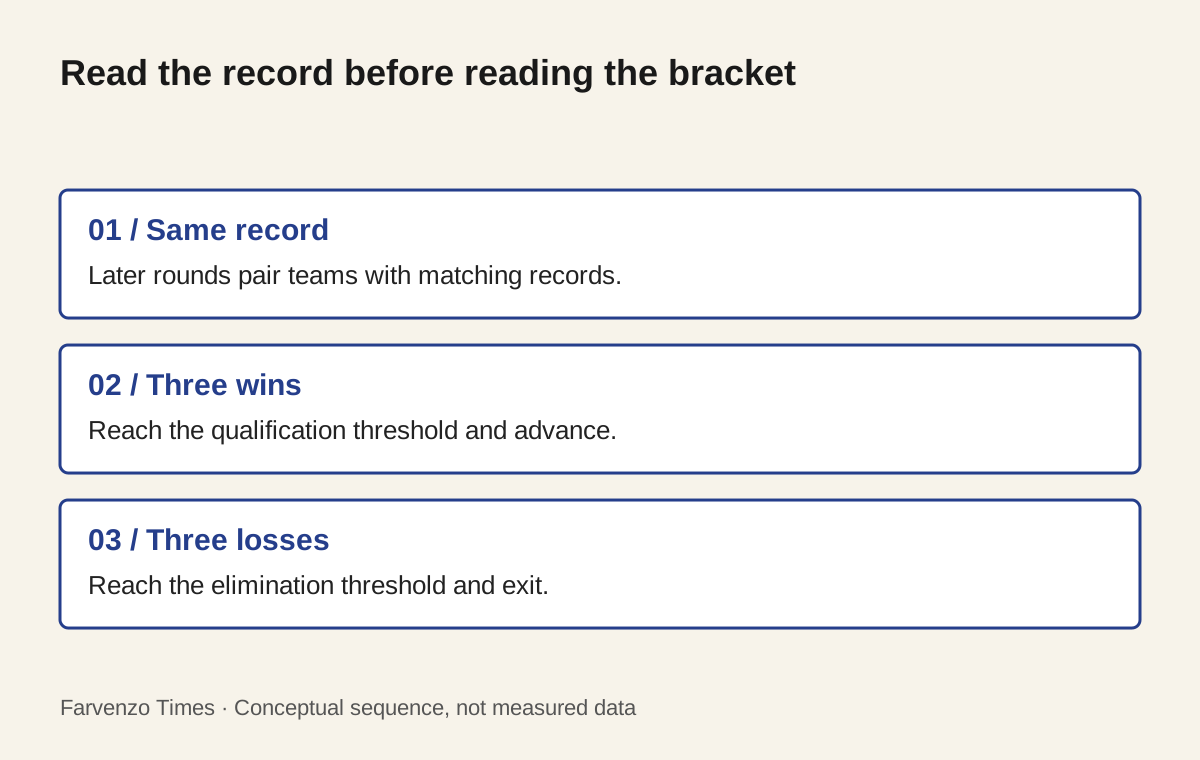
- 01 / Same recordLater rounds pair teams with matching records.
- 02 / Three winsReach the qualification threshold and advance.
- 03 / Three lossesReach the elimination threshold and exit.
Conceptual sequence, not measured data. View the static graphic.
An invented path illustrates the difference. A team that wins, loses and wins reaches 2–1. Its next opponent comes from the eligible 2–1 field under the draw rules. A graphic that connects it to one named opponent before that draw should be read as a possible scenario, not the announced fixture.
Nineteen entrants does not mean nineteen Swiss teams
Riot's tournament update explains that Worlds has 19 qualifying teams, with four entering a separate play-in competition that sends one team onward. The event then moves through Swiss and knockout stages across its US venues. Separate the overall tournament entry count from the field participating at a particular stage.
The official schedule lists Swiss play for October 23–26 and October 28–31. For a live viewing plan, check the current organizer schedule and your local time conversion. A copied poster or an old calendar entry can miss a change or a daylight-saving adjustment.
Use simulators to explore possibilities
A simulator can help explain which records are reachable. Its output becomes a prediction only after assumptions about team strength, draws and match outcomes are supplied. Two simulators can produce different paths without either having information about the next result. This guide reports the structure, not live standings, betting odds or a predicted champion.
When you open the next match, check the record, the consequence of winning or losing and whether the opponent has been officially drawn. Those three checks make the Swiss stage easier to follow. For a separate look at probability mistakes, read our explanation of parlays.