By Farvenzo Times · Published 29 October 2026
Lifestyle / Practical guide
Heat Pump vs Gas Boiler: The Break-Even Test for Your Energy Bill
A heat pump can use less energy yet cost more to run if electricity is expensive relative to gas. Compare the price of useful heat, then check installation costs separately. A worked example shows how.

Illustrative licensed photograph of an outdoor heat pump. Brand shown for context; no endorsement or claim about this unit’s measured savings.
Photo: alpha innotec · Modern outdoor heat pump unit next to building / source · Unsplash License.
Cropped to landscape, resized and encoded as WebP and JPEG. No content edits.
The comparison that a headline efficiency figure misses
A boiler buys fuel and converts part of its energy into heat. A heat pump buys electricity and moves heat from its surroundings. The International Energy Agency explains that heat pumps can reduce energy use even in poorly insulated homes, but the bill still depends on the relative prices of electricity and gas. Energy saved and money saved are different quantities.
Start with the same service: one kilowatt-hour of useful heat delivered to the home. Comparing a gas bill with an electricity bill without matching the heat supplied can hide changes in weather, room temperature, occupancy or hot-water use. A smaller bill after a mild winter is not by itself proof of a better heating system.
Work out the break-even efficiency
For a simplified comparison, gas heat costs the gas unit price divided by boiler efficiency. Heat-pump heat costs the electricity unit price divided by the heat pump’s seasonal performance factor. Use efficiency as a decimal: 90% becomes 0.90. The seasonal factor means heat delivered over the relevant period divided by electricity consumed over that period; it is more useful for an annual comparison than a single favourable operating point.
- 01 / Gas at 90%8 ÷ 0.90 = 8.89¢ per useful kWh
- 02 / Heat pump at 330 ÷ 3 = 10¢ per useful kWh
- 03 / Heat pump at 430 ÷ 4 = 7.5¢ per useful kWh
Conceptual sequence, not measured data. View the static graphic.
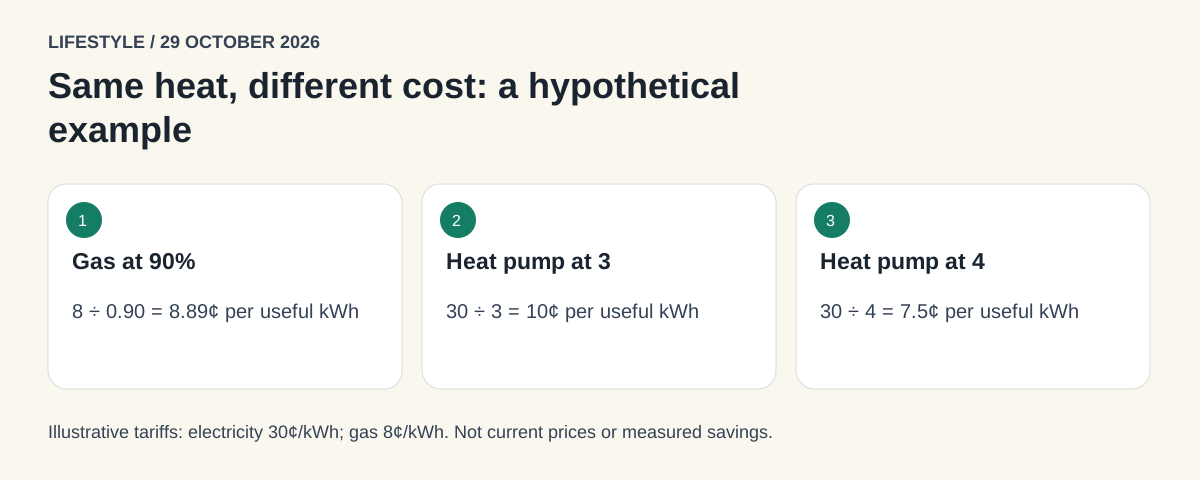
The heat pump has a lower energy-only running cost when its seasonal factor exceeds: electricity price × boiler efficiency ÷ gas price. Keep both fuel prices in the same currency and energy units. This is an arithmetic comparison, not a forecast of your installation.
A hypothetical household, with the numbers shown
Assume electricity costs 30 cents per kWh, gas costs 8 cents per kWh, and the boiler is 90% efficient. Gas heat costs 8 ÷ 0.90 = 8.89 cents per useful kWh. Break-even heat-pump performance is 30 × 0.90 ÷ 8 = 3.375. At a seasonal factor of 3, heat costs 10 cents per kWh; at 4, it costs 7.5 cents.
For an illustrative 12,000 kWh of annual useful heat, those energy costs are about 1,067 currency units for gas, 1,200 for the heat pump at a factor of 3, and 900 at a factor of 4. These invented inputs are not current tariffs or measured performance. They deliberately exclude standing charges, maintenance, financing and installation. Their purpose is to make the comparison reproducible with your own numbers.
Why the system design still matters
Energy Saving Trust describes how insulation, heating distribution and the design of the installation affect the result. A heat-loss assessment helps establish the heat required. Radiators, underfloor heating, hot-water arrangements and controls should be considered as a system, rather than choosing a unit from its headline capacity alone. Ask what performance estimate the quote uses and what assumptions support it.
If time-of-use electricity is offered, compare the rate actually paid during heating operation, including expensive periods. Do not put the cheapest advertised hour into the formula as if every hour cost the same. Solar generation and batteries need their own costs and timing assumptions; electricity used at home may also have an alternative export value.
A cheaper running cost is not the same as payback
Suppose, purely hypothetically, the heat-pump option costs 4,000 more upfront than the realistic alternative and saves 200 per year after operating costs. Simple payback is 20 years before financing, price changes or equipment replacement. If the boiler already needs replacement, compare the extra cost over that replacement, not the entire heat-pump invoice against doing nothing.
Include only savings you can actually make. A gas standing charge disappears only if the gas connection and all relevant gas use can be ended on the applicable terms. Check local incentives and eligibility separately; this guide does not quote a universal grant or promise a future subsidy.
What to ask before accepting a quote
Request the heat-loss calculation, proposed emitters and controls, estimated seasonal performance, backup-heating assumptions, hot-water provision and a complete installed price. Then run a low, middle and high performance case with your tariff. The useful decision is the one that remains understandable when a favourite assumption changes, not the one supported by the largest advertised saving.
Sources
Keep exploring
- Why Oil Prices and Your Fuel Bill Don’t Move Together →
A falling oil benchmark does not translate directly into the same percentage saving at the pump. The route from crude oil to a local fuel bill has several separate costs.
- Why Falling Inflation Does Not Mean Prices Are Falling →
Inflation measures the pace of price increases. When that pace slows but stays positive, the price level keeps rising—and earlier increases remain in the shopping basket.