By Farvenzo Times · Published 2 November 2026 · Sources checked 2 November 2026 · 4 min read
Science / Future technology explainer
Sodium-Ion vs Lithium-Ion Batteries: Cost, Range and Trade-offs
Sodium-ion batteries could be useful where cold-weather performance, material choices and storage costs matter more than squeezing the most energy into the smallest space. They are an emerging alternative for some applications, with trade-offs that prevent a simple claim that they will replace lithium-ion batteries.

Illustrative licensed photograph of an electric vehicle charging. The pictured vehicle is not identified as using sodium-ion batteries, and no product endorsement is implied.
Photo: Kindel Media · Electric vehicle connected to a charging cable / source · Pexels License.
Cropped to landscape, resized and encoded as WebP and JPEG. No content edits.
What changes when the battery uses sodium?
Sodium-ion and lithium-ion batteries operate on the same broad principle of moving ions between electrodes as they charge and discharge. The materials and designs differ, so the chemistry’s name alone does not establish a battery’s price, useful life or performance.
The International Energy Agency’s February 2026 analysis describes sodium-ion as a growing battery technology with potential to reduce exposure to lithium price swings. It also identifies a persistent constraint: lower energy density than leading lithium-ion technologies. In plain terms, a given amount of stored energy can require more battery mass or space.
A vehicle and a stationary store ask different questions
Imagine two hypothetical buyers. One needs a vehicle for frequent long motorway trips. The other needs batteries at a fixed industrial site, where available floor space is less restrictive. Both care about cost and reliability, but carrying extra battery mass has a different consequence in the vehicle.
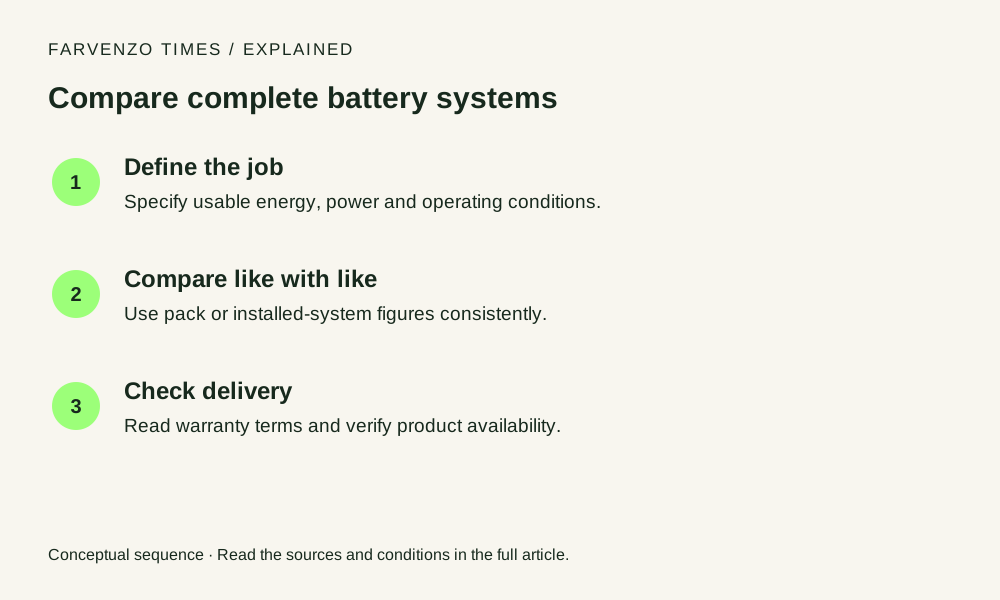
- 01 / Define the jobSpecify usable energy, power and operating conditions.
- 02 / Compare like with likeUse pack or installed-system figures consistently.
- 03 / Check deliveryRead warranty terms and verify product availability.
Conceptual sequence, not measured data. View the static graphic.
A short urban delivery route creates another set of priorities. Its operator might value predictable daily distance and performance in a cold climate differently from a driver seeking maximum range between distant charging stops. These examples explain how to frame the comparison; they are not recommendations for a particular product.
Compare the same level of the system
A battery cell is a component. A usable pack or installed storage system also needs supporting equipment, controls and an appropriate enclosure. When one headline quotes cell energy density and another quotes a complete system, the numbers are not directly comparable.
- Capacity: how much usable energy does the complete product provide?
- Conditions: at what temperature and operating limits was performance measured?
- Output: can it deliver the power required for the application?
- Lifetime: what usage pattern and warranty conditions apply?
- Installed cost: what equipment, installation and ongoing service are included?
- Availability: is this a purchasable supported product, a trial or an announced plan?
For a fair purchasing comparison, request the same assumptions from each supplier. A lower headline cell price is not enough if the products have different usable capacity, warranties or installation needs.
Announcements show progress, not a universal result
CATL and Changan announced a sodium-ion passenger vehicle in February 2026. CATL reported cell energy density of up to 175 Wh/kg and described cold-weather performance. Those are manufacturer statements about a particular technology; they should not be applied to every sodium-ion battery or treated as independent tests.
The IEA’s Global EV Outlook 2026 describes sodium-ion entering a scale-up phase while remaining constrained by supply-chain maturity and energy density. The report points to shorter-range vehicles, industrial equipment and stationary storage as relevant applications. That is a more useful picture than assuming one chemistry will win every market.
Abundant sodium does not make every component abundant
The IEA also cautions that sodium-ion supply chains remain geographically concentrated and that some chemistries use other critical minerals. Removing lithium does not remove all material, manufacturing or geopolitical constraints. Announced manufacturing capacity is a plan, not proof that batteries have been delivered.
For readers following the technology, watch for supported products, independently explained test conditions and comparable whole-system costs. Those developments will reveal where sodium-ion becomes competitive. A dramatic laboratory result or factory announcement is a starting point for questions, rather than a reason to assume your next vehicle or home battery should use it.
Sources
Keep exploring
- AI’s Next Bottleneck: Why the Data-Centre Boom Is an Electricity Story →
Why AI infrastructure needs electricity, financing and useful applications. A sourced guide to the IEA’s projections and the IMF’s October 2026 outlook.
- Heat Pump vs Gas Boiler: The Break-Even Test for Your Energy Bill →
A heat pump can use less energy yet cost more to run if electricity is expensive relative to gas. Compare the price of useful heat, then check installation costs separately. A worked example shows how.