By Farvenzo Times editorial team · Published 26 October 2026 · Sources checked 26 October 2026 · 2 min read
Business / Explainer
Oil Inventories Explained: Why a Bigger Stockpile Does Not Predict the Next Price Move
An oil inventory report records a change in stored supply. Understanding its period, product and context is more useful than treating a build or draw as a trading instruction.

A stock is different from a flow
The US Energy Information Administration describes petroleum inventories as stored crude oil and refined products. They help bridge differences between production and consumption. A build means stored volumes rose over the reported period; a draw means they fell. Neither word by itself identifies why the change happened.
Think of a storage tank as a balance sheet for physical supply. Its ending level depends on its starting level plus what arrived minus what left. A rise could follow stronger arrivals, slower withdrawals or both. The same numerical increase can therefore describe different underlying situations.
Work through a fictional tank
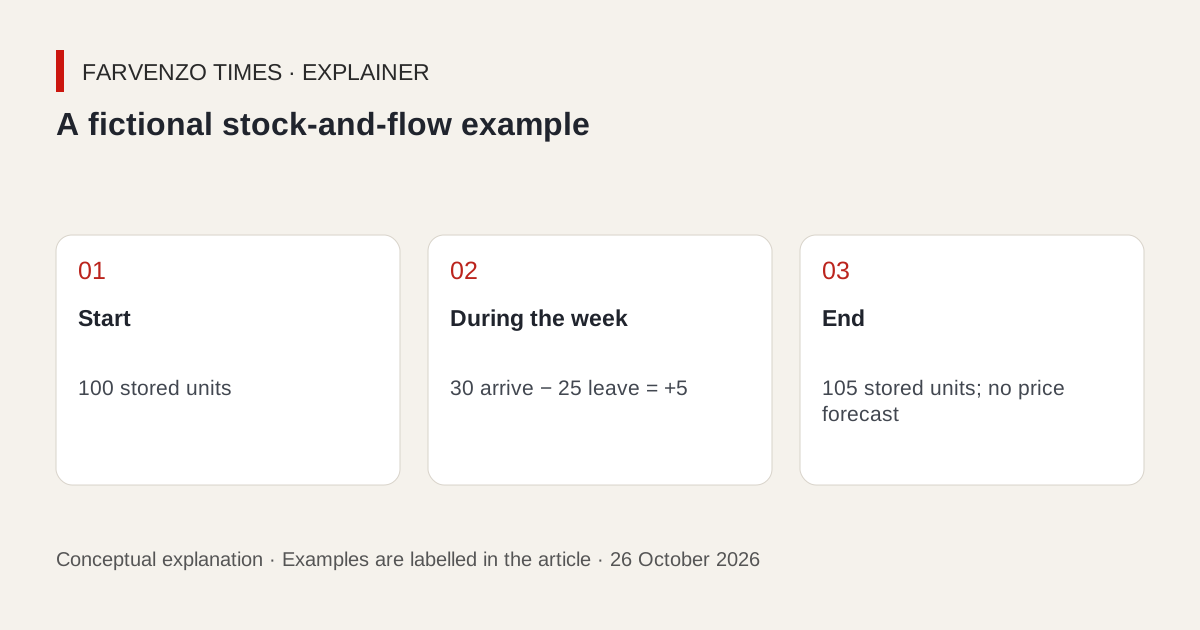
Suppose a simplified system begins a week with 100 units, receives 30 and releases 25. It ends with 105, a build of five. Next week it receives 20 and releases 25, ending at 100, a draw of five. The arithmetic tracks stocks and flows; the units are invented and do not represent a national release.
- 01 / Start100 stored units
- 02 / During the week30 arrive − 25 leave = +5
- 03 / End105 stored units; no price forecast
Conceptual sequence, not measured data. View the static graphic.
Now compare two fictional forecasts for the first week. One reader expected a build of ten and another expected no change. The realised build of five lies below one expectation and above the other. Calling it “an increase” is accurate, but does not describe what either reader learned relative to their prior view.
Ask what is actually being counted
EIA explains that inventories provide a buffer for seasonal demand, refinery maintenance and disruptions. It recommends comparing inventory levels with the same seasonal period rather than interpreting every movement in isolation. Crude oil and a refined product also serve different roles; a headline that drops the product name loses useful information.
A practical reading note should identify the geography, product, measurement date, reporting interval and comparison baseline. Keep the stock level separate from the change during the week. A small weekly draw from a large starting stock is different from the same draw in a much tighter system.
The price question is broader
EIA’s financial-markets explanation describes futures as a way for producers and consumers to manage price exposure and for markets to reflect expectations. Its inventory discussion also connects storage decisions with present and expected future conditions. A report is one input to that assessment, not an automatic price forecast.
Before accepting a claim that a release “must” send prices up or down, ask what else is assumed to stay unchanged. A defensible explanation distinguishes the observation, a possible mechanism and the evidence for an actual market reaction. This article supplies no current oil quote, investment recommendation or claim about the latest weekly surprise. For the separate household question, read our explainer on crude prices and fuel bills.
Sources
Keep exploring
- Why Oil Prices and Your Fuel Bill Don’t Move Together →
A falling oil benchmark does not translate directly into the same percentage saving at the pump. The route from crude oil to a local fuel bill has several separate costs.