By Farvenzo Times · Published 28 October 2026 · 3 min read
Science / News explained
NASA Wants to Pick Science Missions Faster. That Is Only the First Clock.
NASA’s Competition Model 2.0 aims to shorten the contest for science missions by asking for less detail upfront. A faster selection does not by itself mean a spacecraft launches sooner.

NASA/JPL-Caltech photograph of the High Bay 1 spacecraft assembly facility on 12 November 2019. Archival context for mission development, not a photograph of the 2026 policy announcement.
Photo: NASA/JPL-Caltech · High Bay 1 spacecraft assembly facility, 12 November 2019 / source · NASA editorial media usage permission.
Resized and re-encoded as WebP and JPEG; full frame retained. Share image adds neutral padding. No content edits.
A change to the competition
In a 21 October letter, science chief Nicola Fox outlined a science-first approach to mission proposals, followed by more detailed implementation work where needed. NASA scheduled a community town hall on 26 October to explain the changes. Space.com reported the reforms that day. The policy is a staged change to how missions compete, rather than evidence that its promised savings have already occurred.
For Astro-Probes, New Frontiers and Discovery, NASA describes an accelerated two-step process with an initial science case, implementation plan and proof-of-concept design. Its stated target takes one selection interval from 35 months to about 19.5 months. Smaller mission classes move toward a single-step contest. Flagships retain their existing reformed approach; the new model does not place every mission on the same track.
Why earlier selection can matter
A competition has costs even before anyone builds a spacecraft. Researchers must decide how much time to commit, which partners to recruit and whether a promising idea can survive a long wait. Reducing work that every unsuccessful team must do could leave more effort for other research. That is the economic logic of shifting detailed work later, not a measured estimate of money recovered.
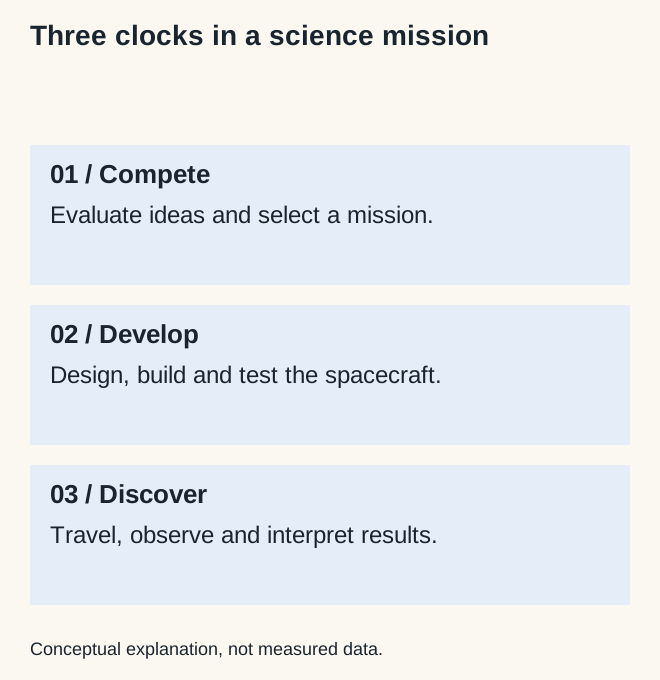
- 01 / CompeteEvaluate ideas and select a mission.
- 02 / DevelopDesign, build and test the spacecraft.
- 03 / DiscoverTravel, observe and interpret results.
Conceptual sequence, not measured data. View the static graphic.
The trade-off is information. A short early proposal can be easier to enter, but a selection still needs enough evidence to separate an exciting question from an executable mission. The important test is whether the later implementation study reveals risks soon enough to change the design or the decision. Less paperwork is useful when it removes duplication; it is costly when it merely postpones discovering a fundamental problem.
Keep the three clocks apart
There is a competition clock, a development clock and a science clock. The first ends with a selection decision. The second covers the work needed to design, build, test and prepare a mission. The third concerns the journey and observations needed to answer the scientific question. A change to the first clock cannot automatically be applied to all three.
For example, a hypothetical mission selected a year earlier might still depend on an instrument that requires several years of development, or a launch opportunity that has not moved. Conversely, an earlier decision could help a team start critical work sooner. Both outcomes are possible; an announced percentage reduction in a selection interval cannot tell a reader which outcome will occur.
What would demonstrate success?
A useful follow-up would compare advertised and actual competition milestones, the effort required from applicants, and the maturity of selected designs. It would then follow the projects into development. An improvement at the proposal stage should be reported as such, without borrowing credit from a launch or scientific discovery that has yet to happen.
The broader stakes extend beyond NASA. Universities and commercial partners need competitions that are accessible enough to attract ideas and rigorous enough to protect scarce research funding. The model is therefore worth watching as a change in how scientific opportunities are allocated. Its success remains an implementation question, to be judged against real decisions and delivered science.
The takeaway for readers
When the next mission headline promises a shorter wait, ask what the wait measures. Proposal submission to selection is a meaningful interval, but it is not interchangeable with time to launch or time to results. NASA has set out a mechanism and targets. The evidence to assess the outcome will arrive over the competitions and missions that follow.
Sources
Keep exploring
- What Is a Free-Return Trajectory? The Route Behind Artemis II's Lunar Flyby →
A free-return path uses Earth–Moon gravity to bring a spacecraft back toward Earth. Here is why that does not mean a mission needs no engines or course corrections.
- Powering AI Data Centers: From Hourly Demand to Nuclear and Renewable Deals →
How to distinguish physical and contractual electricity, read dated IEA forecasts, evaluate hourly matching, and compare grid supply options.