By Farvenzo Times editorial team · Published 25 October 2026 · Sources checked 25 October 2026 · 2 min read
Science / Explainer
What Is a Free-Return Trajectory? The Route Behind Artemis II's Lunar Flyby
A free-return path uses Earth–Moon gravity to bring a spacecraft back toward Earth. Here is why that does not mean a mission needs no engines or course corrections.

Free return does not mean free of propulsion
A free-return trajectory is arranged so that a spacecraft travelling around the Moon returns toward Earth through the geometry of the Earth–Moon gravity field. NASA uses that description for Artemis II. The word free refers to an important property of the return path. It does not mean that launching, reaching the path or bringing a crew safely through reentry requires no energy or operational work.
One way to read the term carefully is to ask what portion of the journey it describes. The route back, the spacecraft's orientation, the landing target and the crew's life support are related problems, but they are not interchangeable. A favorable path does not answer every question about a mission.
What the NASA documents actually show
NASA's mission press kit describes a major propulsion maneuver that establishes the outbound trajectory and smaller correction burns during the journey. Its return description includes corrections to prepare for splashdown. The planning document is useful for understanding the intended sequence; it should not be read as a live mission-status feed.
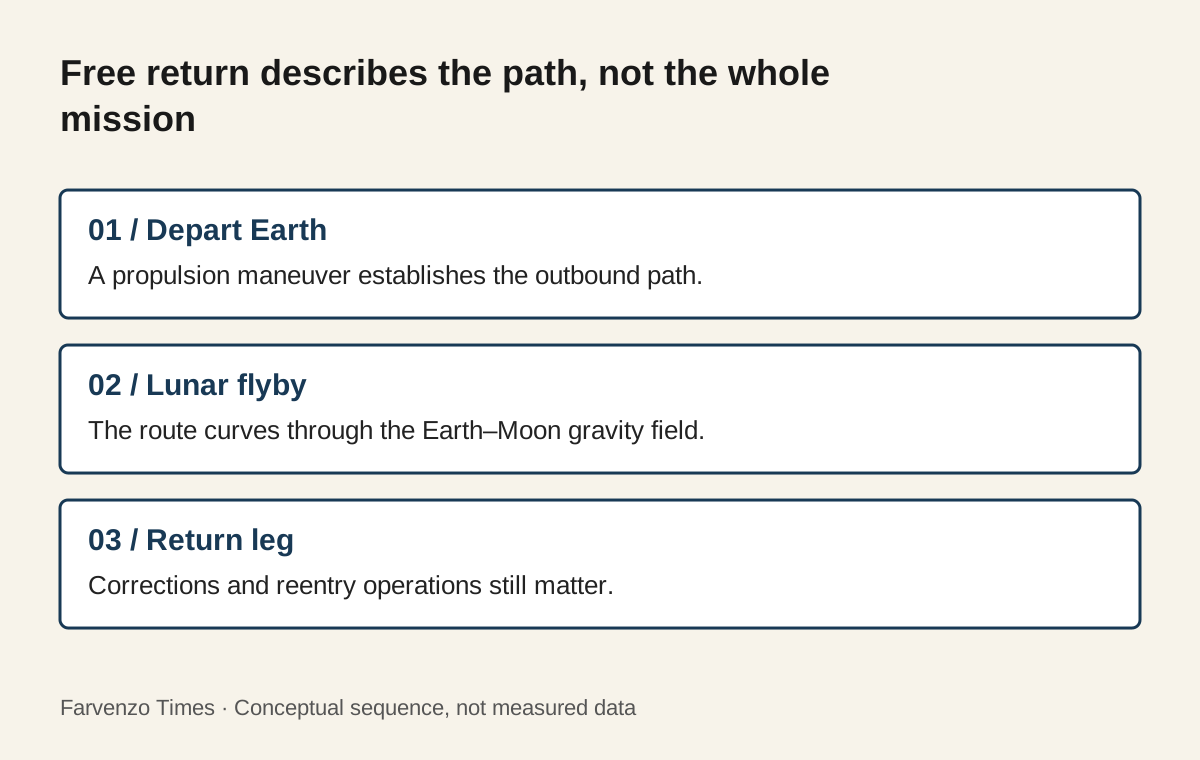
- 01 / Depart EarthA propulsion maneuver establishes the outbound path.
- 02 / Lunar flybyThe route curves through the Earth–Moon gravity field.
- 03 / Return legCorrections and reentry operations still matter.
Conceptual sequence, not measured data. View the static graphic.
A separate NASA Scientific Visualization Studio page, released on April 6, 2026, presents the Artemis II route using flight-derived ephemeris data. That distinction is valuable: a notional planning diagram and a visualization based on flight data are different evidence. Both can explain the path, but their labels tell you what each represents.
Flyby, orbit and landing are different tasks
NASA describes Artemis II's path as a loop around the Moon and back toward Earth. A flyby should not be mistaken for a surface landing. When reading a mission graphic, first identify the labeled route and the operations it actually includes. A curved line near the Moon does not by itself show a landing or an extended stay in lunar orbit.
Our accompanying diagram is a conceptual sequence, not a navigation plot. It deliberately omits distances, speeds and exact geometry. Adding precise-looking coordinates without the underlying mission data would make a teaching illustration look more authoritative than it is.
Three checks for the next space headline
First, distinguish a proposed plan from a measured trajectory. Second, identify whether the milestone is departure, flyby, orbit, landing or return. Third, ask which remaining operations are needed before success can be assessed. These checks are useful even when a headline uses familiar words such as automatic or guaranteed.
The central idea is a carefully chosen route that makes use of gravity. The engineering achievement includes reaching and maintaining that route while supporting the spacecraft and crew. Read the original mission documents for the geometry and operations, and use simple illustrations to understand the sequence rather than infer unreported mission details.