By Farvenzo Times · Published 28 October 2026 · 3 min read
Technology / News explained
Apple’s M6 MacBook Pro Is Here. What Do the Upgrade Claims Actually Mean?
Apple has announced a 14-inch MacBook Pro with M6, with pre-orders opening on 28 October. Its performance claims are useful only when matched to the computer and workload you actually use.

Archival photograph of a laptop used for video editing, published March 2025. Illustrative workflow context; this is not a photograph of the announced M6 model.
Photo: Grigorii Shcheglov · Laptop set up for video editing / source · Unsplash License.
Resized and re-encoded as WebP and JPEG; full frame retained. Share image adds neutral padding. No content edits.
What Apple has confirmed
Apple’s 27 October announcement lists a 12-core CPU, a 12-core GPU and 16GB of unified memory as standard, configurable to 32GB. The stated US starting price is $1,999; Apple says availability begins on 6 November in its initial markets. Prices, configurations and availability elsewhere need checking locally. These are manufacturer specifications, not the results of a Farvenzo hardware test.
The company advertises up to 13 times faster time to first token for a particular large-language-model prompt-processing comparison against an M1 MacBook Pro, and up to 1.3 times against an M5 model. Those two baselines describe very different upgrade distances. The larger number cannot be applied to every task or to every previous MacBook.
Why the baseline changes the story
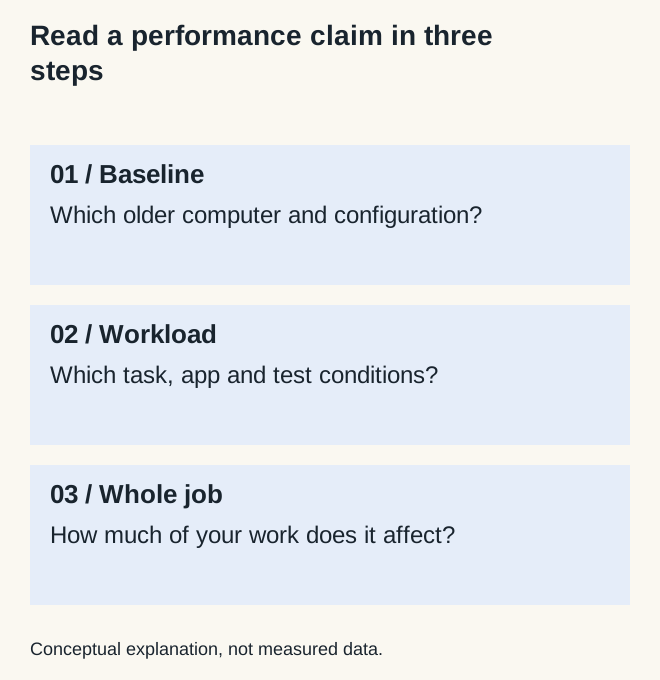
A speed ratio answers a narrow question: how long did this task take on these two configurations under these conditions? It does not tell you how much faster a working day becomes. Opening email, waiting for a client to approve a draft and uploading over a slow connection are different constraints from local computation. A laptop can shorten one part of a job while leaving the rest untouched.
- 01 / BaselineWhich older computer and configuration?
- 02 / WorkloadWhich task, app and test conditions?
- 03 / Whole jobHow much of your work does it affect?
Conceptual sequence, not measured data. View the static graphic.
Consider a hypothetical editor whose one-hour job includes ten minutes of computer processing and fifty minutes of decisions, filming and communication. Even if the processing time were halved, the whole job would fall to 55 minutes, a five-minute saving. That is an illustration of a bottleneck, not an M6 benchmark or an estimate of what any buyer will save.
Software changes deserve a separate column
Apple also announced Creator Studio changes on 27 October, including MotionVFX integration and a Content Hub in Final Cut Pro, and workflows that send timeline images to Pixelmator Pro. These are software and subscription developments. Their presence in the same announcement cycle does not mean a new laptop is necessary to obtain every feature. Check the individual app’s compatibility, plan and regional requirements before linking a software benefit to a hardware purchase.
For a creator, the useful comparison starts with an actual project: the codecs, effects, application versions, memory needs and export settings used in paid work. A generic AI headline is a weak substitute for that list. Also separate a feature that reduces manual editing steps from a chip improvement that reduces processing time. Both may help, but they help in different ways.
Three checks before an upgrade decision
First, name the current constraint. Is the machine running out of memory, waiting on exports, short of storage, or simply inconvenient to carry? Second, compare the complete configuration and total cost, including the equipment and software you actually need. Third, look for independent testing of your workload when it becomes available. This article does not establish battery endurance, sustained performance or reliability from hands-on use.
Readers following touchscreen or OLED speculation should keep that discussion separate from this confirmed M6 announcement. A popular video, an attractive mock-up or a rumoured future machine does not change the specifications of the product being offered today. The question is whether a verified change solves a present problem at a justifiable cost.
What to watch next
The next useful evidence is reproducible application testing, followed by delivery and availability in each market. Until then, Apple’s release establishes what it is selling and what it claims. A purchasing decision needs one additional bridge: evidence that those gains matter to the buyer’s own work. No universal upgrade recommendation follows from a single peak speed ratio.
Sources
Keep exploring
- Small Models, Specific Jobs: An Enterprise Architecture Beyond Parameter Counts →
How to test and deploy small language models with retrieval, selective fine-tuning, held-out evaluation, escalation routes, and realistic TCO.
- Why Two Creator Brand Deals With the Same Views Can Have Different Value →
Compare creator campaigns by the measurement definition, business objective and permitted use of the content—not the view count alone.