By Farvenzo Times editorial team · Published 25 October 2026 · Sources checked 25 October 2026 · 2 min read
Health / Explainer
Creatine and Strength Training: What Changes, and What the Scale Cannot Tell You
Creatine can support repeated intense exercise. Understand the evidence, water-weight changes and the questions to ask before choosing a supplement.

The useful distinction is performance versus weight
Creatine is involved in supplying energy to muscles. The NIH Office of Dietary Supplements describes benefits for repeated short periods of intense effort, including lifting and sprinting. It reports much less value for endurance activities. That distinction matters when a product is advertised as a general solution for every fitness goal. A supplement studied for one kind of effort does not automatically improve every kind of exercise.
Think of two separate questions: can you perform the training more effectively, and what explains a change in body weight? Those questions need different evidence. A bathroom scale cannot tell you how much of a change is muscle, fat or water.
Why an early scale increase can be misleading
The Australian Institute of Sport explains that increasing muscle creatine can increase body water and body mass. An early weight increase therefore need not mean fat gain, and it does not establish that an equivalent amount of new muscle has appeared. That is especially relevant when body weight affects competition eligibility or how an athlete evaluates progress.
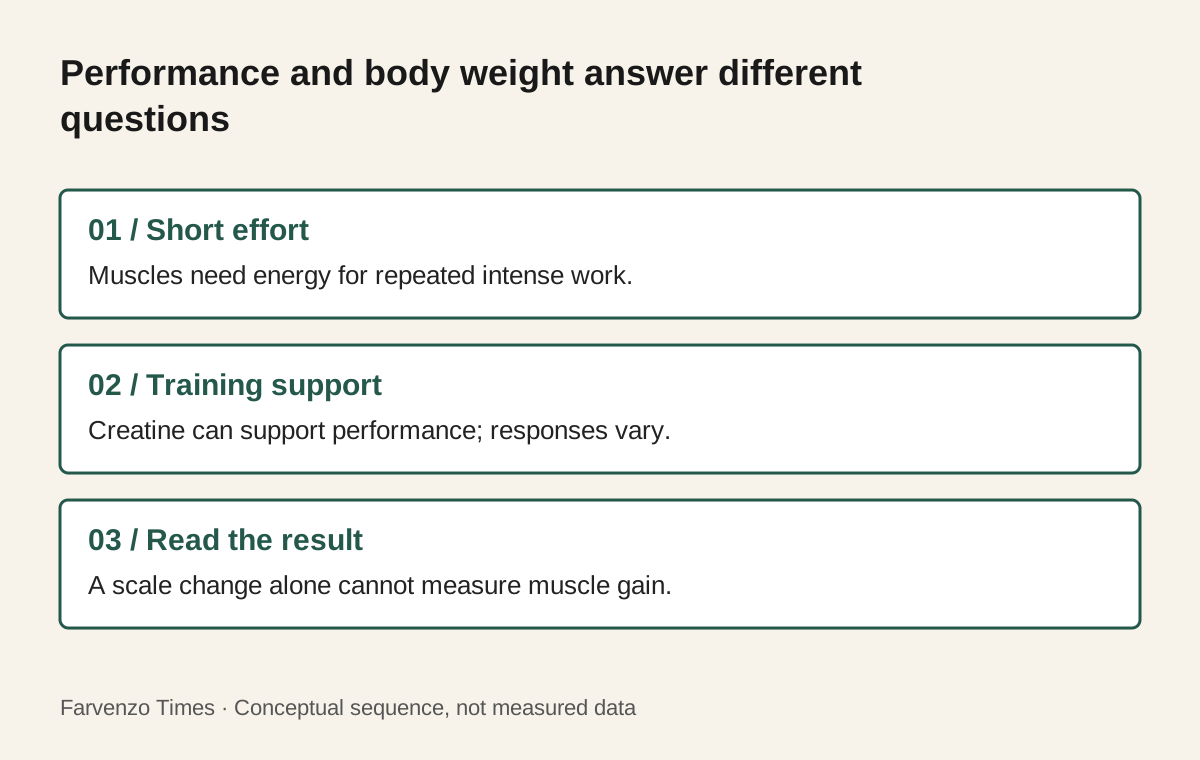
- 01 / Short effortMuscles need energy for repeated intense work.
- 02 / Training supportCreatine can support performance; responses vary.
- 03 / Read the resultA scale change alone cannot measure muscle gain.
Conceptual sequence, not measured data. View the static graphic.
For a hypothetical training diary, record the exercise, load, repetitions and conditions alongside body weight. A heavier scale reading and an unchanged training performance tell a different story from steady progress across comparable sessions. This is a way to organize observations, not a diagnostic test or a promise that a supplement will work.
Evidence for an ingredient is not proof for every product
AIS identifies creatine monohydrate as the form with the established evidence base. A more expensive form or a complicated blend needs its own supporting evidence; the ingredient name alone cannot validate every marketing claim. AIS also describes possible gastrointestinal discomfort. Individual responses and suitability differ.
Before spending money, write down the specific training problem you want to solve. Then ask whether the supporting research measures that outcome, in people and conditions relevant to you. A testimonial, a before-and-after photo and a controlled comparison are different kinds of evidence.
Start with the decision, not a shopping list
NIH recommends discussing performance supplements with a health professional, particularly for teenagers, people with medical conditions and those taking medicines. Training, food and recovery remain part of the broader plan. This article provides general education, not a personal dose, treatment recommendation or product endorsement.
A practical question for that conversation is: what benefit would justify using this product, and how would we recognize an unwanted effect? Defining the outcome first makes it easier to separate useful training support from an expensive change in the number on the scale. Explore the wider evidence behind longevity basics.
Sources
Keep exploring
- Longevity Basics Before Biohacking →
Evaluate longevity claims by separating lifespan, function and biomarkers, then compare evidence, opportunity costs and the practical foundations of health.
- VO₂ Max and Health: A Valuable Measure, Not a Universal Verdict →
Understand measured and estimated VO₂ max, the limits of mortality associations and how fitness information can support sustainable, appropriate activity.