Health, Longevity & Biohacking
Longevity Basics Before Biohacking
Longevity is an attractive promise because it joins two understandable goals: living longer and remaining able to do the things that matter. The commercial conversation often jumps from those goals to supplements, biomarker panels and biological-age scores. A more useful starting point is the difference between lifespan, health, function and a laboratory signal. Evidence that a product changes a marker does not automatically show that it prevents disability or extends human life. Healthy aging requires attention to ordinary but consequential conditions as well as emerging science. The task is to prioritize actions with meaningful support while leaving room for research without turning every preliminary finding into a personal treatment plan.
By Farvenzo Explained · Published · 6 min read
Choose an outcome that matters
Lifespan concerns length of life. Healthspan is commonly used to describe years lived in good health, although definitions and measurements vary. Function includes the ability to move, think, maintain relationships and live with an appropriate degree of independence. These goals overlap but are not identical. A trial can improve a physical-function measure without establishing longer survival. A treatment can extend life while carrying burdens that patients value differently. A useful discussion states the outcome rather than use the word longevity as a catch-all for every desirable change.
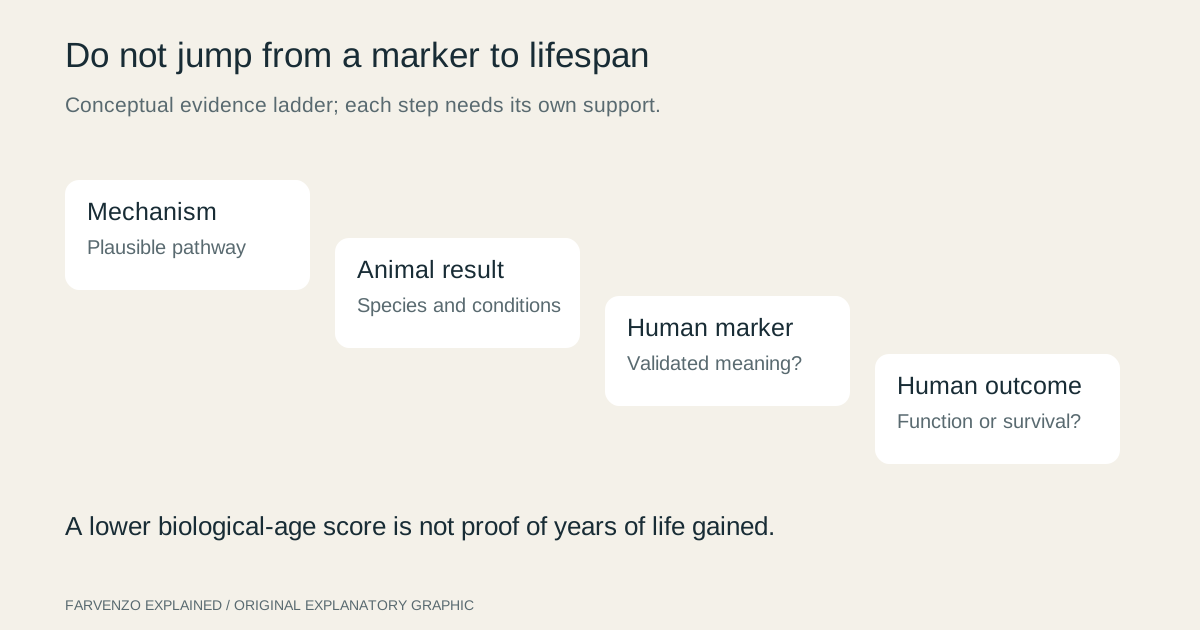
Biological-age estimates are models built from selected measurements and a particular training target. Different models can produce different answers for the same person. A change in a score may be interesting research evidence, but its interpretation depends on reliability, validation and whether changing the score predicts an outcome people care about. It should not automatically be translated into years of life gained or reversed. A commercial report that assigns a precise age needs a clear explanation of what the model measures, its uncertainty and the decisions for which it has actually been validated.
Foundations are a portfolio, not one trick
Authoritative health guidance emphasizes suitable physical activity, adequate nutrition, sleep, avoiding tobacco and managing relevant health risks. Appropriate preventive care and treatment of existing conditions also matter. These are not interchangeable actions and should be adapted to the person. Someone's highest priority may be blood-pressure management, another person's fall risk, and another person's access to regular care. An attractive general checklist cannot substitute for a clinician's assessment of specific needs. The practical aim is to identify important gaps, not to add increasingly elaborate interventions to an already crowded routine.
Function also depends on the environment. Safe places to walk, affordable food, social connection, accessible housing and suitable work conditions can determine whether healthy choices are feasible. A discussion focused only on consumer purchases can make aging appear to be an individual optimization problem detached from resources and circumstances. Businesses and communities can improve conditions that support health without claiming to sell extra years. A person should not be blamed for barriers that cannot be removed by willpower, a tracker or a more expensive supplement subscription.
Worked example: compare two spending plans
Imagine an illustrative household with a discretionary wellness budget of $150 a month. One option is a bundle of supplements and recurring biological-age tests. Another is support for an activity the person can maintain, transport to appointments or a practical change that improves access to suitable food. The choice should begin with the person's needs and existing care, not a presumption that the most technologically elaborate option is best. A supplement may be appropriate for an identified deficiency or another specific reason, but that is different from a general promise to slow human aging.
The household lists the proposed benefit, evidence, recurring cost and possible burden of each option. It asks whether the product improves a meaningful outcome, whether a less costly option serves the same purpose and whether a qualified professional has identified a relevant need. It also checks for interactions with medicines before adding supplements. The hypothetical budget is not a recommendation for how everyone should spend money. It demonstrates opportunity cost: a purchase with uncertain benefit can displace something more useful, even when its absolute price seems small compared with the emotional value of longevity.
Read experimental evidence in stages
Laboratory mechanisms, animal experiments, small human studies and large clinical trials answer different questions. A mechanism can make an intervention worth investigating without establishing that it is safe and effective for people. Animal findings may depend on species, environment, dose and timing. Early human studies can identify feasibility or changes in intermediate outcomes while being too small or short to establish long-term benefits and harms. A responsible explanation preserves the research stage instead of treating the existence of a scientific paper as proof of a finished clinical result.
The endpoint and comparison are equally important. Was the study randomized? What did the control group receive? How many participants completed follow-up, and were outcomes specified in advance? Did the intervention change a marker, symptoms, function, disease events or survival? An impressive relative difference can concern a rare event, while a statistically uncertain estimate can still be marketed as a dramatic improvement. Readers do not need to perform every analysis themselves, but they should be able to identify what the study actually measured and which claims remain beyond it.
Worked example: assess an age-reversal claim
Suppose an illustrative company reports that customers' average biological-age score fell by three years after a three-month program. The program includes exercise, meal changes, supplements and repeated testing. Without an appropriate comparison and information about the model, the result cannot establish that participants became three years younger or will live longer. Selection, measurement variability, regression toward typical values and changes in the measured inputs may contribute. The bundled design also makes it difficult to identify which component, if any, caused the observed change.
A careful evaluator asks for the protocol, participant flow, prespecified outcomes, uncertainty, adverse events and independent validation. The evaluator also asks whether the reported score change predicts a meaningful improvement beyond the model itself. The company may have a useful habit-support program even if the age-reversal claim is unsupported. Separating those propositions allows a fair assessment. The appropriate conclusion can be that one benefit remains plausible while another has not been demonstrated. There is no need to choose between accepting every claim and rejecting the entire field of aging research.
More testing can create more decisions
Testing has value when it informs an action that can improve outcomes. Broad panels can also produce ambiguous or incidental findings, extra costs and anxiety. The more measurements collected, the more likely some will fall outside a reference range by chance or for reasons that require context. A reference interval is not a complete diagnostic rule. Interpretation depends on symptoms, history, methods and related findings. Before purchasing a recurring panel, ask which decision each result would change and whether the testing schedule is supported for someone in the relevant circumstances.
This principle does not mean avoiding appropriate screening or dismissing persistent symptoms. It distinguishes evidence-based assessment from collecting measurements without a clear plan. A clinician can help prioritize testing, interpret unexpected results and avoid contradictory self-directed interventions. Keeping a medication and supplement list can also improve that conversation. People should not change prescribed treatment because a commercial score suggests a different biological age. An indicator designed for a particular research or wellness purpose does not automatically outrank clinical evidence about a diagnosed condition and its treatment.
Companies should be transparent about the status of their products. A supplement is not established as a life-extending medicine merely because its ingredients participate in cellular pathways. Testimonials, influencer routines and before-and-after charts do not provide the same evidence as an appropriate controlled trial. Advertising should describe demonstrated outcomes and disclose meaningful limits. Customers can ask for the exact study supporting the exact claim, including the tested product, population and endpoint. A reference to aging science in general is not enough to establish the effectiveness of a particular commercial bundle.
Healthy aging is best treated as a continuing process of supporting function, addressing important risks and adapting to changing circumstances. Emerging research can improve that process, but uncertainty should remain visible. Start with outcomes that matter, consider personal needs with appropriate professional support and evaluate experimental claims according to their actual evidence. The goal is a sustainable life with better health and capability, not an endless competition to purchase lower age scores. Foundations are valuable because of what they help people do, not because they can be repackaged as a promise to reverse time.
Sources
Keep exploring
- Stoicism and Market Volatility: Control Process, Not Prices →
Apply Stoic reflection to volatile markets by separating controllable conduct from prices, reviewing assumptions and responding responsibly to new evidence.
- Antifragility and the Barbell: Designing Options Without Pretending Risk Is Free →
Distinguish resilience from antifragility and examine bounded experiments, option costs, shared dependencies and the need to protect operating continuity.