Philosophy & Modern Stoicism
Stoicism and Market Volatility: Control Process, Not Prices
Market volatility creates a difficult combination: outcomes change quickly while the desire for certainty becomes stronger. Stoic philosophy offers a way to examine one's judgments and responsibilities under those conditions. It does not provide a valuation model, remove financial risk or guarantee emotional calm. Its practical contribution is to distinguish deliberate choices from events a person cannot command. That distinction can support a more disciplined decision process, provided it is not used to excuse inaction, suppress legitimate concern or ignore new evidence. The aim is responsible agency in uncertain circumstances, not a promise that a philosophical attitude will turn every market decline into an opportunity.
By Farvenzo Explained · Published · 6 min read
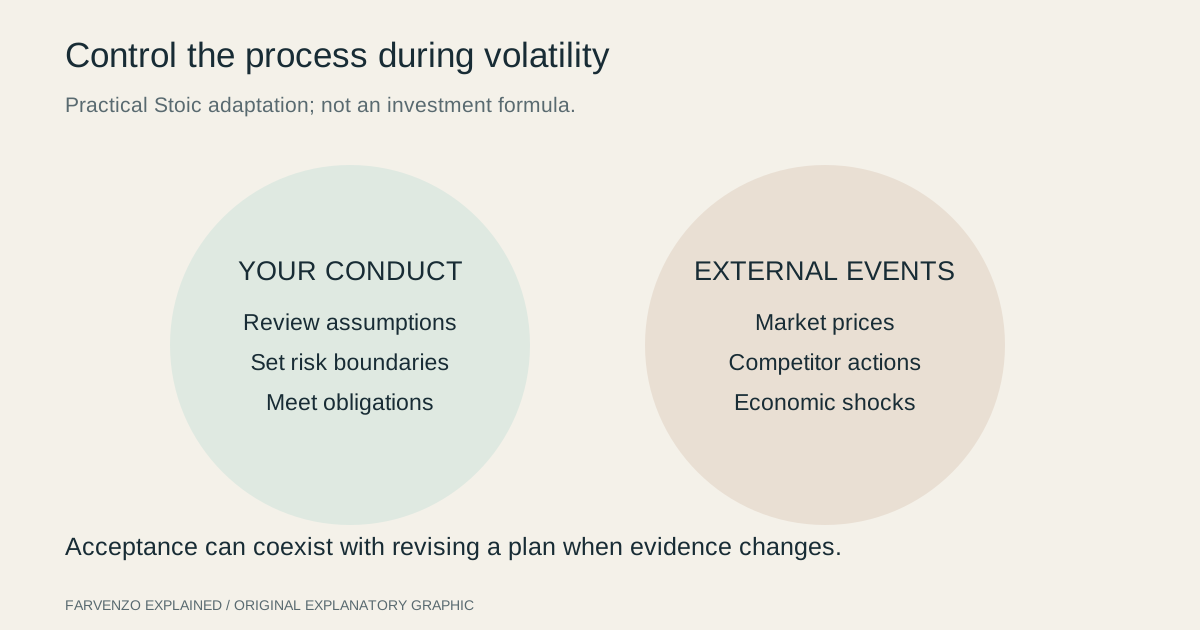
Control concerns judgment and conduct
Epictetus opens the Enchiridion by distinguishing what depends on us from what does not. In a financial setting, a person cannot determine tomorrow's market price or another participant's behavior. They can influence how they gather evidence, what commitments they accept and whether their actions follow a considered policy. Even those actions occur within constraints, so the distinction should not be simplified into a claim of total mastery over every response. It is a guide to attention and responsibility, not an assertion that adverse circumstances are merely imaginary.
Modern investment decisions require knowledge the ancient texts do not supply. Tax, liquidity, borrowing, diversification and suitability depend on contemporary facts and individual circumstances. Stoic ideas can shape how a person approaches those questions but cannot answer them alone. Treating philosophy as a replacement for financial analysis commits the same error as treating a spreadsheet as a substitute for values. A complete decision needs both an understanding of the consequences and a clear view of the responsibilities and objectives that make those consequences matter.
Emotion is information, not an instruction
Anxiety during a decline may reveal that a position is larger, less liquid or more important to near-term needs than expected. The useful response is to inspect that exposure rather than either obey the feeling immediately or dismiss it as weakness. A person can pause an avoidable action, identify what changed and seek appropriate advice. Calm should not become the sole measure of decision quality. Someone can be composed while holding an unsuitable risk, just as someone can feel distressed while following a reasonable and affordable long-term plan.
A practical record separates observations, interpretations and proposed actions. The observation might be that a market price fell. The interpretation might be that the original business case is broken. Those propositions require different evidence. A price can change without resolving the underlying thesis, while new facts can undermine a thesis before price reflects them. Writing down the distinction reduces the chance that an urgent feeling silently becomes a factual conclusion. It also makes the decision easier to review after emotions and market conditions have changed.
Worked example: review a falling position
Imagine an illustrative investor with a written policy, adequate emergency liquidity and a holding that has declined substantially. Before acting, the investor checks the original reason for ownership, the risk limit and any material new information. If the holding now breaches a concentration limit or its underlying facts have changed, action may be appropriate. If the only change is price, the policy may call for a different response. This article does not prescribe buying, selling or holding. The point is to connect the choice to relevant evidence and obligations instead of a demand to recover the purchase price.
The investor records the alternatives, including their tax and liquidity implications, and consults a qualified adviser when needed. They also state what evidence would change the decision. If the outcome later proves unfavorable, the review can distinguish an unforeseeable event from a known risk that was ignored. A good process can still produce a loss, and a weak process can sometimes produce a gain. Stoic reflection can help resist judging one's entire reasoning by the latest result. It does not remove accountability for assumptions that were unreasonable when the decision was made.
Acceptance does not require passivity
Accepting that an event occurred is different from agreeing that it was fair or deciding that no response is possible. A business can acknowledge a currency shock while renegotiating terms, reducing exposure or improving cash planning. A household can acknowledge a loss while addressing the spending or borrowing that made it dangerous. The fact belongs to the past; the response remains a present decision. Confusing acceptance with surrender can turn a useful philosophical practice into avoidance, especially where concrete remedies or duties are still available.
The same boundary applies to wrongdoing. A person should not be told to accept fraud, discrimination or abuse as a test of composure. Reporting, seeking help and pursuing appropriate remedies can be responsible actions. Stoic ethics concerns conduct and obligations, not simply personal tranquility. In organizations, managers should not use the language of resilience to require employees or customers to absorb preventable harm. A philosophy applied well should sharpen responsibility for what can be changed rather than protect a powerful person from criticism.
Worked example: respond to a business shock
Suppose an illustrative importer faces an unexpected exchange-rate move that raises the cost of an upcoming payment. The owner cannot reverse the market movement. They can verify the obligation, review existing hedges, assess liquidity and compare lawful contractual options with appropriate advice. The owner first separates the immediate cash requirement from the longer-term exposure policy. This prevents an urgent payment problem from becoming an improvised speculative trade intended to win back the loss. The response focuses on solvency, customers and commitments before attempting to defend the owner's pride.
After the immediate issue, the company reviews how the exposure arose. Perhaps sales were priced in one currency while costs were committed in another, without a clear policy. The company can improve quotation validity, approval limits or treasury oversight. That learning does not make the original loss desirable or guarantee that the revised process prevents every future shock. It identifies a controllable weakness revealed by an uncontrollable event. The distinction allows the owner to take responsibility without pretending that better character would have made exchange rates obey the business plan.
Build reflection into the operating process
A short review can ask what happened, which judgments were added, what obligations remain and which action is justified. This need not become a long daily ritual. Before a consequential decision, write down the goal, evidence, alternatives and limit. Afterward, compare the reasoning with the outcome and note surprises. Over time, the record can expose recurring patterns such as overconfidence, avoidance or excessive attention to recent prices. The practice is useful because it creates inspectable decisions, not because writing itself ensures wisdom.
Information habits matter too. Constantly checking prices can create repeated emotional triggers without adding relevant evidence. A review schedule should match the nature of the commitment and the possibility of new information. Some roles require continuous monitoring; others do not. Reducing unnecessary checking is different from refusing to receive important alerts. A suitable system identifies which changes require attention and who is responsible for responding. The objective is proportionate awareness, not withdrawal from facts that could invalidate a decision or threaten an obligation.
Philosophical language should remain modest about psychological effects. Stoic reading is not a guaranteed treatment for anxiety or a replacement for mental-health support. People differ in their circumstances and responses. A practice that helps one person may not address another person's distress, especially when the problem is material insecurity rather than an unhelpful interpretation. The useful application is to improve a person's room for deliberate action while recognizing the reality of constraints. It should not turn suffering into a moral failure or imply that needing help shows deficient discipline.
Stoicism can contribute to financial life by keeping judgment, conduct and responsibility visible when outcomes are uncertain. Use it alongside appropriate analysis, policies and professional support. Accept facts without giving up remedies; notice emotions without treating them as commands; review process without pretending outcomes are irrelevant. Markets remain beyond individual control. Decisions about exposure, evidence and obligations remain worth improving. That is a practical contribution to volatility, even though it offers neither a price forecast nor a promise that every loss can be converted into a lesson immediately.
Sources
Keep exploring
- Antifragility and the Barbell: Designing Options Without Pretending Risk Is Free →
Distinguish resilience from antifragility and examine bounded experiments, option costs, shared dependencies and the need to protect operating continuity.
- The Pre-Mortem: Strategic Pessimism Without Paralysis →
Use a project pre-mortem to surface independent concerns, prioritize plausible failures and assign mitigations that change real operating decisions.