By Farvenzo Times editorial team · Published 26 October 2026 · Sources checked 26 October 2026 · 2 min read
Lifestyle / Explainer
Why UK–US Meeting Times Shift Between 25 October and 1 November 2026
The UK and much of the US end daylight saving time on different Sundays in 2026. A recurring meeting can temporarily move by an hour for one participant.

The dates are different
The UK government lists 25 October as the end of British Summer Time in 2026. NIST lists 1 November at 2 a.m. local time as the US end of daylight saving time where it is observed. Those dates leave a week in which the usual relationship between some clocks changes.
This is a calendar explanation for those jurisdictions, not a worldwide clock-change date. Before changing an appointment, check the actual location of each participant and whether it observes seasonal changes. A country name alone may be too broad.
A London–New York example
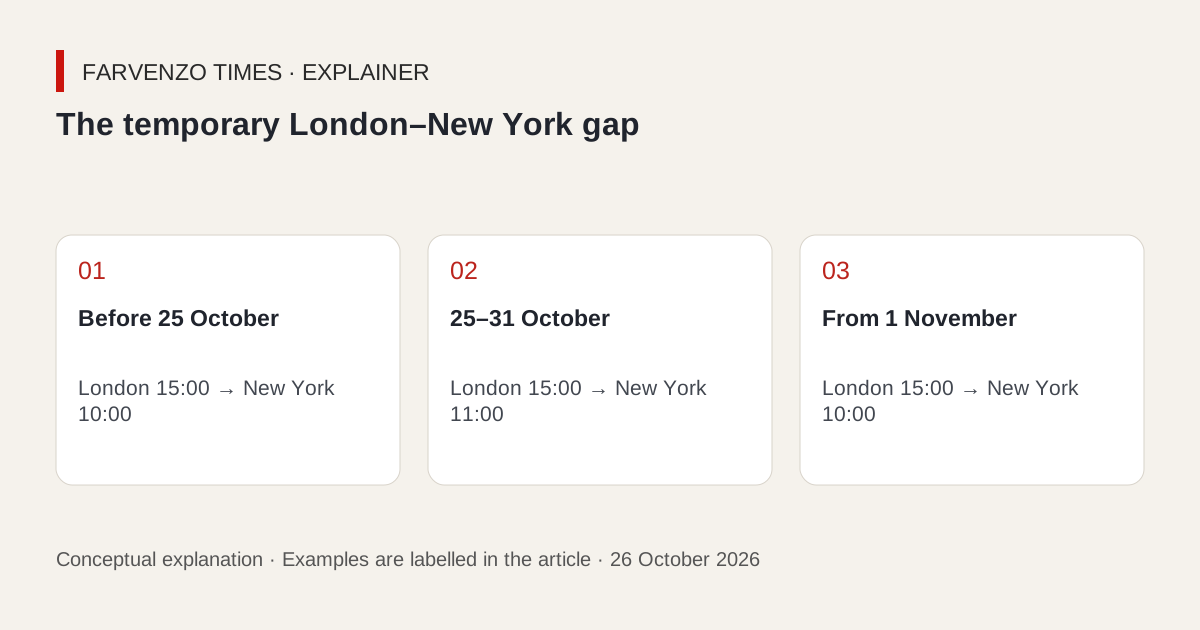
Consider a meeting fixed at 3 p.m. in London. Before the UK change, London is on UTC+1 and New York is on UTC−4: a five-hour difference makes the New York time 10 a.m. From 25 October until New York changes on 1 November, the offsets are UTC+0 and UTC−4, so the same London meeting corresponds to 11 a.m. in New York. Afterwards, the five-hour difference returns.
- 01 / Before 25 OctoberLondon 15:00 → New York 10:00
- 02 / 25–31 OctoberLondon 15:00 → New York 11:00
- 03 / From 1 NovemberLondon 15:00 → New York 10:00
Conceptual sequence, not measured data. View the static graphic.
These are calculated conversions for the example, not a promise about how a particular calendar application stores its events. If an organiser instead fixes the event to New York time, the London participant experiences the temporary shift. The anchor matters as much as the clock-change date.
Check what your invitation actually fixes
A useful invitation names the date, location-based time zone and intended local starting time. A bare “3 p.m.” leaves the recipient to supply missing context. A fixed numerical UTC offset can also describe one date correctly without capturing a location’s later seasonal change.
For an existing recurring meeting, inspect the occurrence during the gap and the following week. Compare the organiser’s intended local time with your displayed local time. Do this before sending a replacement invitation: duplicate events can create a second coordination problem.
Use a two-date confirmation
For a fictional international project, the organiser could send a short note confirming the meeting’s local time in both cities for 28 October and 4 November. Naming the two dates exposes the temporary difference instead of asking everyone to interpret “same time as usual.”
Apply the same method to interviews, online classes and livestreams. Keep transport bookings tied to the times and locations printed by the operator, and confirm consequential appointments with the organiser. The useful habit is not memorising every country’s rules; it is checking the specific occurrence whenever one side changes its clock.
The dates above were checked against government time guidance on 26 October 2026. Later policy changes or different locations require a fresh check.
Sources
Keep exploring
- Owner, Decision, Deadline: An Async Operating System for Global Work →
A practical async system for decision ownership, deadlines, handoffs, escalation, inclusive documentation, onboarding, and information security.