Behavioral Psychology & Decision Science
The Sunk-Cost Test: When Completion Is Rational and When Exit Creates Value
A sunk cost is a cost that a decision cannot recover. It belongs in the history of a project, not in the comparison between today’s alternatives. That rule is easy to recite and difficult to apply because projects contain several kinds of value at once. Money already spent may be irrecoverable, while equipment still has a resale price, a patent can be licensed, and staff can be reassigned. Finishing can be rational when the remaining benefits exceed the remaining costs, even if the project has been disappointing. Exiting can be rational when continuation has a positive accounting contribution but consumes scarce capacity that has a better use. Arkes and Blumer’s experiments documented a sunk-cost effect in choices; the UK Treasury Green Book turns the corrective principle into appraisal practice by emphasizing relevant future costs, benefits, options and opportunity cost.
By Farvenzo Explained · Published · 6 min read
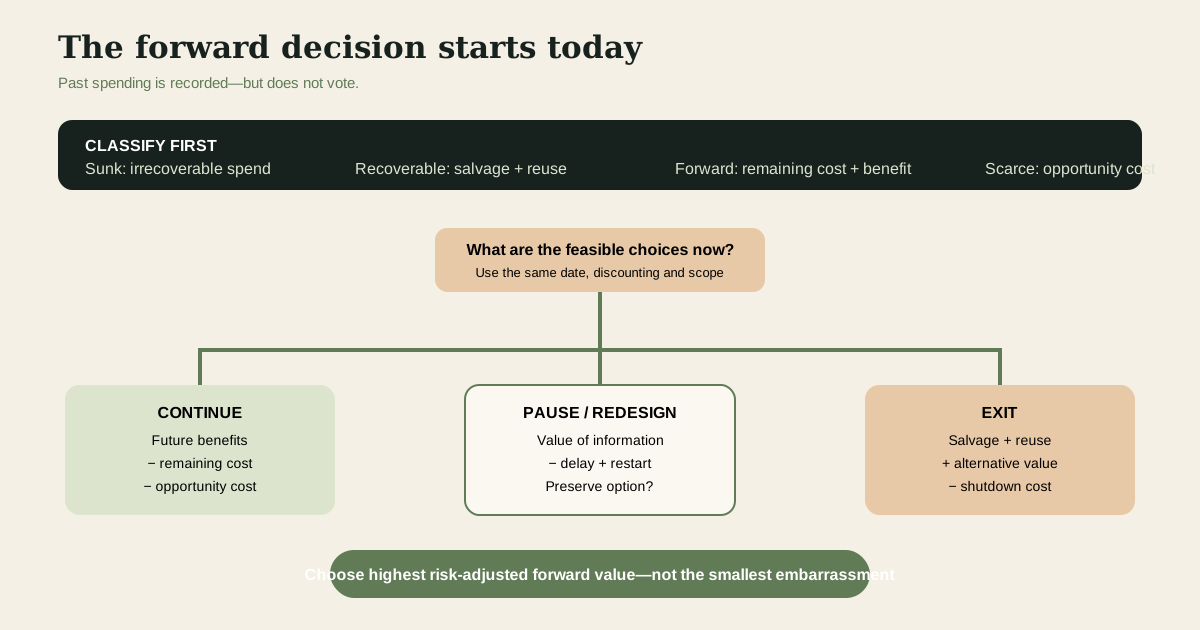
Separate irrecoverable spending from salvage and opportunity cost
Suppose a company has spent $8 million developing a new service. If no decision today can recover that development spending, the $8 million is sunk. It should not appear as a cost of continuing, and it should not be treated as a benefit of avoiding cancellation. Yet a server cluster bought for the project may sell for $600,000, and a transferable software component may save another team $400,000. Those are recoverable or reusable values. Closing the project gives them up or realizes them, so they belong in the forward comparison.
Opportunity cost is different again. A specialized engineering team can spend six more months finishing the service or move to a contractual integration expected to create greater value. The payroll may be paid in either case, but the team’s scarce time is not free. Its opportunity cost is the value of the best credible alternative forgone. A decision memo should therefore classify each line as sunk, avoidable future cost, committed-but-redeployable cost, salvage value, shutdown cost or opportunity cost. Blending those categories lets advocates select whichever total favors their preferred story.
Escalation grows from incentives, identity and information
Escalation of commitment is not simply irrational stubbornness. A sponsor may know that cancellation will expose an earlier forecast, reduce status or threaten a promotion. A vendor may earn more from remediation. Team members may interpret persistence as loyalty and exit as betrayal. Information also arrives asymmetrically: supporters see technical progress while finance sees missed milestones. When those incentives are hidden, another tranche of funding can appear to validate the last one. Governance should ask who benefits from continuation, who bears the failure, and whether dissenters can present evidence without career penalty.
Project reporting can intensify the trap. Percent-complete measures often describe activity rather than remaining risk. A system reported as 90 percent complete may still lack the integration that determines whether it works. Forecasts are repeatedly rebased, turning yesterday’s overrun into today’s clean baseline. Leaders then compare the new request with the original ambition instead of a live alternative. Independent review, stable milestone definitions and a record of forecast changes make escalation visible. The purpose is not to punish estimation error; it is to prevent accountability from disappearing each time the plan moves.
Worked example one: a troubled project that is rational to complete
A manufacturer has spent an irrecoverable $12 million on a compliance system. Finishing requires another $1.5 million over four months. If completed, the system is expected to avoid $2.4 million of external processing and duplicate controls over the next two years, stated in present-value terms. The hardware would fetch $200,000 if the project stopped. Shutdown and contract-termination costs would be $300,000. The forward value of completion is $2.4 million minus $1.5 million, or $900,000. The forward value of stopping is $200,000 salvage minus $300,000 shutdown, or negative $100,000.
Completion is better by $1 million in this illustrative comparison. The earlier $12 million does not justify the decision; it cancels from both branches because neither branch recovers it. Completion remains rational even though the full project may never justify its original business case. That distinction matters for honest reporting. The board can approve the final tranche while acknowledging that the initial investment underperformed. It should still test whether the $2.4 million benefit is incremental, whether the four-month plan includes integration risk, and whether the same staff have a more valuable alternative.
Use forward NPV, scenarios and the option to wait
Forward net present value discounts future incremental benefits and costs from the decision date. A continuation case can include remaining capital, operating cost, working capital, tax effects, shutdown exposure, salvage and opportunity cost. Use ranges where timing or demand is uncertain. A positive expected NPV is not enough when one downside can threaten the organization; liquidity, risk capacity and irreversible commitments also matter. Conversely, a negative central estimate may not require immediate closure if a cheap, time-limited experiment can resolve the uncertainty before a large commitment.
Decision-makers should compare at least three states: continue now, stop now, and pause or redesign. The pause has costs—team decay, contract extensions and delayed benefits—but it may preserve an option. Scenario probabilities should be explicit and challenged rather than hidden in a single forecast. The Green Book’s appraisal logic is useful beyond government because it insists on alternatives and optimism-bias scrutiny. A company can adapt that discipline without pretending its estimates are precise: document the source, range, timing and owner of each assumption, then show which variable changes the decision.
Worked example two: exit despite a cheap-looking final push
A retailer has spent $4 million on an automated returns tool. The team asks for $500,000 to finish, expecting $900,000 of present-value savings. Read alone, continuation appears to create $400,000. However, the same data engineers are required for a fraud project with an independently reviewed present value of $1.1 million after its remaining costs. The returns tool can be sold with its labeled dataset for $150,000, while closure costs $50,000. Continue produces $400,000 before the scarce-team tradeoff. Stop produces $100,000 net salvage and frees the team for $1.1 million, totaling $1.2 million.
Exit leads by $800,000 in this illustrative decision. The lesson is not to insert an imaginary opportunity cost whenever management dislikes a project. The alternative must be feasible, mutually exclusive and evaluated consistently. If another team can execute the fraud work, or if its claimed value lacks evidence, the comparison changes. Likewise, contractual or customer obligations may create closure costs omitted from the example. Writing the branches forces those questions into the open. “Only another $500,000” is not an analysis because it says nothing about benefits, alternatives or recovery.
Precommit exit criteria and preserve a clean decision record
Exit criteria work best when agreed before identity and politics harden. A program can define maximum cumulative exposure, latest acceptable launch, required technical proof, minimum customer commitment, regulatory dependency and a limit on forecast deterioration. Criteria need specified evidence and decision rights. Missing a threshold does not have to trigger automatic death; it can trigger an independent review with named options. What matters is that failure produces a real decision rather than another silent rebaseline. The sponsor should not be the sole judge of a forecast that determines the sponsor’s reputation.
A zero-based review asks: if the organization did not own this project today, would it buy the remaining opportunity for the remaining resources? The answer should include salvage, closure, people and strategic dependencies, not erase them in pursuit of a clean thought experiment. Record the forecast known at the time, the chosen branch, dissent and the evidence that would reopen the decision. Later outcomes should improve estimation rather than become ammunition for hindsight blame. Good capital allocation allows rational completion and rational exit; it refuses to make either choice a referendum on past pride.
- Remove irrecoverable spending from the forward choice while retaining salvage, shutdown and reuse values.
- Price the best feasible alternative use of scarce people, capital and capacity.
- Compare continuation, exit and pause using forward NPV and explicit scenarios.
- Expose sponsor, vendor and career incentives that reward escalation or conceal bad news.
- Set evidence-based exit triggers before the next tranche and preserve the decision record.
Sources
Keep exploring
- Frictionless Payments Without Hidden Costs: A Behavioral and Ethical Guide →
A careful guide to payment salience, coupling, evidence limits, transparent checkout, refunds, recurring consent, and ethical conversion measurement.
- First Principles Without Founder Mythology: A Method for Cost and Constraint Analysis →
How to decompose outcomes and costs, respect physics and regulation, test inherited assumptions, and validate delivery and manufacturing changes.
- Prospect Theory Without the Two-to-One Myth →
How prospect theory describes reference-dependent choice without prescribing investments or asserting a universal loss-aversion ratio.