By Farvenzo Times · Published 3 November 2026 · Sources checked 3 November 2026 · 4 min read
Money basics / UK savings explainer
Premium Bonds November 2026: Why the Prize Fund Rate Is Not Your Return
Premium Bonds’ annual prize fund rate tells you about the pool supporting the draw. It does not promise that your balance will grow by that percentage. November’s results offer a timely reason to separate the prize announcement from the economics of your own savings.
Start with the official result
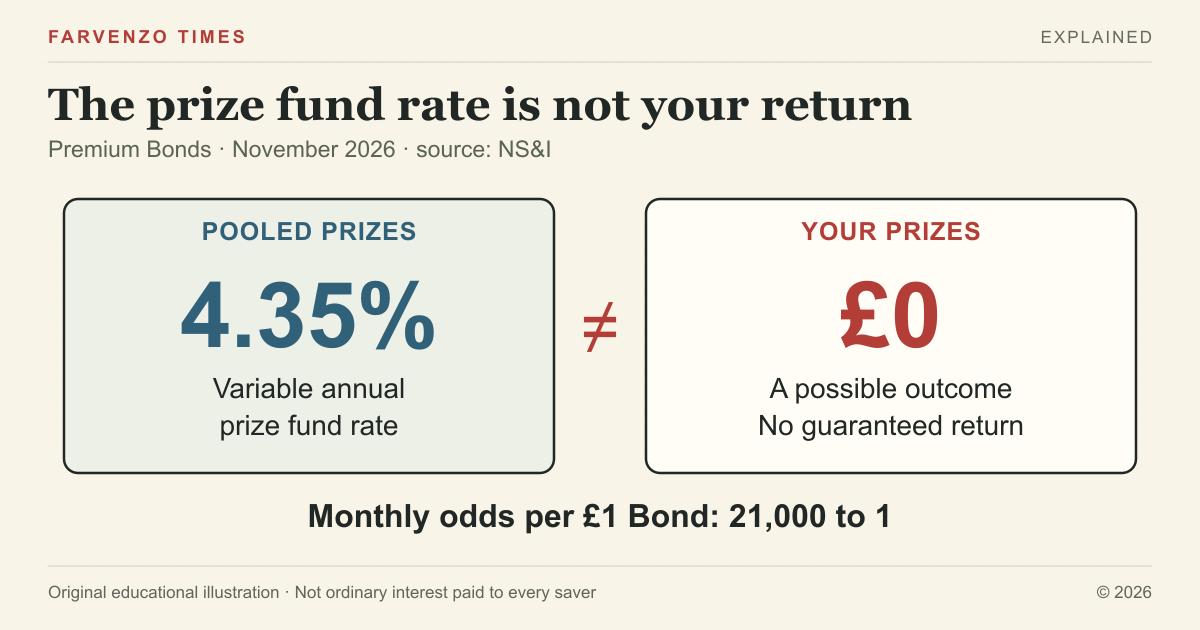
NS&I’s 2 November announcement identifies the month’s two £1 million jackpot winners as holders from Outer London and Shropshire. The dated release gives the November annual prize fund rate as 4.35%, variable, and odds of 21,000 to one for each £1 Bond in a monthly draw. These describe that draw’s terms; they are not permanent product promises.
To check your own result, use NS&I’s official prize checker. Enter personal details there, rather than in an article, social-media comment or an unfamiliar form. A report about someone else’s winning number cannot tell you whether your holding won.
Why 4.35% does not mean £43.50 for everyone
NS&I explains that Premium Bonds do not earn ordinary interest. Money instead funds prizes across eligible holdings. A saver may receive no prize, one prize or several, while a few large awards pull the pooled average upward. The same average can coexist with very different individual outcomes.
Here is a deliberately simplified illustration, unrelated to the actual draw. Imagine 100 people each saving £1,000. A fictional annual prize pool of £4,350 could be distributed as £25 to 94 people and £2,000 to one person, leaving five people with nothing. The average is £43.50 per saver, yet nobody receives £43.50. An average describes the distribution collectively; it is not an instruction to credit every account equally.
Read the odds with the correct unit
The quoted monthly odds belong to one eligible £1 Bond, not one person or one £1,000 holding. More eligible Bonds give more chances, but do not turn a random outcome into a guaranteed monthly payment. Multiplying a balance by the prize fund rate cannot produce a personal payment schedule.
Separate a monthly check from a yearly assessment. Keep the amount held, relevant period and prizes actually received together. If a fictional saver keeps £2,000 unchanged for a full year and receives £50, the simple realised prize return is 2.5%. With no prizes it is 0%. Deposits or withdrawals during the year require more careful timing before comparing returns.
Compare cash flow and purchasing power separately
For contrast, a hypothetical account paying 4% for a full year on an unchanged £2,000 would produce £80 before tax, assuming its stated conditions are met. That is an illustration, not a current account offer. Comparing £80 with prizes actually received answers one question; comparing access terms, tax treatment and security answers others.
NS&I says Premium Bonds are backed by HM Treasury and prizes are free of UK Income Tax and Capital Gains Tax. Capital backing and tax treatment do not guarantee spending power. With hypothetical annual price inflation of 3%, unchanged £2,000 would buy roughly what £1,941.75 bought a year earlier: £2,000 divided by 1.03. That example is not a forecast of UK inflation.
Give each number a job
Future tax rules belong in a separate comparison. The October 2026 Budget rates table lists higher savings-income rates for 2027–28, starting in April 2027. Those future rates should not be applied to this November draw or treated as proof that one savings product suits everyone. Compare the tax year, available allowances and actual account terms together.
Use the official checker for results, the dated rate for product context and your own records for realised outcomes. If a bill requires a known payment next month, a possible prize is not a known receipt. Keep that distinction visible when comparing savings choices; the attraction of a jackpot should not erase the uncertainty of ordinary cash flow.
Sources
- NS&I: final November draw announcement, 2 November 2026
- NS&I: Premium Bonds product terms, prize rate and risks
- NS&I: official Premium Bonds prize checker
- NS&I: how the prize fund is distributed across prize bands
- Bank of England: inflation and purchasing power
- HMRC: Budget 2026 rates table, distinguishing 2026–27 from 2027–28
Keep exploring
- How Much Should You Save Each Month? Work Backwards From Your Goal →
The most useful savings number is the amount that gets a specific goal paid for by a specific date. Here is how to work it out in five steps, with examples you can check in a free calculator.
- The Rule of 72: How Fast Your Money, and Prices, Double →
Divide 72 by a yearly rate and you get roughly the years it takes to double. It works for savings, prices and debts. Here is how close the shortcut is, where it goes wrong, and when to use a calculator instead.
- What is money, really? →
The three jobs of money: exchange, measure and store.