By Farvenzo Times · Published 3 November 2026 · Sources checked 3 November 2026 · 4 min read
Business / Corporate finance explainer
Microsoft’s $25 Billion Bond Sale: Why Cash-Rich Companies Borrow
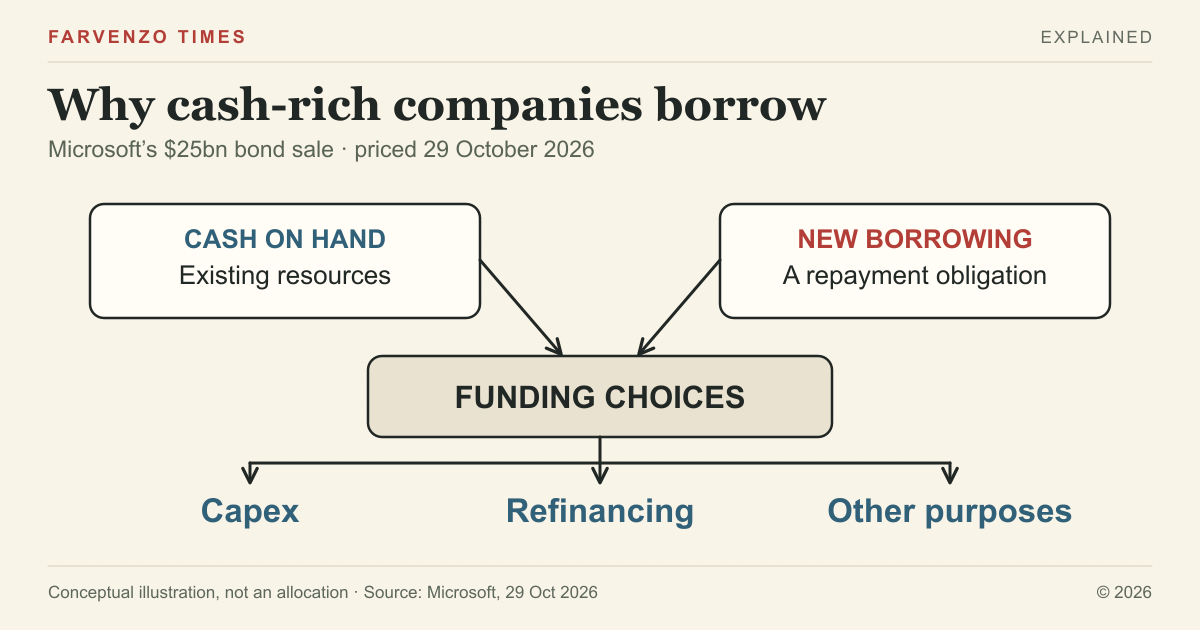
A company can have valuable assets, profitable products and access to cash while still choosing to borrow. Microsoft’s newly priced $25 billion bond offering illustrates the distinction between being able to pay today and deciding how to finance commitments over time.
What the announcement actually establishes
Microsoft announced the pricing on 29 October 2026. Its release describes ten series of senior unsecured notes: two floating-rate series and eight fixed-rate series, with maturities from 2028 to 2066. It expected the offering to close on 4 November. As of this article’s source check, that is an expected closing date, not confirmation that settlement has happened.
The company lists general corporate purposes, potentially including working capital, capital expenditure, share repurchases, acquisitions and repayment of existing debt. AI infrastructure provides relevant context, but the release does not earmark every dollar for AI. A financing announcement and a project-by-project spending budget are different records.
Borrowing changes the timing of cash
Consider a fictional business with $120 million in cash. It plans a $90 million equipment purchase and wants $50 million available for operations. Paying entirely from cash leaves $30 million, below that operating target. Borrowing $20 million would leave $50 million after the purchase. The arithmetic explains a possible reason to borrow; it does not establish Microsoft’s own cash requirements or decision process.
That flexibility has a cost. At an illustrative 5% annual interest rate, $20 million creates $1 million of yearly interest before fees and tax effects, with principal still to repay. A project producing useful equipment can still disappoint financially. Funding availability does not prove that the investment will earn enough to justify its cost.
A coupon is not the buyer’s complete return
Investor.gov explains that corporate bonds are debt obligations, with payment terms and risks distinct from owning shares. In a fictional fixed-rate bond, a $1,000 face value and 5% coupon produce $50 of annual coupon payments if the issuer meets its obligations. That coupon percentage uses face value, not the price a later buyer pays.
If the same bond trades for $900, its running yield is $50 divided by $900, or about 5.56%. At $1,100, it is about 4.55%. Neither figure is yield to maturity, which also accounts for the timing of payments and repayment of principal. Fees, taxes, default and any contractual early-redemption terms can further affect the actual outcome.
Long maturities spread commitments across time
An issuer can divide an offering into tranches with different repayment dates. Think of a payment calendar rather than one giant bill. Spreading maturities changes when financing must be replaced; it does not remove refinancing or repayment risk. From the buyer’s perspective, a longer commitment also creates more time for market conditions to change.
For fixed-rate bonds, market interest-rate increases generally put downward pressure on existing prices. Longer maturities generally increase that sensitivity, other things equal. A familiar technology brand does not remove credit risk or make a bond’s market price constant.
Read the next document with three questions
Ask whether a figure describes money raised, money spent or future commitments. Then identify when principal is due and whether interest is fixed or floating. Finally, compare the stated use of proceeds with subsequent spending disclosures. Those checks connect a dramatic financing headline to the quieter question of whether future business cash flows can support the obligations.
Sources
Keep exploring
- Government Debt and Bond Vigilantes: Why Yields Matter →
Learn how government borrowing, bond prices and yields connect, why mortgage rates can move differently from policy rates, and what bond vigilantes means.
- AI’s Next Bottleneck: Why the Data-Centre Boom Is an Electricity Story →
Why AI infrastructure needs electricity, financing and useful applications. A sourced guide to the IEA’s projections and the IMF’s October 2026 outlook.
- The AI bubble explained: real technology, uncertain returns →
Follow the money from investors to chips, data centres and paying customers.