Prepared by Farvenzo Times on behalf of Dr. Sakshi Roy Skin and Aesthetic Clinic · Published 29 October 2026
Health / Practical guide
Dandruff or Dry Scalp? What Flakes Can—and Cannot—Tell You
A flaky scalp is not automatically just dry skin. Dandruff, seborrheic dermatitis and reactions to hair products can overlap in appearance. Persistent itch, redness, pain or patchy hair loss deserves an assessment.

Licensed photograph of shampoo bottles in a shower. Illustrative hair-care context; pictured products are not identified as dandruff treatments or endorsed by the clinic.
Photo: oning · Three bottles of shampoo on a sink / source · Unsplash License.
Cropped to landscape, resized and encoded as WebP and JPEG. No content edits.
Start with the pattern, not the colour of a flake
White flakes on hair or shoulders can occur with dandruff, but a photograph of a flake cannot establish the cause. NHS guidance describes several conditions that can produce scalp scaling, including seborrheic dermatitis, eczema, contact dermatitis, psoriasis and scalp ringworm. Dandruff itself is not a sign that someone is dirty, and ordinary dandruff is not contagious.
That distinction matters because not every cause belongs in the same treatment routine. Calling every patch “dry scalp” can lead to repeated product changes while the actual problem continues. Calling every itchy patch “fungal” can be equally misleading. A clinician may need to examine the scalp and ask about the timing, products used and other symptoms.
Three questions to note before buying another product
First, is it only loose flaking, or is there also soreness, marked itch or visible inflammation? Second, did it start after a new dye, spray, shampoo or styling product? Third, are there similar patches around the eyebrows, beside the nose or elsewhere? These observations help describe the problem; none is a reliable home diagnosis on its own.
- 01 / Observe the patternRecord itch, new products and affected areas.
- 02 / Use directionsFollow the right product label and advice.
- 03 / Seek assessmentPersistent or concerning symptoms need review.
Conceptual sequence, not measured data. View the static graphic.
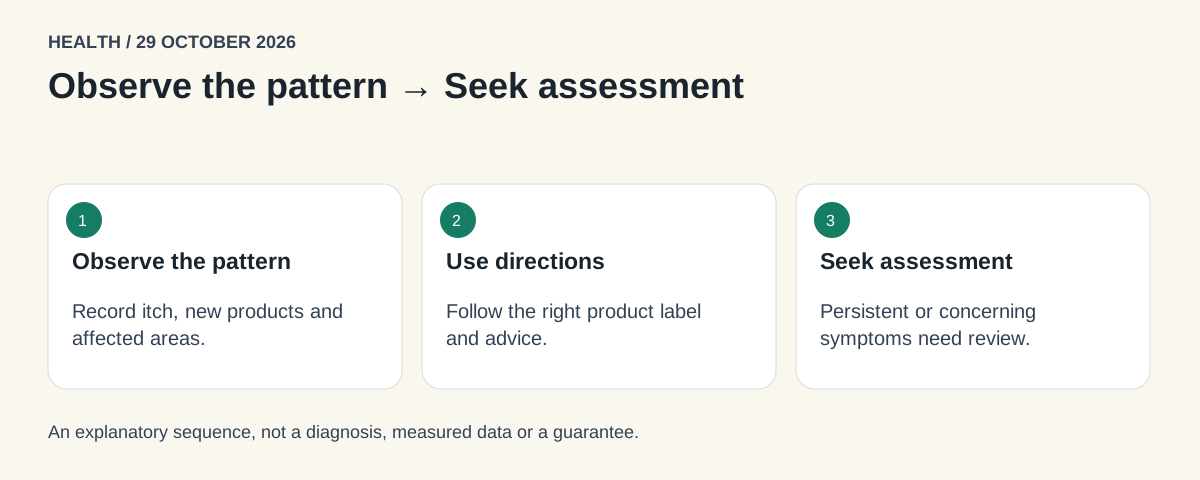
Write down the names of products and when you used them, rather than describing everything as “shampoo.” If you have already tried an anti-dandruff product, record its active ingredient, the label instructions and how long you used it. A brief, accurate record is more useful than adding several new treatments at once and losing track of which change did what.
How anti-dandruff shampoo fits into care
For uncomplicated dandruff, NHS guidance describes trying an anti-dandruff shampoo and asking a pharmacist about its use. Its examples include ketoconazole, coal tar and salicylic acid. Different products have different directions and suitability; follow the locally approved label and a pharmacist or clinician’s advice rather than copying a social-media schedule.
The American Academy of Dermatology explains that medicated shampoo can help mild to moderate scalp seborrheic dermatitis. Some ingredients reduce yeast overgrowth and others help remove scale. Contact time and frequency matter, and the plan may differ with hair type. Let the product remain for the directed time instead of assuming that instant rinsing or extra-long contact will work better.
Do not turn a scalp routine into an experiment
If a product causes irritation, stop that product and seek advice. Scratching, forceful scale removal and repeated harsh treatments add another source of discomfort and can make the original pattern harder to assess. Avoid starting a prescription steroid or mixing medicated products simply because they were suggested for someone else.
A useful hypothetical record might say: “Flaking for three weeks; new hair dye two days before the itch began; product X used twice according to its label; no improvement yet.” That does not prove the dye caused the problem. It gives the clinician a sequence to investigate, with fewer assumptions hidden inside the story.
When to arrange an assessment
NHS advice recommends assessment when dandruff has not improved after at least four weeks of anti-dandruff shampoo, or sooner for severe itch, a red or swollen scalp, or flaky itchy patches elsewhere. Do not wait through worsening pain or concerning symptoms just to finish a trial. Patchy hair loss is another reason to have the scalp examined rather than treating it as routine flakes.
AAD guidance notes that more than one skin condition can be present at the same time. Examination and the response to a tailored plan help establish the next step. Treatment may need maintenance after improvement; a temporary recurrence does not automatically mean every shampoo has failed. Ask what improvement to expect, when to review, and what signs should prompt earlier contact.
Clinic information and educational scope
Prepared by Farvenzo Times on behalf of Dr. Sakshi Roy Skin and Aesthetic Clinic. This is general education, not an individual diagnosis or treatment plan. No personal doctor authorship or medical review is claimed. The clinic links below are promotional and are separate from the medical sources.
Dr. Sakshi Roy’s clinic lists MBBS; Masters in Dermatology (UK); Fellowship in Aesthetic Medicine. Dr. Sakshi Roy Skin and Aesthetic Clinic: B-98, Sector-C, Mahanagar, Lucknow, Uttar Pradesh 226006. Phone +91 73766 60902. Monday–Saturday 11:00 AM–8:00 PM; Sunday 11:00 AM–2:00 PM. Call to confirm appointment availability. The linked clinic website provides directions, WhatsApp and treatment-information pages.
Sources
Keep exploring
- Breaking Out After the Gym? Sweat Is Only Part of the Skin Story. →
You usually do not need to stop exercising because of breakouts. Gentle cleansing, clean clothing and less rubbing can help, but persistent or unusual bumps need an assessment because acne-like eruptions have different causes.
- Glass Skin or Irritated Skin? Why More Skincare Is Not Always Better →
A practical guide by Dr Sakshi Roy: separate the glass-skin aesthetic from healthy skin, question product overload and recognise when irritation needs assessment.