By Farvenzo Times editorial team · Published 26 October 2026 · Sources checked 26 October 2026 · 2 min read
Sports / Explainer
Check-Swing Calls Explained: What an Umpire Appeal Actually Changes
A disputed swing raises separate questions about the rule, the viewing angle and the decision process. Start with those distinctions before treating a replay as a verdict.

Start with the decision, not the screenshot
An image of a bat can look persuasive without explaining the rule being applied. Before treating a line drawn on a television picture as decisive, ask where that test comes from. A viewer’s preferred visual cue and a competition’s controlling standard are not automatically the same thing.
The 2026 Official Baseball Rules define a missed strike by reference to a batter striking at a pitch. Rule 8.02(c), including its comment, describes how the manager or catcher can request help from another umpire after the plate umpire calls a half swing a ball. It does not provide the same request after an initial strike call. These are procedural distinctions, not a measurement of any particular batter’s motion.
An appeal to another umpire is its own process
Under that rule, the plate umpire refers an eligible requested appeal to a base umpire, whose strike judgment prevails. Timing also matters: the appeal has to precede the next pitch or play, with a specific end-of-inning limit. Readers should consult the linked rule for the full conditions.
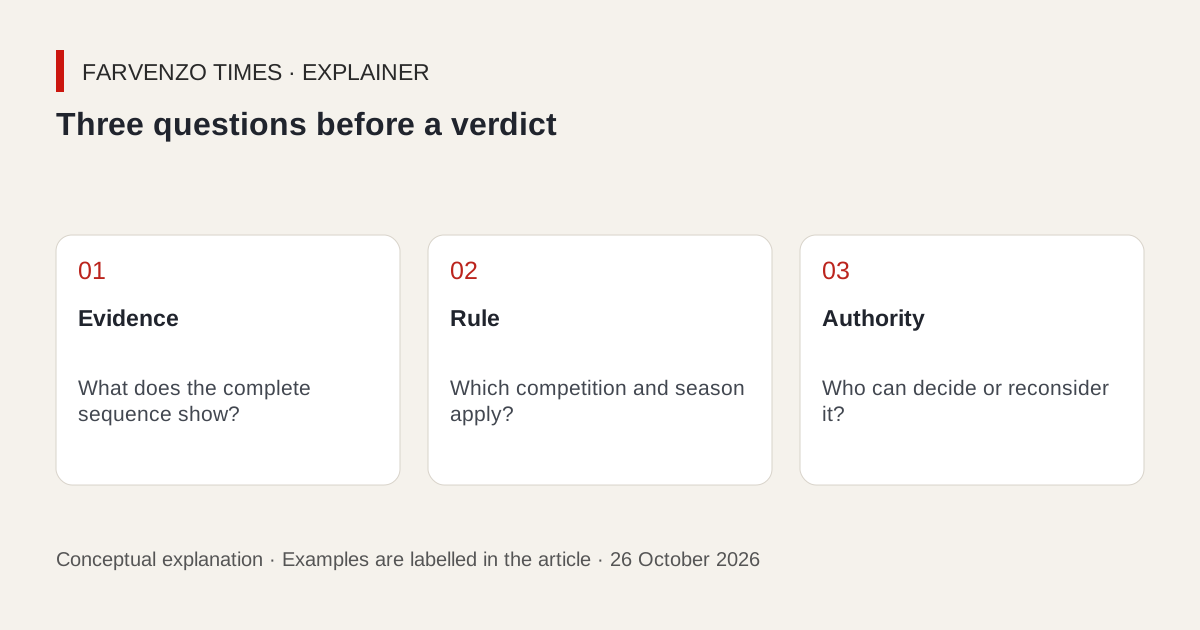
- 01 / EvidenceWhat does the complete sequence show?
- 02 / RuleWhich competition and season apply?
- 03 / AuthorityWho can decide or reconsider it?
Conceptual sequence, not measured data. View the static graphic.
Imagine a fictional pitch called a ball, followed by an appeal and a strike signal from a partner. A clip beginning only with the second signal could make the decision look spontaneous. Reconstructing the sequence answers a different question: who made which decision, after what request? It still does not settle whether the visual judgment was right.
Keep experimental systems in their proper context
MLB described a 45-degree threshold for a 2024 Fall League trial. Its 2025 Single-A report said that experiment was not an imminent Major League change.
A technology demonstration needs a league, season and rule attached to it. A proposed measurement can be internally consistent while being irrelevant to a competition that has not adopted it. Avoid silently importing rules from another league or a training graphic into a current game.
A useful way to assess the next disputed clip
Write down the competition and date, the initial call, whether help was requested and the rule cited. Then compare camera views as evidence about the motion, not as a replacement rulebook. If the original sequence or controlling rule is missing, leave that part of the conclusion open.
This explainer does not adjudicate the final pitch of World Series Game 2 or infer a player’s intent. Its practical point is narrower: evidence, a decision standard and the authorised decision-maker are three separate things. Understanding their relationship makes disagreement more precise and prevents a confident screenshot from carrying more weight than it can support.
Sources
Keep exploring
- Micro-Betting and Parlays: How Speed and Probability Add Risk →
Understand how rapid in-play bets and multi-leg parlays affect decisions. Follow simple probability math and learn why a near miss is still a loss.