By Farvenzo Times editorial team · Published 26 October 2026 · Sources checked 26 October 2026 · 2 min read
Entertainment / Explainer
Why a Movie’s Box-Office Gross Is Not Its Profit
Ticket sales, the distributor’s receipts and the film’s profit measure different things. A simple hypothetical example shows why subtracting a production budget from worldwide gross can mislead.

Follow the ticket money first
A box-office headline describes ticket sales, not a complete film income statement. AMC’s report for the quarter ended 30 June 2024 explains that film exhibition costs are based on a share of admissions revenue under its film licences. That documents a contractual division of ticket revenue; it does not establish one percentage for every film or market.
Disney’s fiscal 2024 annual report likewise describes theatrical distribution revenue in terms of licensing and contractual royalties. The audience’s spending and the distributor’s recognised receipts therefore belong at different stages of the chain. Comparing either directly with a production-budget headline skips that distinction.
An invented example exposes the missing step
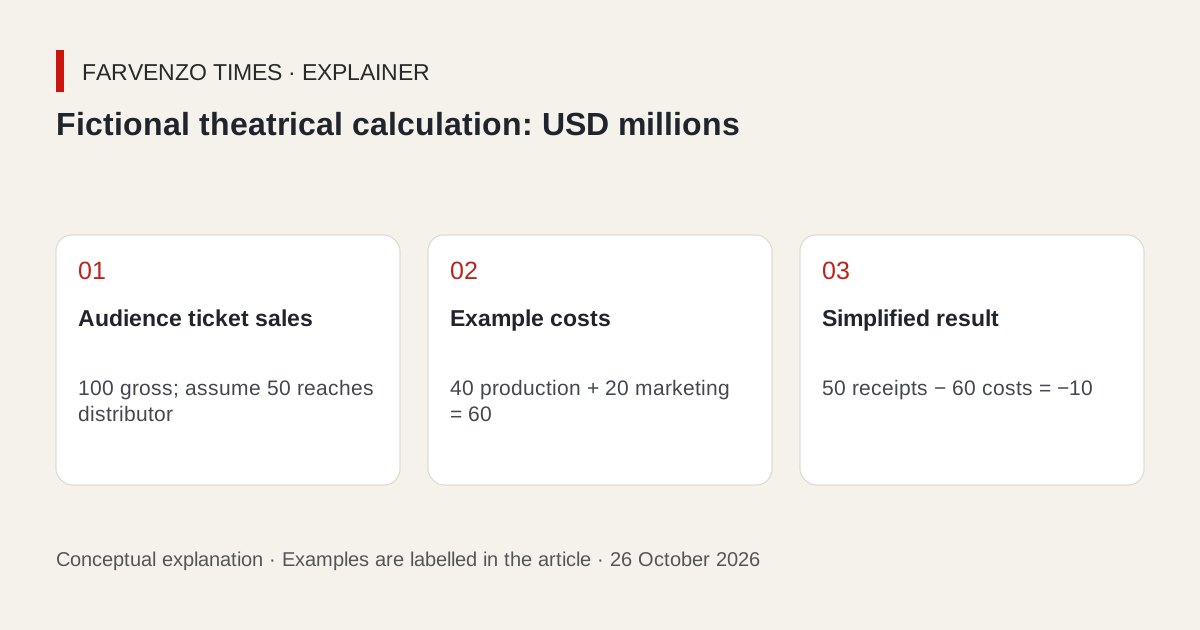
Imagine a fictional film with $100 million in ticket sales. Assume, only for this teaching example, that $50 million reaches the distribution side after the exhibitor share. Also assume production costs of $40 million and marketing costs of $20 million. The simplified theatrical comparison is $50 million against $60 million, a shortfall of $10 million.
- 01 / Audience ticket sales100 gross; assume 50 reaches distributor
- 02 / Example costs40 production + 20 marketing = 60
- 03 / Simplified result50 receipts − 60 costs = −10
Conceptual sequence, not measured data. View the static graphic.
Subtracting the production figure alone from ticket sales would instead produce $60 million. That is a different calculation using the wrong revenue boundary and an incomplete cost list. Our 50% assumption is invented; it is not an industry rate, a valuation or a claim about any released movie.
Costs and revenue arrive through different windows
Disney’s historical report identifies substantial marketing spending before and during theatrical release, as well as other distribution channels such as home entertainment and TV or video-on-demand licensing. Those disclosures explain why the theatrical headline cannot reveal a title’s complete lifetime economics.
The existence of later channels does not prove that a particular film will recover a theatrical shortfall. A useful assessment needs evidence about receipts, costs and the period being evaluated. Announced potential revenue is different from money already earned.
Do not turn a rough rule into audited profit
A production budget reported in an article may not state everything needed for a profit calculation. Ask whose result is being discussed, which revenues are included, how costs are defined and whether figures are estimates or disclosed accounts. The answer can change when the question changes from a cinema operator’s performance to a distributor’s or a financier’s.
A fictional film can sell many tickets and still fail the simplified calculation above; another with smaller sales could have a lower cost base. Scale alone does not settle the question. Nor does a disappointing opening weekend by itself provide the final lifetime result.
Use box-office totals to discuss the ticket-sales measure they actually represent. Reserve claims about profit for cases with enough information to support them. The linked filings are dated historical examples of the business mechanism, not current results for a particular 2026 release.
Sources
Keep exploring
- Why a Profitable Creator Can Still Run Short of Cash →
A sponsorship can look profitable before its payment arrives. Separating work completed, invoices, payment dates and cash commitments exposes the gap.