By Farvenzo Times · Published 2 November 2026 · Sources checked 2 November 2026 · 4 min read
Business / Future technology explainer
Can AI Shopping Agents Spend Your Money? Permissions Explained
An AI shopping agent should buy only within the permission you give it. Asking for product recommendations does not define every condition of a purchase: the item, final price, seller, delivery deadline and approval step still matter.

Illustrative licensed photograph of cards and eyeglasses on a laptop. It does not show an AI shopping agent or a completed purchase.
Photo: Leeloo The First · Credit cards and eyeglasses on a laptop / source · Pexels License.
Cropped to landscape, resized and encoded as WebP and JPEG. No content edits.
In an October 2026 report, Adobe found in its dataset that visits to US retail sites from AI links were 71% higher in September than a year earlier. That measures people clicking through from AI services, rather than agents making purchases independently. It shows why shopping assistance deserves attention without establishing that autonomous checkout is already the norm.
A recommendation is the beginning of a decision
Imagine asking an assistant to find a pair of walking shoes under $100. It returns a suitable pair at $94. That looks straightforward until shipping adds $12, the seller offers a different size, or the delivery estimate falls after your trip. A useful recommendation can still become an unsuitable order.
The practical question is what the agent is allowed to do next. Researching alternatives, preparing a cart and paying for it are separate actions. Before using an automated checkout feature, read the permissions in that particular service rather than assuming every shopping assistant behaves alike.
Two ways an agent can get approval
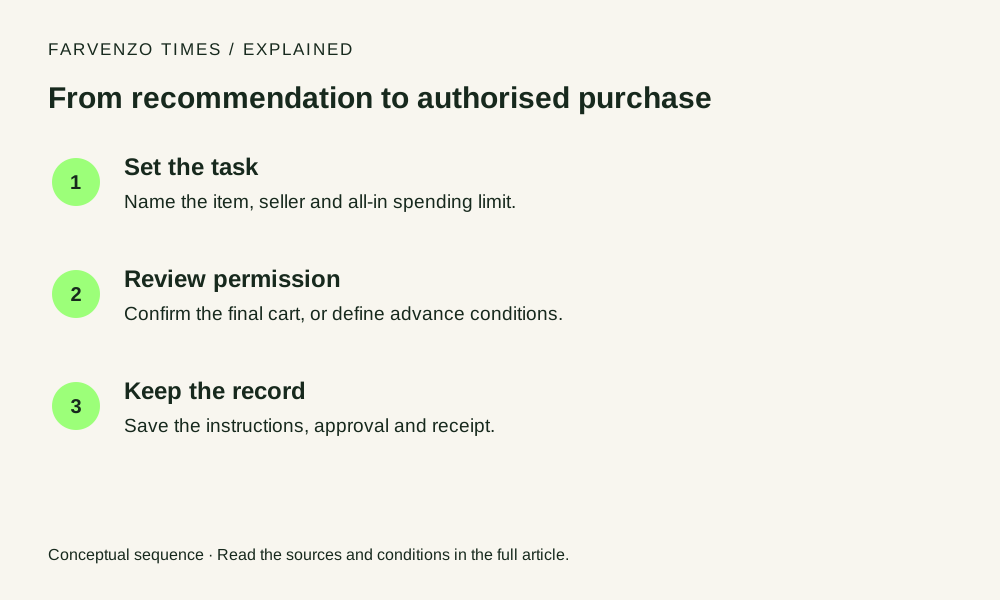
- 01 / Set the taskName the item, seller and all-in spending limit.
- 02 / Review permissionConfirm the final cart, or define advance conditions.
- 03 / Keep the recordSave the instructions, approval and receipt.
Conceptual sequence, not measured data. View the static graphic.
Google’s Agent Payments Protocol, announced in September 2025, describes both purchases where the shopper is present and tasks delegated in advance. In its explanation, approving a specific cart records the items and price. Advance instructions can instead set conditions such as a price limit and timing. These signed records are called mandates.
That is a useful framework for understanding permission, not proof that every shopping tool implements the protocol or offers identical controls. Google’s January 2026 Universal Commerce Protocol announcement describes a broader connection between agents, retailers and payment providers across the shopping journey. A protocol announcement alone does not tell you which features your account or country can use.
Write the instructions like an order you would check yourself
For the shoes example, replace “buy something good under $100” with a short set of conditions. These are illustrative questions to ask of a service, not a claim that every agent supports each setting.
- Product: specify the model or essential features, size and acceptable condition.
- Total: decide whether the ceiling includes delivery, taxes and other charges.
- Seller: define acceptable retailers and whether marketplace sellers are allowed.
- Changes: say whether a different colour, substitute product or partial order requires approval.
- Timing: include a delivery deadline and an expiry for the permission.
- Review: identify when you must see the final cart before payment.
A more expensive substitute should trigger a fresh decision when it falls outside those instructions. Likewise, a discount is not useful if it changes the return conditions or requires an unwanted recurring subscription. Review those terms before granting authority.
Recognising an agent is different from understanding its instructions
Visa’s Trusted Agent Protocol provides a cryptographic approach for merchants to recognise approved agent requests and check their authenticity. That addresses an important merchant question: who is making this request? The shopper still needs a clear answer to another question: what purchase did I authorise?
Keep the instructions, final cart, approval record and receipt together. If something goes wrong, that sequence is more useful than a screenshot of the original recommendation. Check the service’s support route and the retailer’s return process; technical protocols do not, by themselves, establish universal refund rights or settle every dispute.
Start with a small, reversible decision
If you try an agent-assisted purchase, choose a transaction whose details you can inspect easily. Confirm the recipient, address and final amount before approving. Expand the scope only when you understand the controls and can review what happened. Convenience is most useful when the permission remains understandable.
Sources
Keep exploring
- Agentic AI in Finance: What Changes for Entry-Level Jobs? →
Explore how AI agents change junior finance tasks, where human review remains essential, and how to build practical evidence of judgment and analytical skill.
- AI Voice Cloning Scams: How to Verify an Emergency Call →
Learn how AI voice scams exploit trust and urgency, why familiar audio is not proof, and how a callback routine can protect your family and business.