Health, Longevity & Biohacking
Sleep Architecture and Decision Quality
Sleep is not a passive interval that can be reduced to one productivity score. Across a night, the brain moves through non-REM and REM sleep, with the pattern changing over time. Duration, continuity, timing and underlying sleep disorders all affect the quality of the opportunity to recover. These distinctions matter for decision-making because insufficient sleep can impair attention, learning, judgment and emotional regulation. They do not support an exact formula that predicts a person's business performance from a wearable's deep-sleep estimate. A useful approach combines basic sleep science with realistic scheduling and appropriate clinical attention when problems persist. The objective is reliable functioning, not winning a nightly contest over a device's stage chart.
By Farvenzo Explained · Published · 6 min read
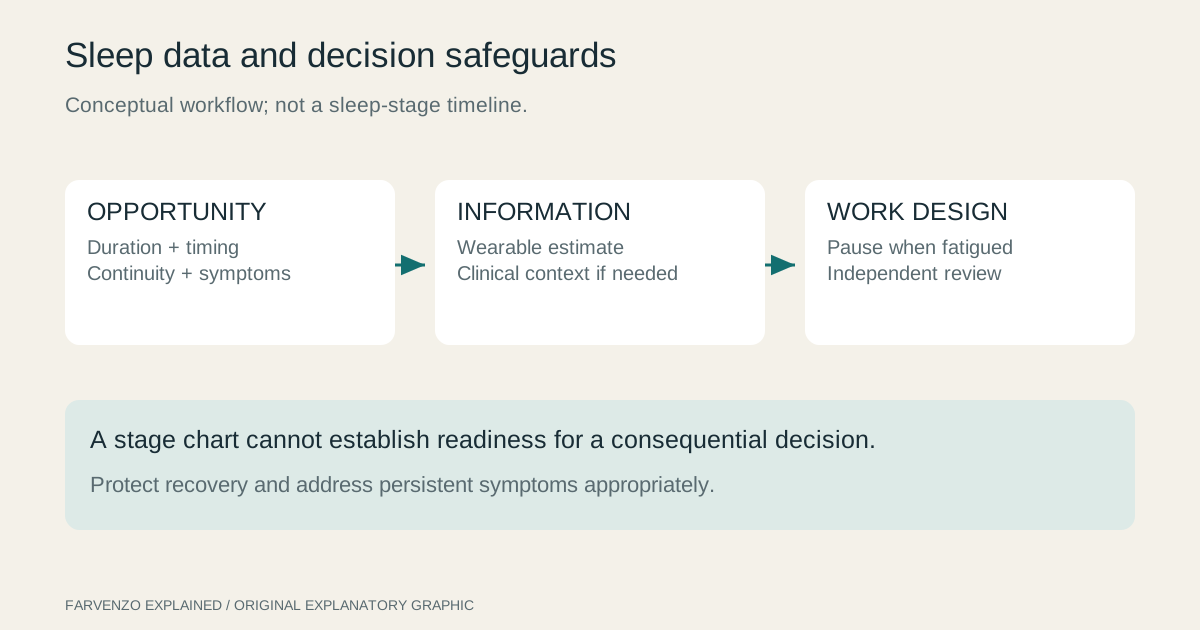
What sleep architecture describes
Non-REM sleep includes three stages, ranging from lighter sleep to deeper slow-wave sleep. REM sleep is another phase with characteristic brain and bodily activity. These phases recur during the night, but their duration and distribution are not identical from cycle to cycle or person to person. NHLBI's explanation of sleep stages provides the basic framework. An average cycle length does not establish that waking at an exact multiple will always prevent grogginess, nor does it justify a universal ninety-minute work-and-rest schedule during the day.
Different aspects of sleep support different functions, and a healthy night should not be described as a competition in which only deep sleep counts. A person can obtain a seemingly attractive stage percentage while sleeping too little overall or experiencing frequent awakenings. Sleep timing also interacts with the body's circadian system and the time a person has been awake. The practical question is whether the sleep opportunity and pattern support health and daytime functioning. A chart is a representation of that process, not the process itself and not a standalone clinical assessment.
Measurement has a hierarchy
Clinical sleep studies can record signals such as brain activity, eye movement, muscle activity, breathing and oxygen levels, depending on the assessment. Consumer wearables generally infer sleep and stages from a more limited set of signals and proprietary models. They can help some people notice trends, but stage estimates are not equivalent to direct measurement of all the signals used in a clinical study. Device changes and software updates can alter the estimates even when the person's underlying sleep has not changed in the same way.
A sensible interpretation starts with repeatable observations: bedtime, wake time, opportunity to sleep, awakenings, sleepiness and relevant circumstances. A single unusual night can reflect travel, illness, stress or measurement error. Persistent symptoms deserve more attention than a minor change in a stage score. People with concerns such as significant daytime sleepiness, breathing pauses or ongoing insomnia should discuss them with a qualified clinician. This is especially important when alertness affects driving, machinery or other safety-sensitive activity. An app should not be used to declare that concerning symptoms are harmless.
Worked example: read a wearable change
Imagine an illustrative manager whose device reports that deep sleep fell from 70 to 45 minutes after a software update. Total time in bed and perceived daytime functioning appear unchanged. The manager initially considers buying a supplement advertised to restore deep sleep. A more careful response checks the update notes, recent routine and whether the pattern persists. The reading may contain useful information, but it does not identify a diagnosis or prove a deficiency that a product can correct. Acting on the score alone would join several unverified assumptions into one purchase decision.
The manager keeps a brief record of sleep opportunity, awakenings, caffeine timing, travel and daytime sleepiness. If difficulties continue, the record can support a clinical conversation. If the apparent change occurs only in the device's stage classification, the appropriate conclusion may be uncertainty rather than treatment. This example does not suggest ignoring symptoms or that wearables are always inaccurate. It shows how to distinguish an inferred stage estimate from evidence that a specific intervention is necessary. The more consequential the action, the stronger the supporting information should be.
Sleep loss changes the conditions for judgment
NHLBI describes how sleep deficiency can make learning, concentration, problem solving and decisions more difficult. The effect on any particular task depends on the person, duration of sleep loss and task demands. A simple task can appear manageable while a complex, monotonous or emotionally charged one becomes harder. Feeling accustomed to a demanding schedule is not itself proof that performance is unaffected. Organizations should therefore design around predictable fatigue exposure rather than wait for someone to admit feeling unable to function.
This is a systems issue as well as an individual one. Staffing, shift timing, travel expectations and after-hours messages determine whether adequate sleep is feasible. An employee cannot solve a schedule that repeatedly provides insufficient recovery by adopting a more elaborate evening ritual. Managers can review handovers, reserve capacity and avoid rewarding visible exhaustion as commitment. Appropriate controls may include independent checks for consequential decisions and clear escalation routes when someone is impaired. The correct design depends on the work and applicable standards; it should not be improvised from a generic productivity article.
Worked example: redesign a late decision
Suppose an illustrative product team schedules its final release review after an overnight migration. The same engineers who performed the migration must decide whether unresolved issues permit launch. Rather than assume determination will compensate for fatigue, the team changes the process. It defines acceptance criteria beforehand, records test evidence during the migration and assigns a rested reviewer with authority to delay release. A documented rollback option reduces the pressure to defend work simply because it consumed a difficult night. The review evaluates evidence against the criteria, not the team's stamina.
The redesigned process still needs coverage if the rested reviewer is unavailable or a new incident occurs. The team names a backup and separates emergency containment from the broader launch decision. Afterward, it examines errors, near misses, handover quality and recovery time. A successful outcome does not prove sleep loss was harmless; the controls may have prevented it from becoming a failure. Nor does one incident establish the exact effect of fatigue on every engineer. The example demonstrates how scheduling and independent evidence can reduce a foreseeable source of decision risk.
Build a workable sleep opportunity
General sleep guidance emphasizes a regular routine, a suitable environment and attention to behaviors that can interfere with sleep. These are useful foundations, but individual needs and constraints differ. Shift workers, caregivers and people with health conditions may need tailored support. A plan should make adequate sleep possible before optimizing marginal details. The most expensive mattress, supplement or tracking device cannot create hours that a schedule does not provide. Practical changes should be judged by sustained functioning and comfort, not by promises of a perfect stage distribution.
People can experiment with manageable routine changes while avoiding rigid conclusions from a few nights. Change one relevant factor at a time when practical, note the circumstances and allow for ordinary variation. A diary can be useful without recording every minute or creating anxiety. If monitoring itself becomes a source of distress, more data may not be the helpful next step. Persistent problems call for appropriate assessment rather than an endless sequence of consumer experiments. Sleep is a health function, and the goal is support rather than constant self-surveillance.
Businesses offering sleep products should match claims to evidence. A study showing that a particular intervention changes a measured signal does not necessarily demonstrate better decision-making, fewer accidents or longer life. The population, comparator and outcome need to match the marketing statement. Testimonials can describe experience but cannot establish a universal causal effect. Responsible communication also acknowledges when a product is unsuitable or when clinical assessment is more appropriate. Clear boundaries help customers make decisions and distinguish an aid to comfort or routine from a treatment claim.
The useful connection between sleep architecture and decision quality is broad but practical: sleep is structured, measurement is imperfect, and inadequate recovery can undermine the conditions for good judgment. Protect sufficient opportunity, watch meaningful symptoms and design work so that fatigue does not silently control consequential choices. Treat stage charts as limited information rather than a command. A sustainable routine and a well-designed decision process offer a more defensible path than attempting to engineer every night around a precise cycle or a promised productivity multiplier.
Sources
Keep exploring
- Continuous Glucose Monitors for Focus: What the Evidence Can—and Cannot Tell You →
Continuous glucose monitors measure glucose patterns, not cognition. Examine authorized uses, limited evidence for focus claims and the costs of tracking.
- Longevity Basics Before Biohacking →
Evaluate longevity claims by separating lifespan, function and biomarkers, then compare evidence, opportunity costs and the practical foundations of health.