Health, Longevity & Biohacking
Continuous Glucose Monitors for Focus: What the Evidence Can—and Cannot Tell You
A continuous glucose monitor can reveal patterns in glucose, but it does not measure attention, mental clarity or productivity. That distinction is easy to lose when a graph appears next to a story about an afternoon slump. Glucose regulation is important to health, and these devices have valuable established roles in diabetes care. Their usefulness for a person without diabetes who wants better focus is a separate evidence question. A meaningful answer requires a clear objective, an appropriate population and outcomes beyond the attractiveness of a smoother curve. The presence of more data does not by itself show that collecting the data will improve the problem a person is trying to solve.
By Farvenzo Explained · Published · 7 min read
Know what the sensor observes
A wearable glucose sensor estimates glucose in interstitial fluid, the fluid around cells. It is not continuously taking a conventional laboratory blood sample. Readings can differ from blood glucose, particularly during changes, and performance depends on the device and conditions. The manufacturer's instructions explain intended use and limitations. A person should not treat every brief rise, dip or mismatch as proof of disease. Nor should a device be used outside its instructions to make treatment decisions that require clinical oversight. Measurement becomes useful only when its limits and the decision it informs are understood.
Regulatory authorization also has a specific scope. In March 2024, the FDA cleared the first over-the-counter continuous glucose monitor for adults who do not use insulin, including some people without diabetes who want to understand how diet and exercise affect glucose. The authorization does not establish that wearing the device improves focus, prevents every metabolic problem or suits every user. In particular, the intended population and warnings matter. Readers should consult current product labeling and professional advice for personal decisions rather than infer broad clinical benefits from the phrase available without a prescription.
A correlation is not a diagnosis
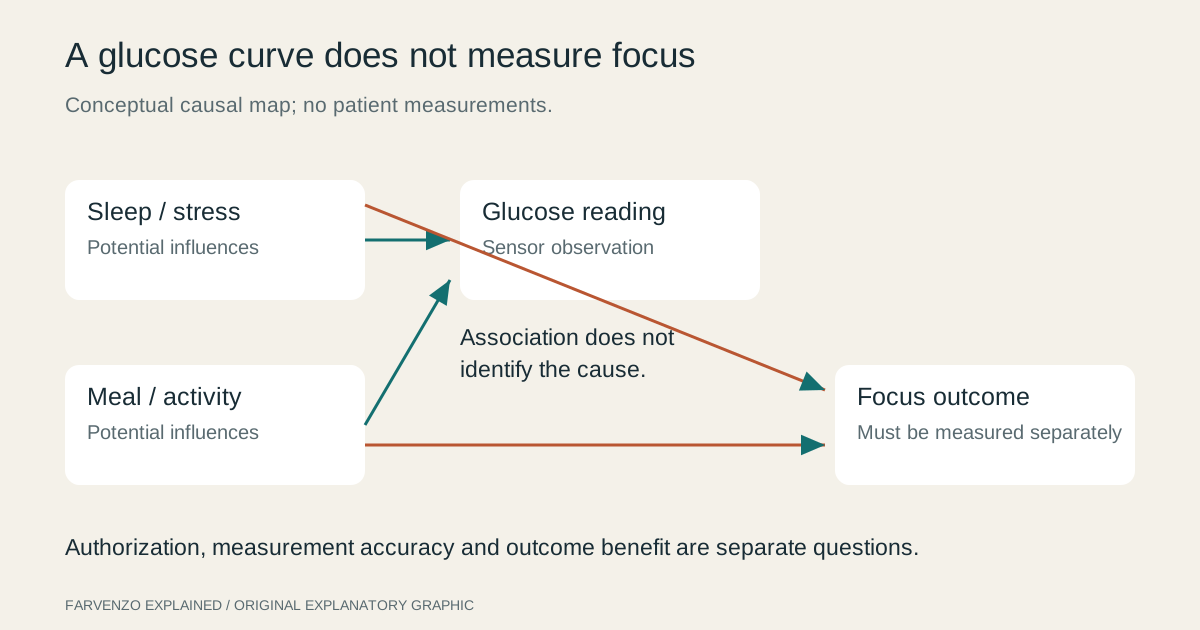
Suppose someone feels tired after lunch and sees a glucose rise on the same afternoon. The meal, sleep, caffeine, hydration, stress, task difficulty and time of day may all contribute to the experience. A graph can suggest a question, but it cannot determine which factor caused the fatigue. Normal physiology includes changes in glucose after eating. Interpreting every excursion as harmful can create unnecessary concern or encourage restrictive behavior unsupported by the person's needs. A clinically meaningful pattern requires context, and unexplained or persistent symptoms deserve appropriate assessment rather than a social-media diagnosis.
Research and expert reviews have identified limited evidence that glucose monitoring improves health in people without diabetes. The evidence for a broad promise of improved concentration is more limited still. This uncertainty differs from evidence that the devices are useless in all circumstances. A clinician may have a reason to investigate a particular problem, and a person may learn something about a routine. However, a marketing claim about sharper thinking needs a study that measures thinking or functioning in the relevant population, not merely a change in a sensor trace.
Worked example: investigate an afternoon slump
Imagine an illustrative analyst who notices tiredness at three in the afternoon. They assume lunch caused a glucose crash and consider buying a monitor. Before making that inference, they review a week of sleep opportunity, meal timing, caffeine, workload and symptoms. The record shows several late nights and long meetings without breaks. These observations do not establish a medical explanation, but they reveal practical factors the original theory ignored. If symptoms are persistent, concerning or interfere with safety, a qualified clinician can help assess the situation and decide whether testing is appropriate.
Suppose the analyst later uses a monitor within its intended use and records tiredness while glucose appears relatively stable. That result weakens the simple story that every slump is explained by a visible glucose swing. It does not identify the real cause or rule out a medical condition. Conversely, a change in the curve after a different lunch would not by itself prove an improvement in attention. The desired outcome must be measured separately. The example illustrates how data can challenge an assumption without becoming a diagnosis, a nutrition prescription or proof of a universal metabolic rule.
Define the outcome before buying the dashboard
If the objective is focus, ask what improvement would count. Fewer self-reported lapses, better performance on a defined task and less daytime sleepiness are different outcomes. Expectations can influence subjective reports, and novelty can briefly change behavior. A useful study would consider comparison conditions, the duration of monitoring, participant characteristics and whether any benefits persist. It should also examine burdens such as anxiety, skin irritation, cost and unnecessary dietary changes. A smoother glucose trace is an intermediate observation, not a substitute for every outcome customers are promised.
Commercial demonstrations often combine a device with coaching, meal changes, exercise and increased attention to sleep. If participants improve, the package may have helped, but the device's independent contribution remains uncertain unless the design can separate it. The same issue affects testimonials. Someone may feel better while monitoring because they adopted a more regular routine, changed work conditions or expected a benefit. These possibilities do not invalidate personal experience. They prevent that experience from being presented as a controlled demonstration that glucose feedback itself causes better cognitive performance.
Worked example: assess a workplace proposal
Consider an illustrative employer offered a wellness package promising better employee concentration through glucose tracking. The vendor presents before-and-after satisfaction scores from volunteers. The employer asks whether a comparison group existed, how participants were selected, whether medication or diabetes status affected results and whether actual work performance was measured. It also asks who can access individual health data and what happens when an employee declines. A voluntary group of enthusiastic users may not represent the wider workforce, and improved satisfaction is not equivalent to a measured reduction in errors.
The employer decides that it cannot justify the advertised productivity claim from the supplied evidence. It can still improve meal access, reasonable breaks and working hours without collecting employees' glucose data. If a health program is considered, qualified professionals and privacy safeguards belong in its design, with a clear purpose independent of performance management. This hypothetical decision is not a judgment on every device or wellness service. It shows why a business should require evidence for the specific promise being sold and avoid turning personal biological data into an employment metric.
Interpret numbers without losing context
A display can look more authoritative than its interpretation deserves. Users may compare their curves with others despite differences in physiology, activity, sensor behavior and circumstances. They may also optimize the appearance of a trace while neglecting overall nutritional adequacy, enjoyment or sustainable habits. The aim of health behavior is not to make every line flat. Decisions about eating and activity should consider the person's broader needs, and those with a history of disordered eating or anxiety may need particular care around intensive tracking. More frequent measurement is not automatically more supportive.
Cost deserves a similarly concrete assessment. Sensors, subscriptions and coaching can create recurring expenditure. Compare that cost with the problem being addressed, the evidence of benefit and other appropriate options. Avoid a false choice in which buying a device is presented as the only way to take health seriously. Established care, adequate sleep, suitable activity and assessment of persistent symptoms may be more relevant. The right sequence depends on the individual, but the need to identify a purpose remains. A purchase is easier to evaluate when its promised outcome is explicit and its limits are visible.
When reading claims, distinguish a device's technical accuracy from evidence that using it improves outcomes. Distinguish an authorized use from a promotional extension, a population association from a personal diagnosis, and glucose movement from cognition. Authoritative sources include the FDA's product information, diabetes-care guidance and research that directly studies the proposed user group. A vendor's explanation can help describe its interface, but it should not be the sole basis for a broad medical or productivity claim. Evidence quality matters most where the promised benefit moves furthest from what the sensor actually measures.
Continuous glucose monitoring can be important clinical technology without being an established universal focus tool. For people without diabetes, its value depends on the purpose, evidence, interpretation and potential burdens. Use it, when appropriate, within its intended role and with suitable guidance. Do not assume that brain fog has one measurable cause or that a smoother curve proves better thinking. The most useful response to a recurring problem is a well-framed question and an appropriate assessment, not necessarily a more elaborate dashboard.
Sources
Keep exploring
- Longevity Basics Before Biohacking →
Evaluate longevity claims by separating lifespan, function and biomarkers, then compare evidence, opportunity costs and the practical foundations of health.
- Stoicism and Market Volatility: Control Process, Not Prices →
Apply Stoic reflection to volatile markets by separating controllable conduct from prices, reviewing assumptions and responding responsibly to new evidence.