Founder Biographies & Corporate History
From Graphics Recovery to a Computing Platform: NVIDIA’s RIVA and CUDA Decisions
NVIDIA’s early graphics recovery and its later creation of CUDA are often compressed into one story about a founder making a single all-or-nothing bet. The record is more useful when the episodes remain separate. RIVA 128, introduced in 1997, was a graphics product that helped NVIDIA compete after earlier architectural difficulties. CUDA, announced in 2006, was a programming platform intended to make the GPU accessible for general-purpose parallel computing. One addressed an urgent product-market problem; the other accumulated value through software tools, libraries, hardware generations, researchers and developers. Official timelines and filings document milestones, but they do not justify invented claims about days of runway, exact internal odds or revenue that a single decision “saved.” Strategy can be studied without turning survival into proof that every risky commitment was wise. The distinction also changes governance: product recovery needs shipment evidence, while platform investment needs ecosystem evidence.
By Farvenzo Explained · Published · 6 min read
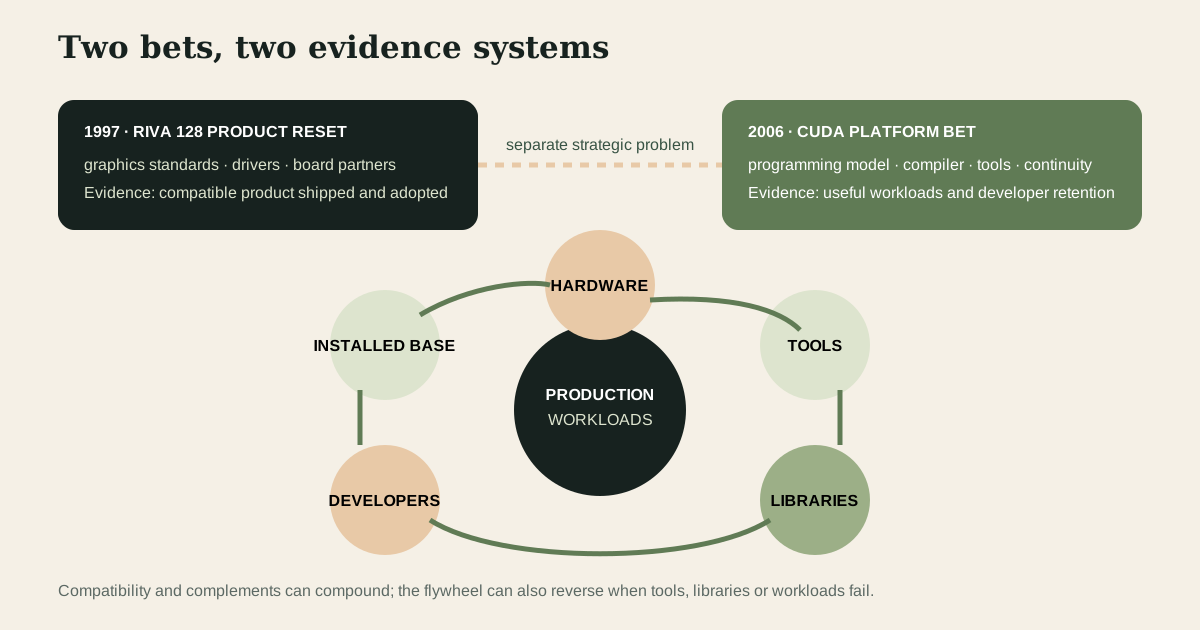
RIVA 128 solved a 1997 graphics-market problem
NVIDIA’s first product, NV1, combined graphics and audio around an architecture that did not align well with the direction of mainstream PC graphics standards. The company’s official timeline places RIVA 128 in 1997 and describes it as its first high-performance 128-bit Direct3D processor. The important strategic change was not mystical conviction. NVIDIA moved toward the interfaces, performance expectations and release cadence of the Windows PC market. A product had to work with game developers, board partners, computer makers, drivers and Microsoft’s evolving application programming interfaces.
A graphics chip is not sold in isolation. Board manufacturers need reference designs; original-equipment manufacturers need reliable drivers and supply; developers need predictable behavior; consumers need games that use the capability. RIVA’s commercial significance therefore came from a system of complements. Exact internal cash positions and counterfactual bankruptcy dates are not established by the public timeline, so they should not be narrated as fact. The defensible conclusion is narrower: after an unsuccessful architecture, NVIDIA shipped a product better aligned with the market’s technical direction and built from there.
Worked example one: evaluate a product reset without hindsight
Imagine a 1996 board choosing between extending a proprietary graphics design and building for emerging industry interfaces. A forward memo would compare engineering completion risk, driver readiness, likely developer support, board-partner adoption and the cost of delay. The standards-aligned route may reduce differentiation but enlarge compatibility. The proprietary route may preserve unique features but require the company to persuade an ecosystem to follow. The correct analysis uses information available then; it does not insert RIVA’s later success as evidence that management should have known the outcome.
The practical lesson is to define the bottleneck. If hardware performance is adequate but developers cannot target it, another transistor feature will not solve adoption. If drivers are unstable, a benchmark win may not translate into a shippable system. A reset can be rational when the remaining value of the old path is lower than the expected value of a compatible one, including switching delay. It can still fail. Survivorship bias appears when analysts study the winning reset but ignore companies that made equally bold changes and disappeared.
Software compatibility also changes the economics of a hardware generation. If customers must rewrite code for every chip, a benchmark advantage competes with migration cost. Stable abstractions can let NVIDIA improve architecture beneath applications, although new features and performance tuning still require work. Backward compatibility is not free: engineering must maintain compilers, libraries and testing across products. The strategic asset is therefore not lock-in alone; it is a credible promise that accumulated developer effort will continue to produce useful results.
CUDA was a platform bet, not another graphics card
NVIDIA introduced CUDA in 2006 as a general-purpose parallel-computing architecture and programming model for its GPUs. The platform allowed developers to express non-graphics workloads without treating the device solely as a rendering pipeline. That required more than capable silicon: a compiler, programming interfaces, debugging and profiling tools, documentation, education and compatibility across hardware generations. The investment created an invitation for outside developers to build uses NVIDIA could not specify centrally.
Platform value grew with complements. Scientific codes, university courses, numerical libraries and later machine-learning frameworks reduced the work required to use GPUs. Hardware sales funded new generations; a larger installed base attracted developers; software support made subsequent hardware more useful. This is path dependence: earlier tools and code influence later choices because switching has cost. It does not mean CUDA’s eventual position was inevitable in 2006. Open standards, rival accelerators, customer bargaining and workload changes remained possible.
Worked example two: the hardware–software flywheel as an investment case
Consider an illustrative accelerator company deciding whether to spend $60 million over three years on a programming platform. Hardware-only forecasts show $20 million of near-term contribution from specialized customers. The platform case expects negative cash flow initially, then greater hardware demand if libraries and developers arrive. Management should define leading evidence: compiler reliability, time to first program, trained developers, library coverage, retained compatibility and workloads moved into production. Downloads alone are weak because they do not prove use or hardware pull-through.
At the first review, developer adoption is strong but production deployment is low because a critical numerical library is missing. The rational response may be to fund that complement rather than abandon the platform or celebrate sign-ups. At the second review, customers report that code runs across two hardware generations with manageable changes. That evidence supports path-dependent value. The example is not NVIDIA’s internal budget. It shows how a platform bet should be governed before the flywheel is visible: milestones must test complements and switching value, not only chip shipments.
The flywheel can reverse. Weak tools reduce workloads, fewer workloads reduce hardware demand, and a smaller installed base discourages complement investment. Governance should watch developer retention, unresolved defects, library release lag and customer porting effort. A platform team needs authority to prioritize ecosystem health even when one hardware launch creates short-term pressure. Conversely, supporting every legacy path can slow improvement. Explicit deprecation schedules and migration tools help balance continuity with technical renewal.
Filings reveal dependencies that founder stories omit
NVIDIA’s filings describe risks such as competition, manufacturing dependence, product transitions, customer concentration, software support and the need to anticipate markets. These disclosures matter because a platform does not remove execution risk. NVIDIA has historically relied on external semiconductor manufacturing, making design, foundry capacity, packaging and supply coordination complements to its own architecture. Developer adoption also creates obligations: compatibility, security fixes and documentation become part of the product.
Corporate histories often select decisions that fit the present. CUDA looks central from an AI-era vantage point, but early users also pursued scientific computing and other parallel workloads. A contemporary strategy review should preserve the options management was actually evaluating. It should also separate company claims from audited financial statements and third-party interpretation. Official milestones establish dates and products; they do not establish every motive attributed later in speeches or profiles.
Use the history as a crosscheck, not a formula
Three principles travel reasonably well. First, product recovery may require abandoning an architecture while retaining accumulated capability. Second, a platform needs complements and credible continuity, not just an interface. Third, long-lived software can shape hardware demand and switching cost. None instructs a founder to spend through a crisis or copy a proprietary ecosystem. The feasibility of a platform depends on capital, installed base, developer benefit and the company’s ability to maintain it.
A fair decision record would state the product problem, ecosystem constraint, evidence available, alternatives and review points. It would avoid invented runway, guaranteed outcomes and the assumption that survival validates the method. NVIDIA’s path contains skill, timing, iteration and external conditions. Studying the separation between RIVA 128 and CUDA produces a better lesson than merging them: urgent product alignment and patient platform construction are different jobs, measured by different evidence over different horizons.
- Treat RIVA 128 as a 1997 graphics-product reset and CUDA as a separate 2006 platform initiative.
- Evaluate chips with drivers, boards, developers, libraries, manufacturing and customer adoption as complements.
- Use contemporary milestones and filings rather than invented runway or rescue figures.
- Measure platform progress through usable tools, production workloads and cross-generation continuity.
- Correct for survivorship bias before converting one company history into a founder formula.
Sources
Keep exploring
- Why Nokia’s Smartphone Transition Cannot Be Reduced to One Mistake →
How software architecture, developer ecosystems, distribution, organizational dependencies, and the Microsoft transition interacted in Nokia’s mobile decline.
- Customer Neutrality, Yield and Scale: How TSMC’s Foundry Model Works →
How the pure-play foundry model aligned customer trust with manufacturing learning, and why capital, tools, yield and utilization made it difficult.
- ASML and EUV: Why Advanced Lithography Is a Supply-Chain System →
EUV lithography depends on optics, materials, service and qualification. Learn why accepted wafer output matters more than a machine’s peak speed.