Founder Biographies & Corporate History
Why Nokia’s Smartphone Transition Cannot Be Reduced to One Mistake
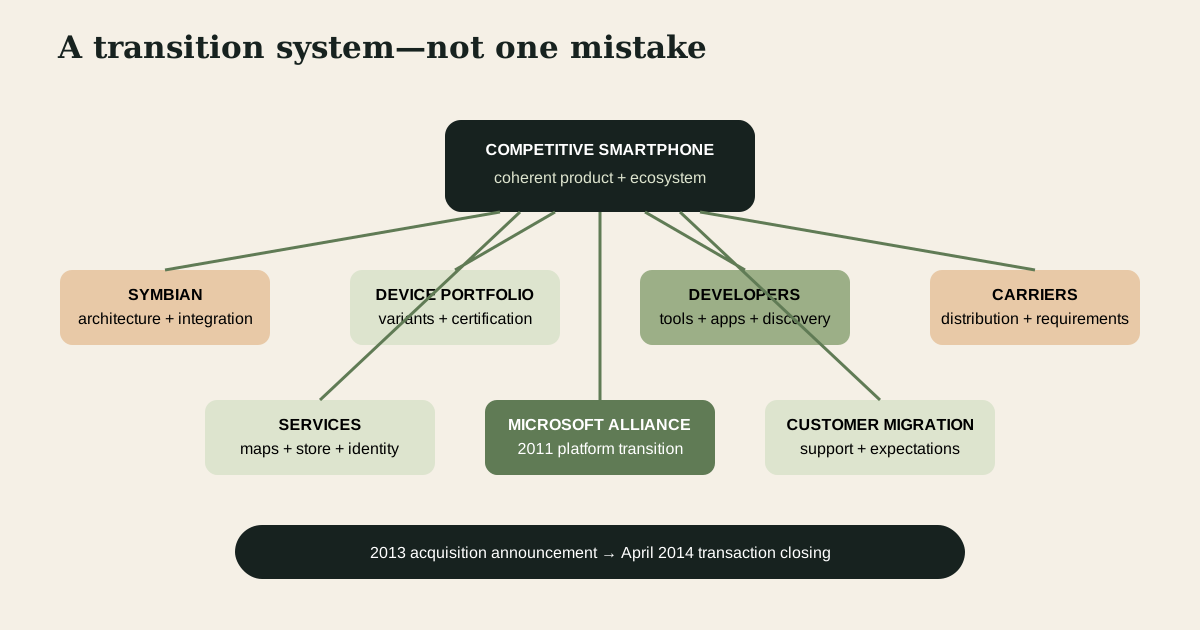
Nokia did not lose its smartphone position because executives simply failed to notice touchscreens or lacked intelligence. It entered the transition with global distribution, carrier relationships, hardware expertise, brand reach and smartphone products. It also carried software and organizational dependencies built for a broad device portfolio. As competition shifted toward integrated operating systems, applications and developer tools, those strengths did not automatically combine into a coherent platform. Nokia and Microsoft announced a strategic partnership in February 2011, Microsoft announced the acquisition of Nokia’s Devices and Services business in September 2013, and the transaction closed in April 2014. Those records establish a sequence, not a single-cause morality tale. The useful analysis maps architecture, ecosystem, channel and transition risk together. Regional outcomes also differed, so a global narrative should not assume one uniform customer response. Device mix, carrier power, price points and local applications changed the transition by market.
By Farvenzo Explained · Published · 6 min read
Symbian carried integration obligations across a broad portfolio
Symbian evolved in a period when mobile devices had tight memory, varied hardware and strong operator influence. Nokia used it across multiple product lines and user-interface layers. That installed capability supported many devices, but changing an established platform required coordination across hardware programs, software components, testing, languages and carrier certifications. A feature demonstrated on one prototype did not become a scalable product until those dependencies worked together. The constraint was system integration, not the absence of isolated ideas.
Software architecture becomes strategic when it determines release speed and developer experience. Fragmented interfaces or device variants increase testing and make applications harder to port. Replacing them carries its own delay because existing customers and products still need support. Nokia’s challenge was therefore a transition while operating at scale: improve the current platform, create or adopt a successor, ship competitive devices and maintain channel commitments. Any account that says the company merely preferred durable hardware over software ignores the cost and sequencing of that transition.
Ecosystems changed the unit of competition
A smartphone platform connects users, developers, device makers, services, accessory providers and distribution. Developers consider tools, documentation, addressable users, payment, discovery and the effort to support variants. Users consider applications and services as well as the handset. A platform with fewer devices can become more attractive if developers expect growth and can reach users efficiently. Conversely, a large installed base may not secure future applications when development is difficult or the roadmap is uncertain.
Nokia retained assets that ecosystem summaries sometimes erase. Carrier and retail relationships opened markets; manufacturing and supply capabilities delivered at scale; mapping and network businesses had distinct value. These complements could support a platform but could not substitute for one. Operators also had their own interests, including differentiation and resistance to dependence on a single platform provider. The transition involved negotiations across these parties, not a clean contest between one Nokia phone and one iPhone.
Developer economics can be measured directly. Track time to install tools, application approval delay, crash rates by device, revenue per active user and the cost of supporting variants. Count strategically important local applications rather than only catalog size. A banking application missing in one country can matter more than thousands of globally available novelties. These measures reveal whether distribution strength is translating into a usable platform and whether architectural work reduces the cost of participation.
Worked example one: map a delayed feature through dependencies
Imagine an incumbent planning a unified messaging feature across twelve devices. The service team finishes the core function, but three user-interface variants need adaptation, older devices have memory limits, two carriers require certification, localization changes layouts, and the application store needs new billing rules. Management reports the feature as 80 percent complete because core code works. Yet launch risk sits in the final integrations. A competitor supporting two tightly controlled device families can ship sooner even with fewer engineers.
The example shows why percent complete and prototype dates are poor measures of platform readiness. A dependency map should identify interfaces, owners, test environments and the critical path. Management can reduce variants, narrow the launch or invest in shared components, but each choice affects customers and channels. The lesson is not that integration complexity always defeats scale. It is that scale built on variation can slow a transition when the market begins rewarding a consistent software surface.
The 2011 Microsoft alliance was a transition choice with two clocks
Nokia and Microsoft’s February 2011 announcement proposed Windows Phone as Nokia’s principal smartphone strategy, with Nokia contributing hardware design, language support, scale, mapping and operator relationships while Microsoft supplied the platform and developer tools. The choice sought a differentiated ecosystem against iOS and Android. It also created two clocks: Nokia needed competitive devices quickly, while a platform ecosystem needed time to attract applications, users and developer confidence. Existing Symbian products still generated activity during the transition.
A platform switch can reduce internal architecture burden while creating external dependence. Roadmaps, release timing and developer momentum now depend partly on the partner. Publicly announcing a transition can also weaken the old platform before the new one reaches full strength as developers and buyers update expectations. That does not prove the alliance was irrational; alternatives had costs and uncertain timelines. Analysis should compare feasible choices available in 2011, not assume Nokia could instantly produce a mature independent platform because one would have been strategically convenient.
Worked example two: govern a platform alliance through adoption gates
Consider an illustrative device company selecting a partner operating system. The agreement lowers internal platform spending by $300 million over three years but requires migration, shared roadmaps and minimum launch commitments. The board defines gates: developer tools ready, top regional applications covered, two devices certified, operator acceptance, upgrade process tested and customer migration support funded. Savings are not recognized as value until transition cost and lost legacy contribution are included. Partner dependence is tracked through release commitments and exit rights.
At the first gate, devices are on schedule but key local banking applications are absent. The company funds developer support and narrows launch geography rather than claim ecosystem completion from global app totals. At the second, operator certification delays one flagship market. The board revises volume and working capital instead of blaming execution in general. This example is not Nokia’s budget. It demonstrates how an alliance should be evaluated through both product delivery and ecosystem adoption, with legacy decline shown explicitly.
The 2013 announcement and 2014 closing mark a transaction, not one cause
Transition communication affects behavior before products change. Employees need to know which platform receives investment; developers need a credible support horizon; carriers need inventory and service plans; customers need upgrade expectations. Ambiguity may preserve short-term optionality but discourage commitment. Excessively final messaging may accelerate decline in the legacy business. Leaders should sequence announcements with tools, devices and migration support, then monitor channel inventory and developer activity for unintended effects.
Microsoft announced its agreement to acquire Nokia’s Devices and Services business in September 2013, and the parties announced closing in April 2014. The transaction transferred a major operating business after the alliance period; Nokia continued as a company with other businesses. It should not be described as Nokia losing everything. Nor does the sale prove one internal cultural diagnosis. Market share, product timing, platform adoption, financial performance and strategic alternatives all influenced the context.
Single-cause stories are attractive because they supply a villain—arrogance, bureaucracy or fear—and a simple warning. Corporate transitions rarely cooperate. Nokia’s case is better used as a dependency audit: architecture, variants, developers, carriers, services, partner roadmaps and organizational decision speed interacted. Leaders should watch release lead time, cross-product reuse, developer retention and unresolved interfaces in addition to market share. Dominance is a lagging measure; transition capacity is visible in whether the organization can change the system while still operating it.
- Treat Symbian as an architecture and integration system, not a synonym for management blindness.
- Map developers, carriers, distribution, services and hardware as platform complements.
- Evaluate the 2011 Microsoft alliance against feasible alternatives and two transition clocks.
- Use the September 2013 announcement and April 2014 closing as distinct documented events.
- Reject single-cause decline stories in favor of measurable dependencies and transition gates.
Sources
Keep exploring
- From Graphics Recovery to a Computing Platform: NVIDIA’s RIVA and CUDA Decisions →
How NVIDIA’s RIVA 128 and CUDA addressed different strategic problems, why complements and developers mattered, and what survivorship bias obscures.
- Customer Neutrality, Yield and Scale: How TSMC’s Foundry Model Works →
How the pure-play foundry model aligned customer trust with manufacturing learning, and why capital, tools, yield and utilization made it difficult.
- From Reported Earnings to Liquidity: How Enron’s Structures Obscured Risk →
How to distinguish estimated earnings from cash, analyze SPE control and guarantees, and separate report allegations from adjudicated findings.