Geopolitics, Macro-History & Global Affairs
ASML and EUV: Why Advanced Lithography Is a Supply-Chain System
An extreme ultraviolet lithography machine is easier to understand as a production system than as an unusually expensive camera. It must generate a difficult kind of light, direct it through specialized optics, position a wafer precisely, expose a pattern and repeat the operation reliably enough for a semiconductor factory. ASML integrates that system, but the capability depends on suppliers, research institutions, customers and accumulated manufacturing knowledge. Its business position therefore comes from coordination as well as invention. For a buyer, the central question is not simply whether the machine prints a small feature. It is whether the entire process produces enough acceptable chips, at the required cost, through a dependable production schedule.
By Farvenzo Explained · Published · 6 min read
What EUV actually changes
Lithography transfers patterns into light-sensitive material on a wafer. Extreme ultraviolet systems use light with a wavelength of 13.5 nanometres. That number describes the light, not the physical size of every transistor feature and not a direct translation of a commercial process-node name. Resolution also depends on the optical system and processing choices. Treating a wavelength as a complete description of a chip confuses one enabling input with the outcome of many fabrication steps. A chip goes through repeated patterning, deposition, etching, cleaning and inspection operations before useful devices emerge.
EUV light is strongly absorbed by ordinary air and materials that conventional optics can transmit. The equipment consequently uses a vacuum environment and specialized reflective optics. A laser-driven tin plasma provides the light source; the optical path collects and directs a fraction of that output. ASML and ZEISS describe this architecture in their technical explanations. The commercial difficulty is making every subsystem operate together under production conditions. Improving the source alone does not guarantee higher factory output if contamination, wafer movement or process defects becomes the next constraint.
The machine depends on a wider process
Consider the sequence from a design file to a shipped chip. Design rules describe what a fabrication process can manufacture reliably. Mask preparation converts a design into the patterning information used by the exposure system. Photoresist chemistry responds to light, and subsequent processing turns that response into a physical pattern. Metrology measures whether the result matches the intended dimensions and alignment. Defect inspection looks for problems that could reduce yield. Each stage has its own suppliers, qualification procedures and feedback loops. The exposure machine is a critical participant in this chain, not the whole chain.
This distinction matters when evaluating a claimed breakthrough. A faster exposure can create little value if it also increases rejected wafers or requires additional inspection. A new resist may improve one patterning characteristic while complicating another. Engineers optimize a process window: a range of conditions within which the result remains acceptable. Factory managers also care about service access, replacement parts, equipment availability and the repeatability of maintenance. A successful demonstration establishes possibility. Qualified, repeatable production establishes a different and more demanding capability.
Worked example: count accepted wafers
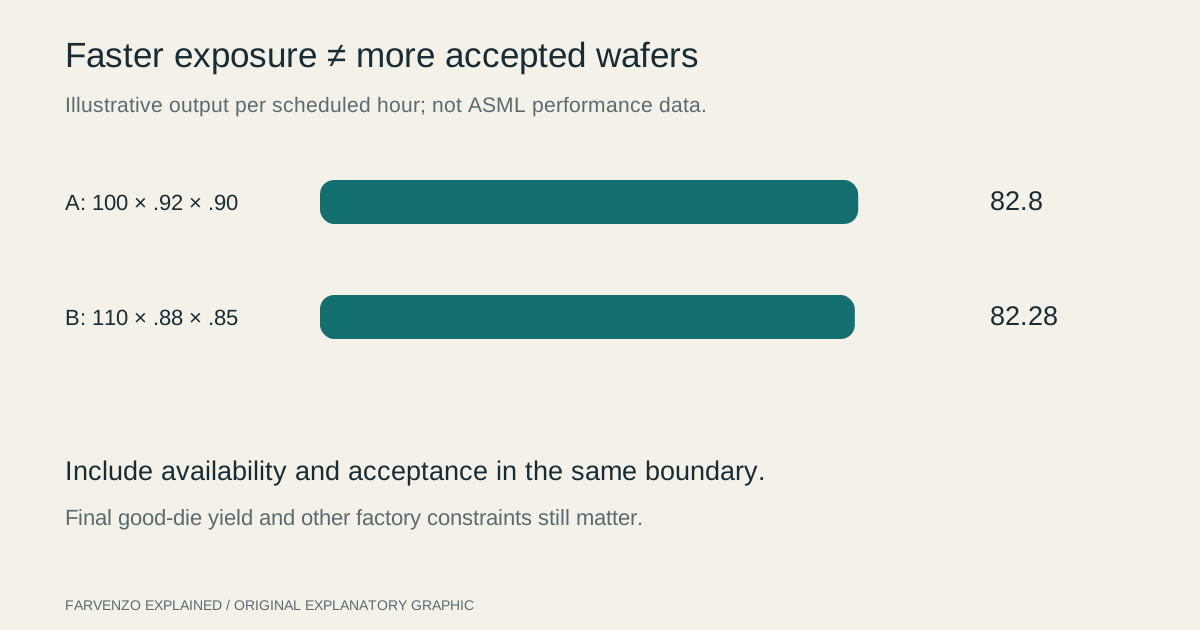
Imagine a purely illustrative fabrication line comparing two exposure configurations. Configuration A processes 100 wafers per hour while available and produces 92 accepted wafers from each 100 processed. It is available for 90 percent of scheduled time. Configuration B processes 110 wafers per hour, produces 88 accepted wafers per 100 and is available for 85 percent of scheduled time. For a simple common comparison, accepted-wafer throughput is about 82.8 per scheduled hour for A and 82.3 for B. The faster nameplate configuration delivers slightly less usable output under these assumptions.
This arithmetic is deliberately simplified. Real wafer acceptance is not the same as final good-die yield, and the production line may have constraints outside lithography. The example nevertheless shows why throughput, availability and quality must appear together. An equipment buyer should ask which losses the vendor's metric includes, how long the test ran, which products were processed and whether recovery after a fault was counted. A single peak number can conceal the operating conditions required to obtain it. Procurement needs distributions and acceptance criteria, not just a best result.
Why supplier qualification creates persistence
A specialized supplier becomes difficult to replace when its contribution is deeply coupled to the rest of the system. An alternative mirror, light-source component or motion-control assembly may require mechanical changes, new software, recalibration, reliability testing and renewed customer qualification. The relevant switching cost includes the risk of disrupting production while those changes are tested. This does not make substitution impossible. It explains why established relationships can persist even when a newcomer can produce an impressive component in isolation.
Supplier concentration also creates a vulnerability for the system integrator. A small number of qualified sources can constrain expansion or prolong repairs. Customers may want more capacity at the same time that suppliers need long lead times for equipment and specialist training. Resilience can involve spare assemblies, repair capability, capacity reservations and redesign for alternative parts. Each option costs money and may require advance commitment. An investor or industrial-policy analyst should therefore distinguish strong bargaining position from freedom from dependency: a company can possess both commercial power and concentrated operational exposure.
Worked example: evaluate a spare assembly
Suppose an illustrative factory faces a potential five-day outage if a critical assembly fails and no local spare is available. Its finance team estimates that each lost day would delay contribution worth $300,000, subject to whether production can later be recovered. Holding a qualified spare costs $250,000 initially plus storage, maintenance and eventual obsolescence. The decision cannot be made by comparing $250,000 with $1.5 million alone. The probability of failure, replacement lead time, recovery opportunities and usefulness of the spare across several machines all change its expected value.
The factory develops three scenarios rather than assigning a convenient failure probability. In one, a supplier can provide a replacement quickly; in another, a shared regional spare is available; in a severe case, several factories need the same assembly simultaneously. The team checks contractual priority, transport requirements and installation skills. It may choose a shared spare arrangement instead of owning one, or decide that local ownership is justified. The worked decision illustrates the economic importance of service infrastructure without pretending that any hypothetical number describes ASML's actual contracts or margins.
Read the business through evidence
Public-company reports can help a reader distinguish system sales, installed-base services, orders and recognized revenue. These measures answer different questions. An order does not automatically become revenue on the same date, and a large installed base does not guarantee a particular service margin. Customers' capital budgets, technology transitions and factory schedules affect demand. Technical leadership can coexist with cyclical spending. A useful analysis identifies the measurement period, product mix and accounting definition before interpreting a reported increase as a permanent change in industry economics.
Export restrictions add another boundary. The applicable rules depend on the equipment, destination, end user, jurisdiction and date. A statement about one restricted product is not a reliable description of every lithography shipment. Readers should consult current official rules and the company's dated disclosures rather than extrapolate from a headline. This article's process explanation does not establish which individual transaction is currently permitted. Compliance is a separate factual inquiry involving the actual parties and equipment.
For businesses that depend on advanced chips, the practical lesson is to map the dependencies that affect their own delivery risk. A software company may have no direct purchase from a lithography supplier but still depend on fabrication capacity, packaging and customer allocation decisions. A hardware company may need alternate designs or longer qualification schedules. The goal is not to predict every disruption. It is to identify where a small upstream failure could become a large downstream delay, then decide which inventory, contract or design options are worth paying for.
EUV's importance is therefore neither a story of one machine doing everything nor proof that a successful supplier faces no constraints. It is a case of a tightly coordinated industrial capability. Evaluate the physics, the process, accepted output, service arrangements and commercial definitions together. That approach reveals why replacing an isolated component differs from replacing a functioning production system, and why maintaining the system can matter as much as selling the next machine.
Sources
Keep exploring
- Dollar Dominance and Payment Alternatives: Reading the Data Carefully →
Separate reserve shares, invoicing, settlement and currency trading to assess dollar dominance, alternative payment rails and business currency exposure.
- Critical Minerals Without the Category Errors →
Trace critical minerals from extraction to qualified components, and compare second sourcing, inventory, recycling and redesign without category errors.