Health, Longevity & Biohacking
GLP-1 Medicines and Business: Separating Evidence From Market Narratives
Medicines affecting the GLP-1 pathway have changed the discussion of obesity treatment and created substantial commercial interest. That interest can blur several different questions: what a particular medicine has demonstrated, who is eligible under its approved labeling, whether a patient can obtain and continue treatment, and how consumer markets might respond. None of those questions can be answered by a single headline about weight loss. A useful business analysis starts with the clinical evidence and then follows access, persistence, costs and behavior. It does not treat every medicine in the category as identical or assume that a clinical result automatically predicts the fortunes of food, fitness or insurance companies.
By Farvenzo Explained · Published · 7 min read
Start with the medicine and population
GLP-1 receptor agonists act on a hormonal pathway involved in glucose regulation and appetite. Other medicines can act on more than one related pathway, so calling every product simply a GLP-1 drug can conceal differences. Approved uses, formulations, evidence, contraindications and risks vary by medicine and jurisdiction. The applicable prescribing information is the proper starting point for an individual product. This article explains business and evidence questions; decisions about treatment, suitability or changes to medication belong with a qualified clinician who can consider the person's circumstances.
A clinical trial also has a defined population and endpoint. A study of people with established cardiovascular disease does not automatically establish the same benefit for everyone seeking weight loss. The SELECT trial, published in 2023, studied semaglutide in people with overweight or obesity and preexisting cardiovascular disease who did not have diabetes. It demonstrated a benefit for its specified cardiovascular outcome in that population. The useful lesson is methodological: retain the eligibility criteria, comparator, follow-up and outcome when describing a result, instead of expanding a finding into a universal health promise.
Access is a sequence of separate decisions
Clinical eligibility does not guarantee practical access. A patient may encounter prescribing, coverage, prior authorization, pharmacy availability, affordability and follow-up requirements. These steps differ across health systems and insurance plans. List prices are not necessarily the amounts paid by an insurer, employer or patient. Rebates, negotiated arrangements, assistance programs and benefit design can change the effective cost. A commercial analysis should specify whose cost is being measured and which period it covers. Otherwise the same price figure can be incorrectly used as manufacturer revenue, payer spending and household expense.
Persistence matters because initial uptake is not the same as ongoing use. People may stop or change treatment for reasons including adverse effects, cost, access or clinical judgment. Evidence about what happens after stopping depends on the medicine and study. A company forecasting demand should not assume that every initial prescription becomes an uninterrupted lifetime customer. Equally, a temporary supply or coverage barrier should not be mistaken for proof that treatment lacks clinical value. The relevant model separates starts, continuation, discontinuation and switching, with assumptions that can be updated from credible data.
Worked example: build an employer cost scenario
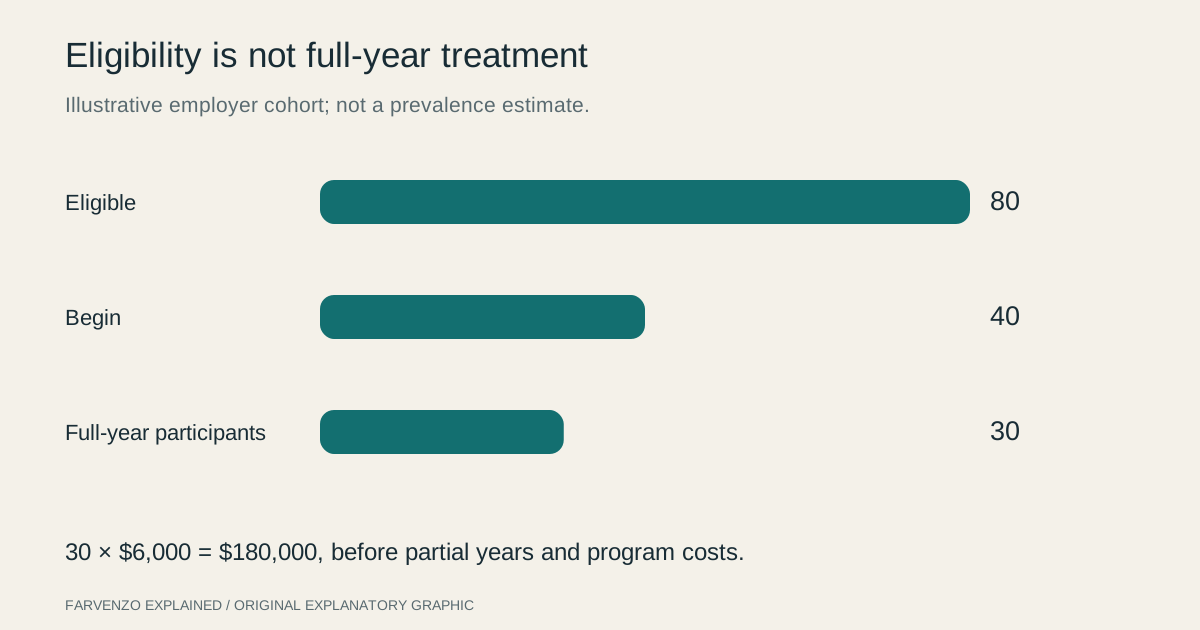
Imagine an illustrative employer covering 1,000 people under a health plan. Its consultant estimates that 80 might meet a particular program's eligibility criteria, 40 might begin treatment and 30 might remain covered for a full year. These are planning assumptions, not prevalence estimates. If the employer's net annual medicine cost were $6,000 for each full-year participant, the 30 continuing participants alone would imply $180,000, before partial-year costs, clinical support and administration. Simply multiplying 80 eligible people by a list price would answer a different and potentially misleading question.
The employer then tests several uptake and persistence scenarios, includes partial-year treatment and considers what outcomes can actually be observed. It does not book speculative savings from fewer cardiovascular events as if they were guaranteed cash in the same budget year. Any evaluation needs a suitable comparison, time horizon and protection of employee privacy. Coverage decisions also involve clinical, ethical and contractual considerations that a spreadsheet does not resolve. The example shows how to expose assumptions and distinguish budget impact from long-term value, not how an employer should decide an individual's care.
Consumer-market effects are hypotheses to test
A change in appetite or eating behavior can affect purchases, but aggregate business effects depend on how many people use treatment, how behavior changes and what spending replaces the old pattern. A reduction in one product's consumption may coexist with greater spending on another. Household behavior can also differ from the treated individual's behavior. Food manufacturers, restaurants and retailers should study their actual customers rather than assume that a clinical weight-loss result determines category revenue. Price, convenience, taste, product mix and wider economic conditions continue to matter.
The same caution applies to fitness and wellness businesses. Treatment does not eliminate the importance of appropriate nutrition, activity, strength and clinical follow-up, but it does not establish that every gym or supplement company will benefit. A business needs evidence about demand for its particular service, the qualifications required to provide it and the cost of delivery. Marketing should avoid implying that a commercial program replaces medical supervision. A credible offering addresses a real need within its competence instead of attaching an unsupported health promise to a popular medicine category.
Worked example: test a retailer's response
Suppose an illustrative food retailer notices lower basket spending among customers who voluntarily identify an interest in weight management. That observation does not show medication caused the change. The customers may differ in income, promotions used, household size or prior shopping behavior. The retailer can examine aggregated, privacy-respecting category patterns and ask what customers need without collecting unnecessary health information. It might test smaller package sizes or clearer nutritional information across a broad customer group. Those product decisions can be evaluated without diagnosing shoppers or inferring medication use from purchases.
For a hypothetical test, the retailer offers two pack sizes in comparable stores and measures unit sales, total margin, waste and repeat purchase over a stated period. It monitors whether the smaller pack merely shifts sales from a larger pack or attracts demand that was previously unmet. A useful result is a documented response to a product choice, not a conclusion that one drug class has permanently changed all food economics. The retailer should retain alternative explanations and avoid segment labels that disclose or speculate about a person's health. Business learning does not require turning sensitive medical behavior into a targeting system.
Evaluate supply, competition and evidence separately
Manufacturing capacity, quality systems, distribution and intellectual-property arrangements influence medicine supply. A shortage report has a specific product, location and date; it is not a permanent description of every formulation or market. Competition can involve new clinical evidence, delivery formats, coverage terms and manufacturing execution. A forecast should state which assumptions concern approval, capacity, pricing or adoption. Adding projected sales across competing products without considering overlap can overstate the market. Commercial opportunity remains uncertain even when a medicine has demonstrated meaningful clinical benefit.
Safety information must also stay current and product-specific. An advertisement or social post is not a substitute for approved labeling and professional assessment. Products sold through unverified channels can raise separate questions about authenticity, ingredients and oversight. A business article should not offer dosing, sourcing shortcuts or instructions to bypass clinical safeguards. It can explain why quality and regulatory status matter while directing readers to authoritative information for the relevant jurisdiction. Distinguishing a licensed medicine from a marketing claim protects both the reader and the quality of the economic analysis.
Investors and operators should resist a common narrative shortcut: selecting a few likely winners and losers from a broad behavioral trend. A company's outcome depends on valuation, competition, costs, financing and execution as well as demand. A favorable market mechanism can already be reflected in its price, while an apparently threatened company may adapt. This article provides no security recommendation. The useful analytical work is to map exposure, identify measurable leading indicators and specify what evidence would weaken the thesis. A story becomes a business case only when its assumptions can be challenged.
GLP-1-related medicines deserve attention because of their clinical and commercial significance, not because every proposed downstream effect is already established. Keep medicine-specific evidence, access, persistence, payer economics and consumer behavior in separate parts of the analysis. Connect them only where evidence supports the link. That approach allows businesses to prepare for change without overstating medical outcomes, invading customer privacy or treating a plausible scenario as a forecast. The clinical decision remains individual; the business analysis should remain explicit about its population, costs and uncertainty.
Sources
Keep exploring
- Sleep Architecture and Decision Quality →
Explore sleep stages, wearable limits and the effects of insufficient sleep on judgment, with practical examples for interpreting data and designing work.
- Continuous Glucose Monitors for Focus: What the Evidence Can—and Cannot Tell You →
Continuous glucose monitors measure glucose patterns, not cognition. Examine authorized uses, limited evidence for focus claims and the costs of tracking.