Founder Biographies & Corporate History
Incentives, Base Rates and Inversion: How to Use Munger’s Mental Models Carefully
Charlie Munger’s speeches on worldly wisdom and the psychology of human misjudgment argue for a latticework of important ideas from multiple disciplines. The concept is often turned into a list of named models that supposedly generates investment answers. That misses the method. Incentives, base rates, opportunity cost, feedback, scale and human judgment are crosschecks on a concrete case. Inversion asks how an outcome could fail; it does not prove the remaining option is good. A circle of competence marks what the decision-maker can evaluate and where uncertainty should produce restraint. Original speech transcripts and Berkshire Hathaway letters provide the relevant record, but paraphrases should not be promoted into invented quotations or a guaranteed formula. The discipline is strongest when the models generate different questions before the decision, not polished explanations afterward.
By Farvenzo Explained · Published · 6 min read
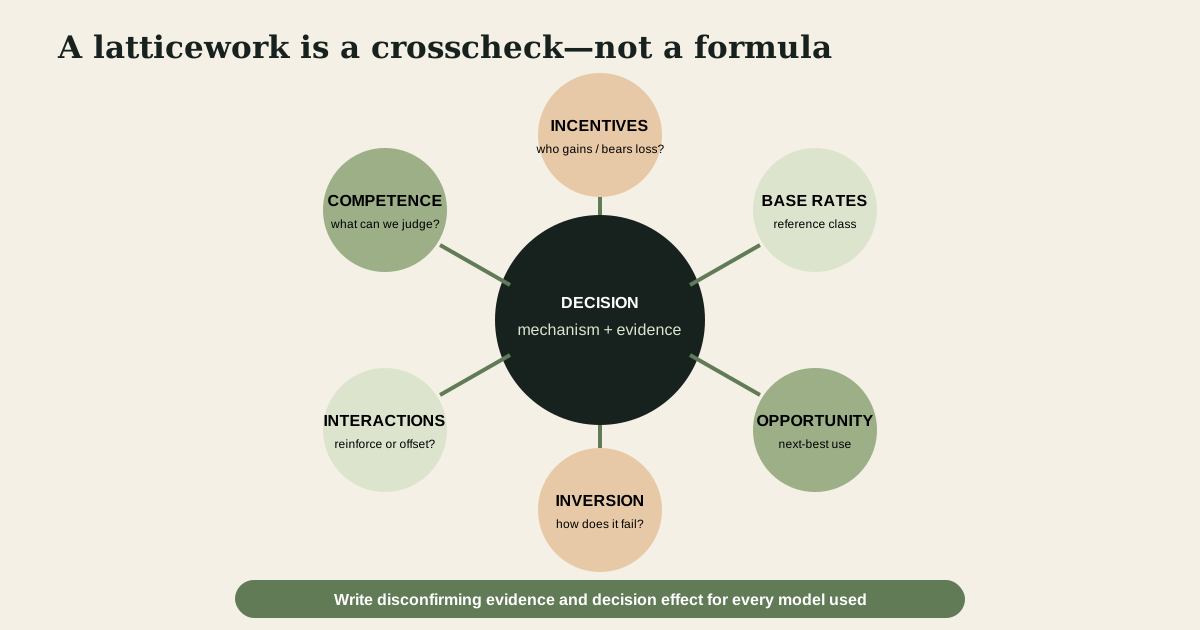
A latticework connects mechanisms rather than collecting labels
In his 1994 USC business-school talk, Munger argued that isolated facts are less useful unless they hang together on a framework of models. The practical unit is a causal explanation. An airline can be examined through fixed costs, capacity, competitive response, labor relations, regulation and customer switching. Naming “economics” and “psychology” does not complete the work. The analyst must show how each mechanism changes cash flow, risk or behavior and where the mechanisms interact.
A model deserves weight when it fits evidence and the decision boundary. Natural selection is not a metaphor that proves every market outcome efficient. Physics does not determine customer demand. Psychology can suggest incentive or bias questions without diagnosing an executive from afar. The latticework protects against one-discipline overconfidence by requiring several independent views. It becomes decorative when the analyst adds labels after reaching a preferred conclusion.
Incentives and base rates challenge the inside story
Munger’s 1995 psychology speech placed strong emphasis on incentives and the ways multiple tendencies can combine. Incentive analysis begins with contracts, promotion, status, measurement and downside. A salesperson paid on bookings may favor deals with weak collection; a manager rewarded for launch date may defer reliability work. The point is not that everyone acts cynically. It is that systems repeatedly shape attention and reporting, so a forecast should identify who benefits if its assumptions are accepted.
Base rates ask what happened in a relevant comparison class before accepting the vivid case narrative. A new restaurant concept may have enthusiastic customers and still face the economics of restaurants in similar locations and price bands. Selecting the reference class requires judgment; too broad a class hides differentiation, while too narrow a class becomes the case itself. The analyst should show more than one plausible class and explain why the chosen rate applies.
Interaction is where a latticework adds value. High fixed costs and price competition can jointly make an industry fragile; incentive compensation and hard-to-audit estimates can jointly inflate reported performance. Munger used the term lollapalooza effect for outcomes driven by several tendencies acting in the same direction. Analysts should not invoke that label merely because many things happened. They should show whether mechanisms reinforce, offset or depend on one another and avoid counting the same cause several times.
Worked example one: crosscheck a recurring-revenue acquisition
An illustrative buyer considers a software company reporting 95 percent annual revenue retention and rapid growth. Incentive analysis finds that seller compensation depends on closing before a large renewal cohort. Base-rate review shows similar products often lose customers after a platform policy change. Opportunity cost compares the purchase with improving the buyer’s own product. Technical review finds that one contractor controls deployment. Customer interviews confirm value but reveal dependence on a single integration.
No model alone decides. Combined, they change the diligence plan: verify cohort definitions, wait for the renewal, inspect platform terms, secure code access and compare the internal-build alternative. The deal may still be attractive at a revised price. The latticework has not produced a valuation formula; it has exposed correlated risks that the growth narrative omitted. If the buyer cannot evaluate the code or platform dependency, the circle of competence indicates a need for expertise or a pass, not a guess disguised as conviction.
Inversion finds failure paths; opportunity cost ranks alternatives
Inversion changes “How will this succeed?” into “What would make this fail?” For a factory expansion, answers may include yield shortfall, unqualified suppliers, permitting delay, customer concentration and financing stress. Teams can assign indicators and mitigations. Inversion is not pessimism and does not establish probability by itself. A long failure list can paralyze action unless risks are ranked by likelihood, impact, detectability and control.
Opportunity cost prevents a safe-looking option from winning merely because it has positive returns. Capital, management attention and reputation are scarce. A project expected to create $10 million may be inferior to a feasible $15 million alternative with similar risk, or superior to holding idle resources if no such alternative exists. Berkshire letters repeatedly discuss capital allocation and business quality in context. The relevant comparison is not a slogan such as “wonderful company”; it is the price, future economics and next-best use of resources.
Base rates and inversion can conflict constructively. A base rate may say most projects of a class miss schedule, while inversion identifies controls that could make this project different. The team should estimate how much those controls plausibly change the reference-class outcome rather than abandon the base rate. Opportunity cost then asks whether the improved case is still best. The sequence keeps outside evidence, case-specific mitigation and alternatives in one decision rather than allowing any single model to dominate.
Worked example two: invert a product launch inside the circle
A medical-device supplier considers launching scheduling software. Its team understands hospital procurement but lacks experience operating cloud services. The circle-of-competence review separates known customer workflow from unknown security operations. Inversion identifies breach, downtime, failed integration and unclear clinical responsibility. Base rates from adjacent enterprise software suggest implementations take longer than sales forecasts. Incentives show the product leader’s bonus depends on signed contracts rather than successful go-live.
The company responds with a limited pilot, an experienced operations partner, milestone compensation and a decision gate after two integrations. It does not infer that adjacent customer knowledge automatically creates software competence. If evidence later shows reliable deployment and repeatable support, the circle can expand. If not, the company may license the capability. This worked example shows why competence is dynamic but evidence-based. It should not become an excuse to avoid learning or a claim that management understands any business it admires.
The method needs a written crosscheck and disconfirming evidence
A circle of competence also has organizational dimensions. A board may understand consumer distribution but not credit underwriting; a company may know semiconductor design but not operate a fab. Hiring an expert can extend evaluative capacity only if governance lets that expert challenge the thesis and if other leaders can understand the decision boundary. Outsourcing analysis without the ability to judge assumptions transfers work, not accountability. The written crosscheck should identify who supplies competence and how their evidence is tested.
A practical template has six columns: mechanism, evidence, implication, interaction, disconfirming evidence and decision effect. Include incentives, base rate, opportunity cost, failure inversion and competence boundary when relevant; add industry-specific models rather than force a canonical list. State which factors are independent and which repeat the same underlying risk. Five labels that all describe customer concentration are not five confirmations.
Munger’s value lies in resisting monoculture and motivated reasoning, not in supplying authority for a stock pick. Quotations should be checked against speeches or Berkshire records and kept in context. Outcomes should be reviewed against the reasoning available at the time. A good decision can lose and a weak process can win. The latticework is most useful when it makes the analyst easier to correct: assumptions become visible, missing competence is named, and another model can overturn the first conclusion.
- Connect models through causal evidence instead of collecting memorable labels.
- Inspect incentives and relevant base rates before accepting the inside narrative.
- Use inversion to identify failure paths and opportunity cost to rank feasible alternatives.
- Define the circle of competence by evaluative ability, not familiarity or admiration.
- Record disconfirming evidence and interactions so the latticework remains correctable.
Sources
Keep exploring
- From Graphics Recovery to a Computing Platform: NVIDIA’s RIVA and CUDA Decisions →
How NVIDIA’s RIVA 128 and CUDA addressed different strategic problems, why complements and developers mattered, and what survivorship bias obscures.
- Customer Neutrality, Yield and Scale: How TSMC’s Foundry Model Works →
How the pure-play foundry model aligned customer trust with manufacturing learning, and why capital, tools, yield and utilization made it difficult.
- The Sunk-Cost Test: When Completion Is Rational and When Exit Creates Value →
How to separate irrecoverable spending from recoverable value, calculate forward NPV, recognize escalation incentives, and design exit rules.