Geopolitics, Macro-History & Global Affairs
Sovereign Wealth Funds in Technology: Patient Capital With Public Responsibilities
A sovereign wealth fund is not simply a venture-capital firm with a government owner. Public investment institutions have different mandates, funding sources, withdrawal rules and responsibilities. Some help stabilize budgets when commodity revenues fluctuate. Others save wealth for future generations or pursue specified development objectives. Those differences affect how much illiquidity, concentration and uncertainty a fund can tolerate. Technology investments should be understood within that mandate before being judged by the fame of a founder or the size of an announced deal. The central question is whether the investment, governance and risk fit the public purpose entrusted to the institution.
By Farvenzo Explained · Published · 6 min read
The mandate comes before the asset
A stabilization fund may need to provide cash during a fiscal shock. A long-horizon savings fund may accept more short-term market volatility because withdrawals are limited. A development-oriented institution may evaluate domestic economic effects alongside financial returns, subject to its actual legal mandate. Pension reserve arrangements can introduce another set of future obligations. These categories are useful distinctions, not guarantees about how any named fund operates. Read the institution's governing documents, investment policy and reporting rather than infer its objective from the phrase sovereign wealth fund.
A long horizon does not make risk disappear. A fund can survive a temporary price decline yet still lose capital permanently through fraud, excessive valuation, weak governance or a business model that fails. It may also face withdrawals or political pressure at an inconvenient time. Liquidity planning connects asset choice to those obligations. Public reporting should explain what resources are available, what commitments remain unfunded and which risks could occur together. The relevant comparison is with the fund's mandate and portfolio, not a generalized belief that patient capital always wins.
Technology creates overlapping exposures
A technology portfolio may include listed shares, private companies, venture funds, infrastructure, credit and co-investments. Labels can hide common economic dependencies. Several different funds may own companies that depend on the same cloud provider, advertising market or financing conditions. An investment in a semiconductor business and one in a data-center operator can share exposure to the same spending cycle. Portfolio analysis should therefore look through legal vehicles to the underlying drivers. Counting the number of managers is not enough to establish diversification.
Private investments add valuation and liquidity challenges. A reported valuation may come from a recent financing round with special terms that do not apply to every shareholder. An ownership stake can be diluted by later fundraising. Exit opportunities depend on buyers, public markets and contractual restrictions. A fund should understand preferences, governance rights, transfer limits and future capital needs. The economics of a headline transaction cannot be reconstructed from the announced valuation alone. Nor does a large investment prove that the public investor controls the company or directs its operations.
Worked example: test liquidity under stress
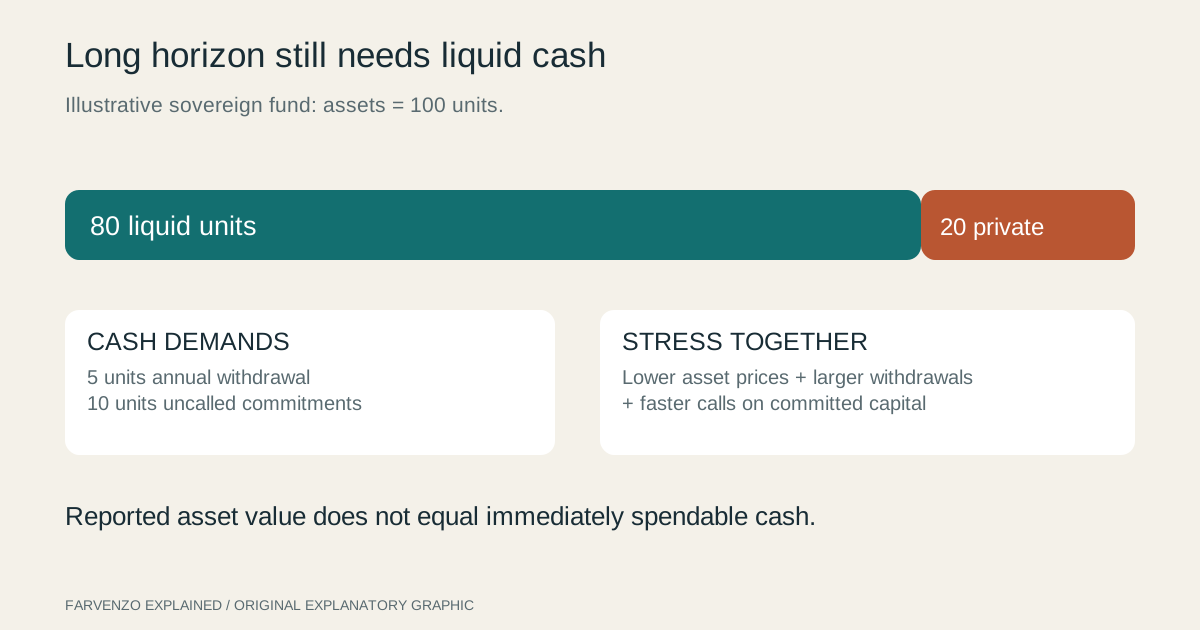
Imagine an illustrative public savings fund with assets of 100 units. It holds 20 units in private investments and has committed another 10 units that managers may call over several years. The government expects a withdrawal of five units annually under its normal budget plan. A stress scenario combines lower market prices, higher public withdrawals and accelerated capital calls. The fund's reported asset value may remain large, yet it must still find liquid assets to meet cash obligations without selling at unfavorable prices. Uncalled commitments belong in that analysis even though they are not all current balance-sheet assets.
The investment committee tests whether the remaining liquid portfolio can absorb those demands while preserving its policy limits. It examines currency needs, settlement timing and restrictions on asset sales. Possible responses include pacing new commitments, holding additional liquidity or renegotiating the allocation target through the proper governance process. The example does not imply that any named sovereign fund has this exposure. It illustrates why a long investment horizon should be translated into an explicit cash-flow policy, not used as a reason to ignore near-term obligations.
Governance rights are specific contracts
A minority investor may have information rights, a board seat, observer status or protections over particular corporate actions. These rights differ from day-to-day management control. Their practical value depends on the contract, ownership structure, other investors and applicable law. A board representative also has duties that may not simply duplicate the appointing investor's preferences. Analysts should distinguish ownership, voting power, board representation and operational authority. Treating them as interchangeable can lead to unsupported claims about a government's control over a business.
Conflicts require an equally specific approach. A fund might invest in a business that bids for domestic contracts or competes with another portfolio company. The appropriate safeguards can include disclosure, recusal, independent review and clear separation of investment and procurement decisions. Those safeguards should be evaluated through evidence. It is inaccurate to assume that every public investor acts only for geopolitical influence, just as it is inaccurate to assume public ownership creates no additional governance questions. A useful review identifies the actual incentive, decision right and control.
Worked example: evaluate a co-investment
Suppose an illustrative fund is offered a direct stake alongside an established venture manager. The opportunity avoids some management fees, but requires the fund to assess the company and negotiate rights. The proposed business projects rapid growth, with several future funding rounds likely before positive cash flow. The committee compares the co-investment with its existing exposure through the manager's fund. It asks whether this deal creates additional concentration, whether the manager has a conflict in allocating attractive opportunities and whether the public fund has the staff to monitor the holding.
The fund then examines a downside case in which revenue grows more slowly and new financing occurs at a lower valuation. It calculates dilution, additional funding requirements and potential recovery under the security's actual terms. An apparently low-fee investment can be expensive if it duplicates exposure or consumes scarce specialist capacity. The fund may invest at a smaller size, request different rights or decline. The decision should be documented against the mandate and portfolio. The presence of a prominent manager is evidence of participation, not a substitute for independent underwriting.
Accountability should reveal the decision framework
The Santiago Principles provide a voluntary framework addressing institutional arrangements, governance and investment practices for sovereign wealth funds. They are not a certification that every investment is successful or that every member institution operates identically. Their practical value lies in making objectives, responsibilities and risk management discussable. Public accountability can examine whether the institution has a clear mandate, an appropriate division of roles, credible reporting and a process for managing conflicts. Financial returns then need to be assessed over a period and against a benchmark suitable for that mandate.
Transparency also has boundaries. Publishing every prospective private investment or negotiating limit could harm commercial interests. Confidentiality, however, should not become a reason to hide the governing framework or aggregate risks. Institutions can report asset allocation, costs, risk measures and governance arrangements while protecting deal-sensitive information. The question is what the public needs to evaluate stewardship and what information would impair legitimate execution. Different legal systems resolve that balance differently, so comparisons should explain the reporting rules rather than assume that every missing detail proves misconduct.
Technology performance should be evaluated net of relevant costs and with appropriate treatment of unrealized valuations. Comparing a private portfolio's reported return with a listed index without considering timing, cash flows and risk can mislead. A development mandate may also require separate reporting of policy outcomes, with a method that avoids counting every job or supplier relationship as caused by the investment. Financial and public-purpose results can both matter, but blending them into an undefined success measure makes accountability weaker. State the objective, measurement and evidence for each claimed result.
For founders, public investors can offer capital, networks and a long relationship, but terms and expectations still matter. Understand decision timelines, disclosure obligations, governance rights, sanctions compliance and potential effects on other markets or investors. For citizens and analysts, the durable questions concern mandate fit, portfolio exposure, liquidity, governance and reporting. Sovereign capital can support technology development without being free money or a universal strategic threat. Evaluating the institution and transaction on their actual terms produces a more useful explanation than treating every public investment as the same kind of bet.
Sources
Keep exploring
- VO₂ Max and Health: A Valuable Measure, Not a Universal Verdict →
Understand measured and estimated VO₂ max, the limits of mortality associations and how fitness information can support sustainable, appropriate activity.
- GLP-1 Medicines and Business: Separating Evidence From Market Narratives →
Separate GLP-1 clinical evidence from market forecasts by examining medicine-specific outcomes, treatment access, persistence and payer budget assumptions.