Creator Economy & Digital Solopreneurship
Programmatic SEO With Editorial Standards
Programmatic SEO is a publishing method: structured records feed a template that produces pages for related user tasks. A directory of repair services, a library of product specifications or a public-data comparison tool can all use this approach. The useful question is whether each resulting page helps someone complete a real task. Changing a place name in otherwise identical prose does little for a reader. A maintained comparison with verified fields, clear limitations and useful filtering can do much more. The editorial challenge is to make scale preserve the connection between evidence and the person using the page, while accepting that some records should never become public pages.
By Farvenzo Explained · Published · 6 min read
Start with a task and a defensible dataset
Define the decision the visitor needs to make before choosing keywords or page counts. Someone comparing train stations needs accessibility, connections and operating information; someone researching equipment needs compatible specifications and a clear basis for comparison. Those are different tasks with different freshness requirements. A keyword list can suggest demand, but it cannot establish that the publisher has the information or rights needed to answer it. Interviewing users, inspecting search intent and testing a small prototype can reveal whether the planned pages resolve a problem or merely repeat information already available elsewhere.
The dataset needs a provenance model. For each important field, record the source, collection date, definition, permitted use and owner responsible for updates. A blank value should remain distinguishable from zero, unavailable and not applicable. Combining sources can introduce mismatched units, geographic boundaries or reporting periods. The template must expose relevant differences instead of silently blending them. Original analysis, verified local reporting or a genuinely useful tool can add value, but attaching a decorative paragraph to copied records does not create a reliable editorial product. The evidence should survive inspection at the individual page level.
Worked example: a useful comparison library
Consider an illustrative publisher comparing 120 public libraries across a region. It has authorized access to official branch records and manually verifies accessibility and opening-hour fields. Its first prototype covers ten branches, with a map, transport information, source dates and links to the operators. A visitor can compare services and understand what to confirm before travelling. The publisher discovers that holiday schedules change more often than building addresses. It separates those fields and establishes different review intervals. That is a publishing system shaped by the reader's task, rather than a single generic refresh date applied to every fact.
Suppose each initial review takes 25 minutes. Reviewing 120 branches requires 3,000 minutes, or 50 hours, before corrections and follow-up. If ongoing checks average five minutes per branch each month, that adds ten hours monthly. These are planning assumptions, not industry benchmarks. They reveal the maintenance burden hidden behind an inexpensive page-generation process. If the publisher can support only 40 branches, a smaller reliable directory may serve users better than an incomplete regional claim. The business case should budget for verification, support and changes, with a clear way for readers to report errors.
Templates need editorial behavior
A template should make missing evidence visible and prevent unsupported claims. If a service has no verified accessibility information, the page should say so rather than infer accessibility from a photograph. Comparison tables should use consistent units and explain exceptional cases. Titles and descriptions should describe the actual record without manufacturing superlatives. A page about a single location should not imply that an editor has visited it unless that happened. Byline, source and update information need to represent real editorial work. Automation can distribute a misleading statement across thousands of pages just as efficiently as it distributes a correct one.
Build validation before publication: required fields, valid links, reasonable ranges and relationships between fields. Then add manual review across ordinary records, sparse records and awkward edge cases. A record with a missing address or contradictory opening hours should enter a review queue. Sampling alone cannot catch every problem, so combine it with systematic checks and a correction route. The release should have an owner who can pause publication when the data changes unexpectedly. Editorial controls become more valuable as volume rises because a shared template defect can affect the entire collection at once.
Worked example: decide which pages deserve to exist
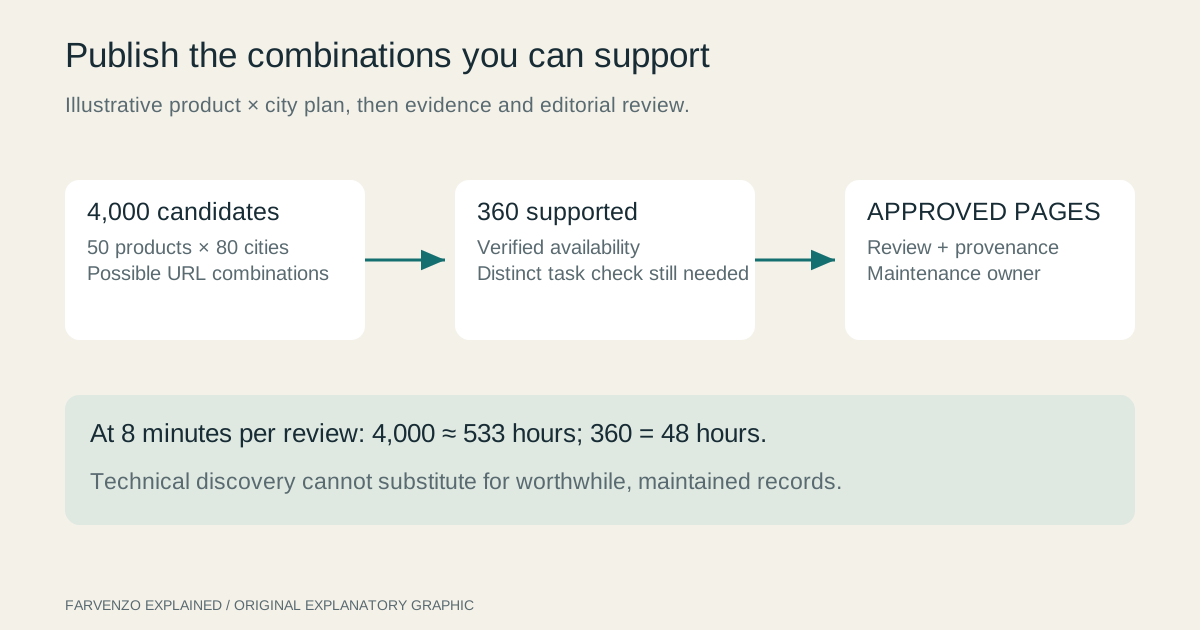
Imagine a business considering pages for 50 products in 80 cities, producing 4,000 combinations. It actually serves only 12 cities, and product availability varies within those locations. Publishing every combination would create pages that imply an offering the business cannot deliver. The team instead joins verified service areas with current product availability. Suppose that leaves 360 supported combinations. It then tests whether each combination answers a distinct question; some can be handled more clearly with a filter on a broader page. A possible URL is not automatically a useful destination.
Assume manual review takes eight minutes per candidate. Reviewing all 4,000 would require roughly 533 hours, while reviewing 360 would take 48 hours. Neither figure includes research, fixes or future checks. The smaller set is not justified solely by its lower cost; it has a better factual basis. If the data supports only a broader city page, publish that page and make its scope clear. Keep unsupported combinations out of public discovery. When coverage expands, create new pages from verified offerings rather than reserving thousands of thin pages in anticipation of search traffic.
Discovery and quality are separate responsibilities
Technical delivery should make the chosen public pages accessible, internally linked and consistent. Check that a page returns the intended status, renders its substantive content and uses a stable public URL. Duplicate representations need an intentional handling strategy. A comparison filter may be useful to visitors without needing every possible filter combination to appear in search. Canonical links should correspond to the page's content and the site's URL policy. Treat technical signals as part of a coherent publishing system; they do not repair weak evidence, misleading descriptions or records that lack a useful purpose.
A sitemap is an inventory for discovery, so populate it from the same approved registry that controls public pages. Structured data should describe what the visitor can actually see and what the page represents. Validate required properties and inspect representative outputs. Avoid claiming reviews, ratings, expertise or publication dates that the underlying editorial process did not produce. Search features have eligibility rules and may change. Passing a validator establishes only part of technical correctness. It cannot promise that a search engine will index a page, display a special result or send a particular amount of traffic.
Operate the collection as a maintained product
After release, measure whether people complete the intended task. Search impressions and visits are useful, but also inspect comparison use, error reports, abandoned searches and requests for missing information. A page with low traffic may serve a narrow but important audience; a high-traffic page may still mislead people. Segment results by template and data quality so aggregate growth does not conceal a failing subset. When a field becomes unreliable, suspend the affected claim or page while investigating. A quiet correction can protect readers more effectively than continuing publication to preserve a page count.
Set an update policy that distinguishes substantive revisions from routine checks. Preserve original publication dates and record meaningful changes honestly. Keep redirects, removal responses and internal links consistent when records are retired or merged. Assign maintenance responsibilities before an employee or data supplier leaves. If operating costs exceed the value delivered, reduce the collection to what can be supported. A programmatic project needs a lifecycle from ingestion through correction and retirement. Without that lifecycle, the same scale that made launch easy can turn a useful resource into a large archive of uncertain claims.
Google's spam guidance addresses manipulative scaled publishing, including pages produced in volume without meaningful user value. The production tool alone does not settle editorial quality. A practical standard is to review a page as if it were the only one a reader encountered: does it answer the promised question, show a defensible basis and make uncertainty understandable? This article's examples and review-hour calculations are original planning scenarios. The linked official documentation supports the technical and policy boundaries. Successful programmatic publishing begins with worthwhile records and continues with the work required to keep them trustworthy.
Sources
Keep exploring
- ASML and EUV: Why Advanced Lithography Is a Supply-Chain System →
EUV lithography depends on optics, materials, service and qualification. Learn why accepted wafer output matters more than a machine’s peak speed.
- Dollar Dominance and Payment Alternatives: Reading the Data Carefully →
Separate reserve shares, invoicing, settlement and currency trading to assess dollar dominance, alternative payment rails and business currency exposure.