Artificial Intelligence & Emerging Tech
Humanoid, AGV or Robot Arm? A Factory Economics Test Built Around Good Units
A humanoid robot can be compelling because factories, tools and workstations were built around the human body. Two arms, dexterous hands and legs may let one platform approach several tasks without rebuilding the facility. That possibility does not establish superior economics. A wheeled automated guided vehicle may move material more reliably; a fixed industrial arm may repeat a precise motion faster; a modest fixture may eliminate the task entirely. Factory evaluation should begin with good units produced safely during scheduled time. The financial denominator is productive hours after charging, faults, changeovers, supervision and blocked work—not hours on the lease or a polished demonstration. Boston Dynamics’ electric Atlas materials show the direction of development, while OSHA’s robotics guidance underscores that integration and human exposure remain central control issues.
By Farvenzo Explained · Published · 7 min read
The bill of materials explains capability and maintenance burden
A humanoid platform combines structural links, electric actuators, transmissions, joint encoders, force or torque sensing, cameras, inertial measurement, onboard compute, communications, batteries, power electronics, thermal management, hands or grippers and safety systems. The charging station, end effectors, spare parts and integration software belong to the deployed system even when they are outside the robot shell. These categories are more useful than invented percentage shares. Supplier contracts, production scale and design choices change cost, and commercial manufacturers seldom publish an audited component breakdown.
Each subsystem creates a reliability question. Hands encounter impacts and contamination. Batteries lose runtime under heavy loads. Cameras can be occluded. Joint heat may constrain duty cycles. Software must estimate the robot’s state and plan motion while respecting limits. A facility also needs wireless coverage, floor conditions, lighting and recovery procedures. A broad-purpose body may reduce the need for fixed infrastructure but increase the number of failure modes carried between tasks. Maintenance planning should therefore follow assemblies, expected cycles and replacement time rather than treating the machine as one indivisible asset.
Choose the form factor after defining the material flow
An AGV follows managed routes to transport loads; an autonomous mobile robot may navigate more flexibly. A fixed arm excels where the workpiece can be presented consistently inside a guarded or safety-rated cell. A humanoid may be attractive where doors, stairs, shelves, controls and tools cannot readily be redesigned, or where one machine can cover several low-volume tasks. The comparison is not robot versus worker in the abstract. It is a specific system against the best feasible alternative, including process redesign and simple mechanical aids.
Suppose totes must move 80 meters from storage to a line. If pickup and drop-off are standardized, a wheeled vehicle probably avoids the energy and balance complexity of walking. If the job also requires opening varied cabinets, selecting parts and operating existing handles, a humanoid could reduce infrastructure changes—but only if manipulation is reliable. For machine tending with a stable cycle and fixed pose, an arm may dominate. A useful request for proposal describes payload, reach, cycle, surfaces, human traffic, environmental limits and acceptable intervention rate before naming a preferred body shape.
Worked example one: compare good units, not nominal shifts
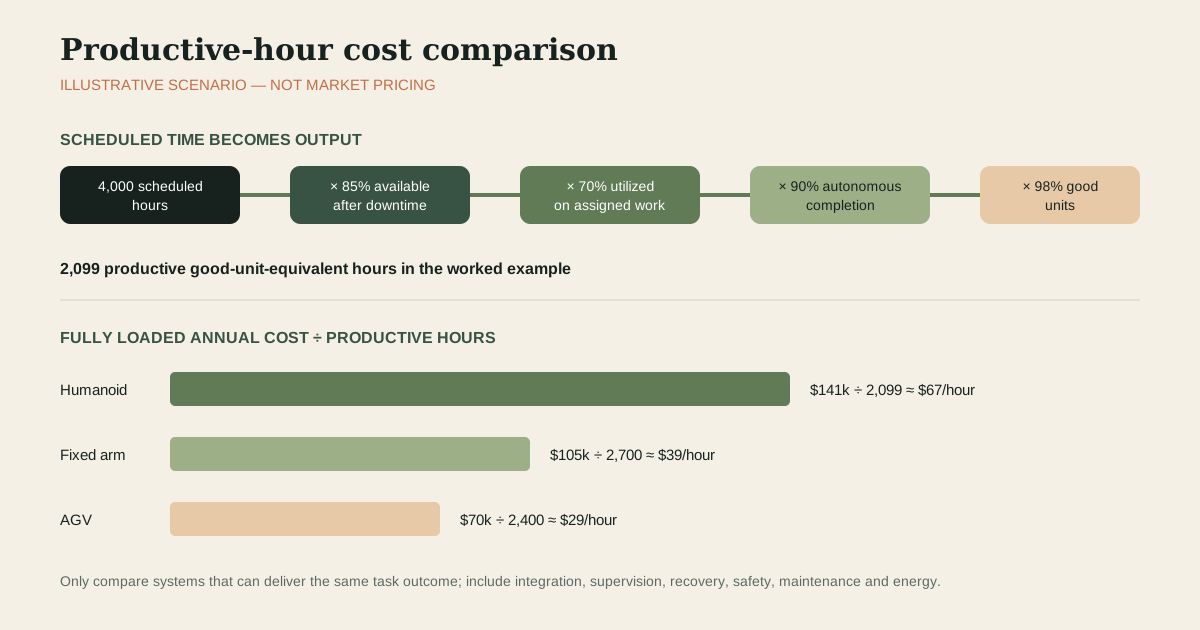
Consider an illustrative packaging station scheduled for two eight-hour shifts, 250 days a year: 4,000 scheduled hours. A humanoid is available 85 percent of that time after charging, maintenance and faults. It is assigned productive work during 70 percent of available time because upstream material and trained supervision are not always ready. During assigned time it completes 90 percent of cycles without human recovery, and 98 percent of completed units pass quality inspection. Multiplying those factors yields about 2,099 productive good-unit-equivalent hours: 4,000 × 0.85 × 0.70 × 0.90 × 0.98.
The multiplication is deliberately unforgiving. Quoting 4,000 operating hours would ignore the time that creates no accepted output. An AGV or arm should be evaluated with the same structure, but the factors will differ. A fixed arm might have high availability and first-pass yield yet low utilization if the product mix rarely uses its cell. A humanoid could have lower cycle reliability but higher utilization across several stations. The plant should also count the actual good units and bottleneck effect; one hour saved at a non-bottleneck may not increase factory output at all.
Supervision and recovery are production inputs
Procurement acceptance should use production-like trials rather than a vendor’s prepared route. Select representative parts, floor conditions and shifts; freeze the success criteria before the trial; and require the integrator to disclose teleoperation and resets. Track mean time between interventions and mean time to recover, but retain the distribution because one two-hour recovery can matter more than many quick resets. Acceptance can be staged: safe basic motion, stable task completion, sustained-rate operation, and finally operation with normal nearby work. Payment milestones can follow those demonstrated capabilities.
Remote assistance is sometimes described as an exception service, but its labor must be measured. Record interventions per hour, median and tail recovery time, skills required, number of robots one supervisor can safely cover, and whether production stops while help arrives. A robot that requests guidance every twenty minutes may still be useful for hazardous work, yet it is not autonomous in the economic sense. If one specialist watches four robots, allocate that labor across the fleet and include coverage for breaks, nights and absences.
Recovery design affects both uptime and safety. Workers need a clear way to stop the machine, establish a safe state, release stored energy and resume without creating an unexpected movement. Maintenance staff need diagnostic access and training. A factory should capture near misses and nuisance stops, not disable protective features to improve the dashboard. OSHA does not provide one universal humanoid standard; employers must evaluate relevant hazards and applicable requirements. Risk assessment should cover crushing, impact, trapping, dropped loads, battery incidents, cybersecurity and changes in the shared workspace.
Safety depends on the application, layout and human contact
A robot’s published speed or force limit is not a complete safety case. The same machine creates different hazards carrying an empty tote, a sharp tool or a heavy part. Floor friction, blind corners and worker expectations matter. Controls can include physical separation, safety-rated monitored stops, speed and separation monitoring, limited power and force, protective equipment and administrative procedures. Validation should test foreseeable misuse and component failure, not just the intended cycle. Changes to software, payload or end effector may require the risk assessment to be revisited.
Human factors deserve equal attention. Workers should know which motions signal intent, where the robot senses them, and how to report a confusing behavior. Production incentives must not punish an operator for stopping unsafe work. Video used for robot perception may capture employees and create privacy or labor-relations questions. A pilot should involve operators, maintenance, safety, cybersecurity and quality from task selection onward. A system that achieves speed by shifting vigilance onto nearby workers has externalized cost rather than automated the process.
Worked example two: productive-hour cost with downtime included
Take an illustrative humanoid deployment costing $180,000 for the robot, $45,000 for integration and tooling, and $30,000 in initial safety and training work. Spread that $255,000 over five years without assuming resale value: $51,000 annually. Add $18,000 maintenance and spares, $6,000 energy and connectivity, $24,000 software and support, and $42,000 allocated supervision and recovery labor. Annual cost is $141,000. Using the 2,099 productive good-unit-equivalent hours from the first example produces about $67 per productive hour. That is not a universal humanoid wage; it is one scenario.
Now compare an illustrative fixed arm system at $105,000 annual cost and 2,700 productive hours, or about $39 per productive hour, and an AGV system at $70,000 and 2,400 productive hours, or about $29. Neither alternative may perform the same task. If the humanoid replaces three separate low-utilization cells or works where redesign is impossible, its broader coverage could justify the premium. If it merely transports standardized totes, it probably does not. Sensitivity analysis should vary availability, intervention labor, service life and utilization; optimistic assumptions in those four cells can manufacture a cheap hourly number.
- Describe the task, environment, payload, cycle and hazard before selecting a robot form.
- Track availability, utilization, autonomous completion and first-pass quality as separate factors.
- Allocate remote assistance, maintenance, charging, recovery and safety work to the system cost.
- Compare the humanoid with an AGV, fixed arm and process redesign that deliver the same outcome.
- Report cost per productive good unit or productive hour and label every scenario assumption.
Sources
Keep exploring
- From Invoice Matching to Payments: A Control Map for Finance Agents →
A control-first guide to finance agents, including three-way matching, evidence, permission tiers, prompt injection, exceptions, and illustrative ROI.
- Small Models, Specific Jobs: An Enterprise Architecture Beyond Parameter Counts →
How to test and deploy small language models with retrieval, selective fine-tuning, held-out evaluation, escalation routes, and realistic TCO.
- No Q-Day Countdown: A Banking Migration Plan for Post-Quantum Cryptography →
A practical post-quantum migration guide covering cryptographic roles, NIST standards, long-lived data, inventories, vendors, and interoperability.