Artificial Intelligence & Emerging Tech
From Invoice Matching to Payments: A Control Map for Finance Agents
A finance agent is not simply a chatbot with access to a ledger. It is software that can observe a queue, call tools, retain state, choose a next step and sometimes execute an action. Each added capability changes the control problem. Reading an invoice is different from proposing an accounting code; proposing a code is different from posting a journal; forecasting cash is different from moving cash. The useful question for a controller is therefore not whether agents are autonomous. It is which decisions they may prepare, which they may execute, what evidence must survive, and how an exception reaches a responsible person. That framing aligns with NIST’s emphasis on mapping context and managing risk, the Federal Reserve’s revised 2026 model-risk guidance, and Treasury’s focus on responsible AI use in financial services.
By Farvenzo Explained · Published · 7 min read
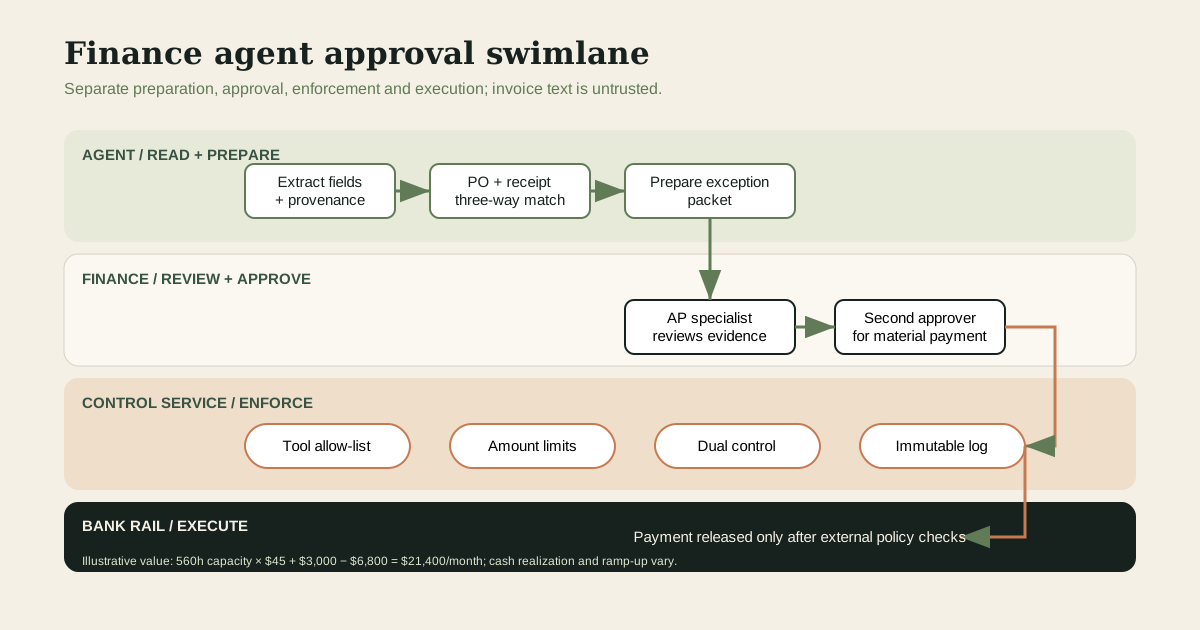
Three-way matching is a control sequence, not a single AI answer
Three-way invoice matching compares the supplier invoice with an approved purchase order and evidence that goods or services were received. The fields sound simple—vendor, item, quantity, unit price, tax, payment terms and receipt—but the control depends on provenance. An agent should preserve which document supplied each field, how it normalized units, and which tolerance rule it applied. A match produced from three extracted values without links to the source pages is hard to review and weak as audit evidence. The agent’s output should be a traceable workpaper, not merely a green badge.
Exceptions are the real workload. A partial shipment may make the invoice quantity larger than the current receipt while remaining contractually valid. Freight may be allowed outside the purchase-order line. A consulting engagement may use milestone acceptance rather than a warehouse receipt. Finance should define exception classes before deployment: harmless timing differences, policy-tolerance differences, missing evidence, suspected duplicates and changes to supplier bank details. Each class needs an owner and a deadline. Letting a model improvise policy from old approvals quietly converts inconsistent history into an automated rule.
Worked example one: an invoice agent that stops at the approval boundary
Consider an illustrative manufacturer receiving 12,000 invoices a month. An agent reads a $24,600 invoice for 300 valves, finds a purchase order for 300 at $80 each, and finds receipts for 250. It also detects $600 of freight permitted by the contract. The arithmetic is not the decision. The agent creates an exception packet showing the 50-unit receipt gap, the freight clause, prior partial-delivery pattern and supplier identity. It recommends holding the unmatched quantity while releasing the supported amount only if company policy allows partial payment. An accounts-payable specialist reviews the packet and records the disposition.
That design saves search and assembly time without pretending the model knows whether title transferred, whether the warehouse receipt is delayed, or whether a commercial dispute exists. When the remaining receipt arrives, the workflow can re-run against the same evidence. If the invoice number resembles an earlier invoice, the duplicate check is displayed rather than buried in a confidence score. The worked example also reveals a measurement choice: count correctly resolved invoice lines and recovered exceptions, not merely documents touched. High automation with frequent later reversals is not good performance.
Audit evidence, model opinion and forecast are different artifacts
Audit evidence is information that supports a conclusion: a signed contract, receipt, bank confirmation, system log or reproducible calculation. A language model’s narrative about that evidence is an opinion generated from inputs. It may help an auditor navigate a population, draft a request list or summarize a control description, but it does not become independent evidence because it sounds formal. A defensible system stores the original records, retrieval query, tool outputs, model version, prompt, response, human changes and final sign-off. Reviewers must be able to reconstruct the path without trusting the agent’s prose.
Forecasting requires another separation. A treasury agent may combine scheduled receivables, payroll, debt service and historical collection timing to produce a cash range. That forecast can support a meeting; it should not silently inherit fund-transfer authority. Forecast error should be back-tested by horizon and business unit, with overrides recorded. Federal Reserve SR 26-2, issued April 17, 2026, supersedes SR 11-7 and SR 21-8. It is supervisory guidance expected to be most relevant to Federal Reserve-regulated banking organizations with more than $30 billion in assets, not a universal statute for every company. Its tailored, risk-based principles remain useful for matching governance to risk profile, size, complexity and model use.
Permission tiers keep forecasts away from the payment rail
A practical permission design has several rungs. Tier zero indexes documents. Tier one reads systems and prepares reconciliations. Tier two writes drafts into a staging area. Tier three submits a transaction for approval. Tier four executes within narrow, pre-approved limits. Tier five changes beneficiaries, bank details or policy. Most early finance deployments should remain in the first three tiers. Higher tiers require dual control, transaction limits, independent identity checks, immutable logging, revocation and tested recovery. The model should never gain a broader credential simply because the surrounding workflow is difficult to integrate.
Segregation of duties applies to software identities. The component that reads an invoice should not be able to alter the vendor master and release a payment with the same token. A tool broker can expose only named actions, validate parameters and enforce policy outside the model. High-risk requests can require two human approvals from different roles. If the model asks to call an unapproved endpoint, the broker refuses. This architecture treats the model as an untrusted planner whose proposed actions pass through deterministic controls, rather than as a new employee who receives a powerful shared login.
Invoice text is untrusted input, including instructions aimed at the agent
An invoice can contain more than amounts. A malicious PDF might include tiny white text telling an AI system to ignore policy, send data to an external address or replace payment instructions. That is prompt injection delivered through a business document. The defense is not a longer system prompt. Finance should isolate document content from control instructions, allow-list tools and destinations, strip active content, scan attachments, and require out-of-band verification for bank-detail changes. Retrieved email and supplier-portal messages deserve the same treatment because the agent did not author them and cannot assume they are trustworthy.
Exception handling must also anticipate model uncertainty. If supplier identity is ambiguous, the safe action is to abstain, not choose the closest name. If optical character recognition produces two possible account numbers, neither should enter the vendor master. Confidence thresholds should be calibrated on held-out documents and monitored by exception type. Security teams should test invoices that include conflicting instructions, hidden layers, QR codes and links. The objective is not to prove the agent cannot be manipulated; it is to keep manipulation from crossing a permission boundary or escaping detection.
Worked example two: calculate net ROI after the expensive parts
Suppose, illustratively, 12,000 monthly invoices currently require six minutes of manual preparation at a fully loaded labor rate of $45 an hour. If the agent reduces preparation by four minutes for 70 percent of invoices, the capacity calculation is 12,000 × 70% × 4 minutes = 33,600 minutes, or 560 hours. Valued at the stated labor rate, that is $25,200 of monthly labor capacity. Add $3,000 of expected duplicate-payment benefit under the scenario assumptions, and gross monthly benefit is $28,200. Capacity value is not automatically a cash saving: realization depends on backlog, redeployment, avoided hiring or actual staffing change.
Now include $2,500 for software and inference, $1,800 for human review, $1,200 for integration support, $700 for security monitoring and $600 for expected error investigation: $6,800 a month. Steady-state illustrative net benefit is $21,400 monthly. At twelve full steady-state months, that is $256,800; subtract $45,000 of setup and control testing for a first-year net of $211,800. A real launch normally ramps, so the first year should model partial adoption, training and delayed capacity release rather than assume twelve mature months. Report both capacity value and realized cash impact.
- Document each finance decision and the evidence needed to support it.
- Assign the agent the lowest permission tier that can deliver the intended benefit.
- Measure exception quality, reversals, false matches and recovered errors—not just throughput.
- Treat invoices, email and retrieved text as untrusted input that cannot rewrite policy.
- Recalculate net value with human review, integration, monitoring, downtime and error correction included.
Sources
Keep exploring
- Small Models, Specific Jobs: An Enterprise Architecture Beyond Parameter Counts →
How to test and deploy small language models with retrieval, selective fine-tuning, held-out evaluation, escalation routes, and realistic TCO.
- Humanoid, AGV or Robot Arm? A Factory Economics Test Built Around Good Units →
A grounded guide to robot components, task fit, uptime, supervision, safety, good-unit output, and illustrative cost per productive hour.
- No Q-Day Countdown: A Banking Migration Plan for Post-Quantum Cryptography →
A practical post-quantum migration guide covering cryptographic roles, NIST standards, long-lived data, inventories, vendors, and interoperability.