Productivity, Habits & High Performance
Route, Default, Check: A Practical System for Repeated Decisions
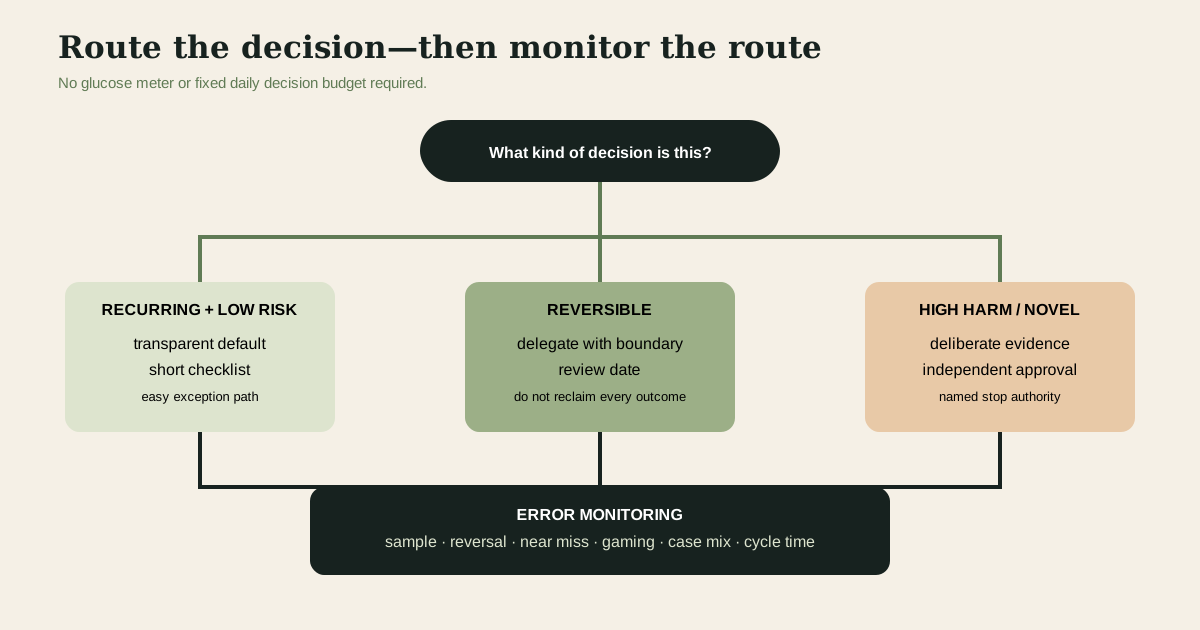
Decision fatigue is a useful everyday description for feeling worn down after repeated choices. It is not a single established mechanism with a fixed daily budget. Choice overload concerns how the number and structure of options can affect selection under some conditions. Ego-depletion research proposed that exerting self-control reduces performance on a later self-control task, but large replication efforts and methodological debate have challenged the size and reliability of the effect. A 2021 multi-lab test in Psychological Science is part of that contested record. None of this supports a simple glucose-resource law for willpower. Organizations do not need that law to improve decisions. They can reduce unnecessary choices, clarify defaults, separate reversible from irreversible calls, delegate with boundaries, use checklists for recurrent risk and monitor errors rather than infer quality from a leader’s subjective energy.
By Farvenzo Explained · Published · 6 min read
Subjective fatigue, option structure and self-control are different questions
Subjective fatigue is an experience: effort feels costly, attention wanders or motivation changes. It can reflect sleep, workload, stress, illness, boredom, conflict or time on task. Choice overload asks whether a choice set’s size or complexity makes selection harder; effects depend on preferences, expertise, presentation and whether options can be compared. Self-control studies examine another construct, often using sequential tasks. Treating all three as one depleted resource produces confident explanations without identifying what the work actually requires.
Diagnosis should begin with the process. Are decision-makers missing information, comparing incommensurable options, repeating low-value approvals, or working while sleep deprived? Is the queue ordered by arrival rather than consequence? Do incentives reward speed over correction? A leader who feels tired may need recovery, but the organization may chiefly need better decision rights. Conversely, a clean checklist will not correct chronic understaffing. Naming the mechanism keeps an appealing psychological label from obscuring ordinary operational causes.
Ego depletion remains contested, not a management law
Choice overload is also conditional. A large option set can be welcome when customers understand attributes and have strong preferences; a smaller set can still be confusing when tradeoffs are opaque. Category structure, recommendation quality, expertise and consequence all affect difficulty. In internal work, the remedy may be a comparison template or staged filter rather than fewer options. Do not remove legitimate alternatives merely to simplify a manager’s screen, especially when the excluded options represent minority needs or meaningful risk treatments.
The ego-depletion hypothesis inspired many experiments and practical claims, including the metaphor that self-control operates like a limited fuel. Replication projects have produced mixed and often smaller effects, and researchers continue to debate tasks, theory and publication bias. The specified 2021 registered multi-lab study tested the sequential-task paradigm and should be read as evidence in an active scientific dispute, not as the last word. Management articles that cite an early result without later replication evidence overstate certainty.
The glucose story is especially easy to misuse. The brain uses glucose, but that fact does not establish that ordinary acts of choice drain a discrete glucose reserve that a sugary drink restores. Feeding employees sugar is not a decision-governance system. Organizations should follow health guidance rather than derive nutrition rules from a contested psychological metaphor. The robust practical case for breaks, sleep, manageable workload and clear processes can stand on safety, attention and humane work design without claiming a biochemical meter for willpower.
Worked example one: route procurement decisions by stakes and reversibility
An illustrative company sends every software renewal above $1,000 to its operations director. The queue contains 90 monthly decisions, from familiar low-risk tools to a new system that will store customer records. The director spends roughly ten hours reviewing items, often repeating the same checks. The redesign creates three routes. Approved-vendor renewals within budget and with no material term change renew by default after owner confirmation. New low-risk tools receive a standard review. Systems with sensitive data, long lock-in or high switching cost go to a cross-functional decision.
The default does not eliminate accountability. Owners receive notice, cost change and a cancellation window; finance samples renewals for duplicate licenses; security can revoke approved status. The director now sees exceptions and consequential commitments rather than every transaction. The company measures unauthorized spend, later cancellation, security findings, review time and exceptions reversed. If error rises, thresholds tighten. The improvement comes from routing and monitoring, not from assuming the director had only a certain number of decisions available before depletion.
Defaults and checklists should expose exceptions, not conceal them
A default is the outcome that occurs without an active alternative. Defaults reduce repeated selection and can standardize a safe common case, but they also influence behavior and may persist through inattention. A legitimate default is transparent, easy to change and aligned with the person’s role or stated objective. High-impact defaults need review and notice. Automatically enrolling a system in backup may be protective; automatically renewing an unwanted paid service through obscured cancellation is manipulative. Context and control determine the ethics.
Checklists are best for recurrent, observable failure points: identity confirmed, contraindication reviewed, rollback tested, approval recorded. They should be short enough to use and connected to a stop authority. A checkbox can become ceremonial when staff lack time or evidence. Monitor completion quality and near misses, and revise items after incidents. Expert judgment remains necessary for novel cases. The checklist protects the floor; it does not define the ceiling of good reasoning or guarantee a correct outcome.
Worked example two: redesign an editorial risk review
A newsroom editor reviews every article in publication order, mixing routine copy edits with legal and medical risk. Late in the shift, a sourced but sensitive investigation receives less time than several low-risk explainers. The team creates intake labels based on verifiable features: allegation about an identifiable person, health instruction, confidential document, numerical claim, image rights and deadline. Routine articles use a standard source and rights checklist. High-risk flags trigger specialist review and cannot be waived by the commissioning editor alone.
The schedule reserves an early review window for irreversible publication decisions and leaves capacity for breaking news. A second editor samples routine work to estimate false negatives. The team tracks corrections, legal escalations, missed deadlines and unnecessary referrals. Suppose referrals initially double because writers flag uncertainty defensively. Training and examples improve routing over the next month. This is a process result, not proof that morning brains are universally better. The design moves consequential, hard-to-reverse choices toward stronger evidence and independent challenge.
Delegate decisions with boundaries and monitor the error system
Decision systems create their own errors. A default can perpetuate an outdated supplier, a checklist can anchor attention on listed hazards, and a delegation threshold can encourage people to split purchases. Monitoring should therefore search for gaming and blind spots, not only compliance. Periodically review cases just below thresholds, compare sampled defaults with active decisions and invite reports of exceptions the form could not express. Every control needs an owner and a review trigger so efficiency mechanisms do not become permanent after their assumptions expire.
Delegation requires a decision owner, scope, budget or risk limit, escalation condition and record. “Use your judgment” is not sufficient when the delegate cannot tell which exceptions matter. Reversible choices can be made quickly with a review date. Irreversible or high-harm choices deserve more evidence and independent approval. Leaders should avoid pulling delegated work back whenever they dislike an outcome; that teaches people to seek approval for everything. Review process quality and whether the decision stayed within agreed boundaries.
Error monitoring completes the design. Sample decisions, track reversals, near misses, complaints, cycle time and concentration by person or time. A spike late in the day may suggest fatigue, but it may also reflect harder cases arriving then. Examine case mix before asserting cause. Ask staff about workload and clarity without using subjective fatigue as proof of poor performance. The aim is a learning system that catches weak defaults, overloaded queues and unclear authority. Scientific uncertainty about ego depletion is not a reason to ignore fatigue; it is a reason to avoid simplistic causal claims.
- Distinguish felt fatigue, option complexity and self-control rather than treating them as one resource.
- Do not turn contested ego-depletion findings or glucose metaphors into workplace law.
- Route decisions by stakes, reversibility, sensitivity and novelty.
- Use transparent defaults and short checklists with exception and stop authority.
- Monitor reversals, near misses, case mix and cycle time so the process can correct itself.
Sources
Keep exploring
- Beyond the 23-Minute Myth: A Practical Audit of Context Switching →
How to distinguish cognitive switching mechanisms, measure local recovery costs, design resumption cues, and protect both focus and incident response.
- From Saved Links to Defensible Memos: An Evidence-Led Knowledge System →
How analysts can turn captured material into traceable claims, test retrieval, preserve contradictory evidence, and cross-check AI-generated summaries.
- Design Focus Around Capacity, Task and Evidence—not a Biological Timer →
Why sleep cycles do not establish a universal 90-minute work law, and how teams can test block length, breaks, quality, and interruption policies.