Productivity, Habits & High Performance
Beyond the 23-Minute Myth: A Practical Audit of Context Switching
Context switching is often summarized as a universal 23-minute productivity penalty. The underlying research supports a more useful and more careful account. Switching between task rules can impose measurable reconfiguration costs in controlled experiments. Leaving one unfinished task for another can create attention residue that impairs performance on the next task. Workplace interruptions can alter speed, stress and strategy, but their effects vary with timing, task, relevance and recovery support. Mark, Gudith and Klocke’s 2008 controlled experiment found that participants compensated for interruptions by completing work faster while reporting greater stress, frustration, time pressure and effort. It did not measure a universal 23-minute return time. A credible workplace audit separates the immediate switch, the unfinished goal, the external interruption, and the coordination benefit that sometimes justifies the disruption.
By Farvenzo Explained · Published · 7 min read
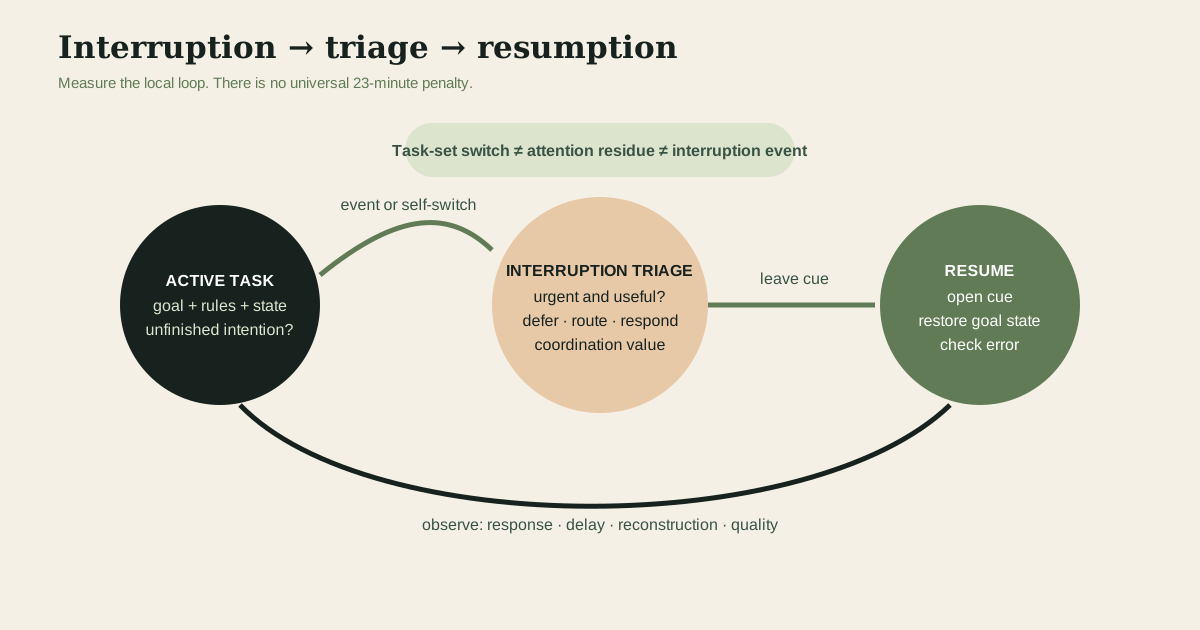
Three mechanisms are usually collapsed into one productivity claim
Task-set reconfiguration refers to preparing the rules needed for a different task. Rubinstein, Meyer and Evans showed that switching can add time, with costs shaped by task complexity and preparation. A person moving from checking a numerical reconciliation to writing a client explanation must activate different goals, representations and response rules. The laboratory finding does not translate directly into a fixed number of workplace minutes. It establishes that a switch can carry a local performance cost and that the cost is not identical for every pair of tasks.
Attention residue concerns what remains mentally active after leaving a task, especially when it is unfinished. Leroy found that transitioning from unfinished work can impair performance on the next task because attention has not fully disengaged. Interruption is an event: a message, colleague, alert or self-initiated check that breaks activity. One interruption may trigger both reconfiguration and residue, but it may also deliver information needed to avoid wasted work. A useful audit labels which mechanism is plausible instead of assigning every delay to a generic switching tax.
Resumption depends on finding the goal state again
When work resumes, a person must reconstruct where they were, what they intended to do next and which assumptions were active. The difficulty is greater when state is held only in working memory. Resumption cues externalize that state. Before a planned switch, an analyst can leave a short marker: “variance traced to freight accrual; next test is vendor mapping; workbook version 14.” A developer can keep the failing test, branch and next hypothesis visible. The cue need not be elaborate. Its purpose is to reduce the search for the previous goal.
Good tools preserve place without creating another documentation burden. Drafts should reopen at the last edited section; case systems should show pending evidence; dashboards should distinguish viewed from resolved. Teams can reserve two minutes at the end of a focus block to record next action and unresolved risk. For an unexpected interruption, a quick capture field can serve the same function. The organization should test whether cues shorten recovery or reduce errors locally. A ritual that consumes more time than it saves has become administrative theatre.
Worked example one: estimate an analyst’s local switching cost
An illustrative finance analyst reviews 24 complex contracts in a week. During twelve sampled reviews, an unrelated message arrives 18 times. The analyst records three intervals: time spent responding, time until contract work resumes, and time until the original review pace and error-check sequence are restored. Across this small sample, the median response is two minutes, resumption navigation is three minutes, and reconstruction is four minutes. The observed median burden is therefore nine minutes per interruption, not 23. The sample is too small and person-specific to claim an organizational constant.
At 18 interruptions, the illustrative week contains 162 minutes of measured disruption. Valuing time at a fully loaded $60 an hour gives $162, but that is not yet a business loss. Some messages prevent duplicated work or unblock colleagues. The analyst tags five as urgent and useful, eight as deferrable, and five as unnecessary status requests. The practical response is to batch the deferrable group, redesign the status view that generated unnecessary questions, and preserve a clearly marked urgent route. The measurement produces a workflow change rather than a dramatic annual payroll number.
Triage protects concentration without hiding urgent work
Coordination value should be priced with the same care as interruption cost. If a ten-minute question prevents an analyst from building the wrong model for two hours, the interruption creates net value. If five people each send status requests because project state is invisible, the interruptions signal an information-design failure. Record who was blocked, how long they would otherwise wait, and whether the answer changed action. This turns the audit from an individual-focus exercise into a map of dependencies and missing shared state.
A focus policy needs an intake system. Define urgent in operational terms: safety event, customer outage, legal deadline, payment failure or another named condition. Assign a staffed channel and an acknowledgment target. Routine questions go to queues with stated response windows. If everything arrives through the urgent channel, the definitions or incentives are broken. If people fear using it, the policy can delay serious issues. Triage should measure false alarms, missed urgency, response time and workload on the people who absorb interruptions for the group.
Coordination cost moves; it does not disappear. Protecting ten engineers with one on-call person concentrates switching and emotional load on that role. Rotations, handoff quality and recovery time should be designed explicitly. Likewise, a manager who batches every response for a day may improve personal focus while blocking six colleagues. Team-level throughput, waiting time and quality matter more than one person’s uninterrupted hours. The right design often combines protected maker time, predictable office hours, documented status and a genuine escalation path.
Worked example two: incident response is a justified interruption
A software team is in a two-hour planning block when monitoring detects payment failures affecting customers. The on-call engineer interrupts the facilitator through the declared incident channel. Planning stops for three people whose expertise is needed; everyone else records a resumption cue and continues a lower-dependency task. The incident lead states severity, owner, next update and decision needed. After 35 minutes, the fault is contained. The team schedules a follow-up and resumes planning from the written decision point rather than reconstructing the entire discussion.
The interruption consumed concentrated time, yet delaying it would have increased customer harm. A productivity system that classifies the event as failure optimizes the wrong outcome. The review asks whether the alert was accurate, whether three people were necessary, whether documentation shortened diagnosis and whether the resumed meeting repeated work. Incident readiness can lower the cost of warranted interruption even when it cannot eliminate interruption. The exception also clarifies why notification bans need escape routes: operations contain events whose value exceeds the local switching cost.
Run an audit that records uncertainty instead of importing a constant
Measurement itself can change behavior. People may postpone useful questions during an audit, or become unusually diligent about cues because they know recovery is observed. Keep the study short, explain that it evaluates workflow rather than individuals, and repeat after the novelty fades. Pair logs with interviews because timestamps cannot show whether a switch was welcome, whether the original task had naturally paused, or whether a message prevented error. Uncertainty belongs in the result, especially when converting minutes into money.
For two weeks, sample work rather than surveilling every keystroke. Record task type, interruption source, whether the switch was voluntary, unfinished state, response duration, resumption delay, error or rework, and coordination benefit. Use medians and distributions because a few long recoveries can dominate. Ask participants to annotate unusual context. Protect the data from performance scoring; otherwise people will underreport collaboration and avoid useful help. The objective is process diagnosis, not a leaderboard of supposedly focused employees.
Change one mechanism at a time: disable a notification class, add a resumption cue, introduce an office hour, or improve a status page. Compare output quality, waiting, employee experience and urgent response before and after. Results may differ by role. An incident commander, receptionist and researcher have different interruption economics. There is no universal 23-minute penalty and no universal deep-work schedule. The defensible claim is narrower: switching and unfinished work can impose costs, and teams can measure, route and reduce avoidable disruption without sacrificing coordination.
- Distinguish task-set reconfiguration, attention residue and the interruption event.
- Leave lightweight resumption cues that capture state, next action and unresolved risk.
- Define urgent channels and response windows so routine work can be batched safely.
- Measure coordination benefits and waiting time alongside the interrupted person’s recovery.
- Use local samples and ranges instead of applying a universal 23-minute constant.
Sources
Keep exploring
- From Saved Links to Defensible Memos: An Evidence-Led Knowledge System →
How analysts can turn captured material into traceable claims, test retrieval, preserve contradictory evidence, and cross-check AI-generated summaries.
- Design Focus Around Capacity, Task and Evidence—not a Biological Timer →
Why sleep cycles do not establish a universal 90-minute work law, and how teams can test block length, breaks, quality, and interruption policies.
- Owner, Decision, Deadline: An Async Operating System for Global Work →
A practical async system for decision ownership, deadlines, handoffs, escalation, inclusive documentation, onboarding, and information security.