Creator Economy & Digital Solopreneurship
Creator Equity Deals and Holding Companies: Ownership With Real Risk
A creator offered equity instead of a sponsorship fee is being asked to make two decisions at once: whether to provide a service and whether to accept investment risk as compensation. A holding company can organize several ventures, but it does not remove the risk inside them. The appeal is understandable. Ownership can participate in future growth rather than end with one campaign. Yet the value depends on the security, contract, business and eventual ability to receive cash. A percentage on a presentation slide is not the same as spendable income. Evaluating a creator-equity deal starts with that distinction and follows the obligations on both sides.
By Farvenzo Explained · Published · 6 min read
Separate compensation from investment
A cash fee pays for defined work under agreed terms. Equity can have uncertain value, transfer restrictions, vesting conditions and exposure to future dilution. Receiving shares does not guarantee dividends, a sale or a public listing. The creator may also face tax consequences before receiving cash, depending on the arrangement and jurisdiction. Those consequences require qualified legal and tax advice based on actual documents. A general explanation can identify questions but cannot determine whether an individual deal is suitable or which structure produces the right result.
Start by pricing the service independently. What content, usage rights, appearances, exclusivity and support would be required, and what would those services otherwise earn? Then examine the investment separately. This prevents the excitement of a large claimed company valuation from obscuring the work being exchanged. A creator can reasonably prefer ownership, cash or a combination, but the trade-off should be visible. If the company would not sell the same security on comparable terms to an informed investor, the creator should understand why the service-based arrangement differs.
A percentage needs a capital structure
Ownership percentages can be quoted on different bases. Outstanding shares, fully diluted shares, options, convertibles and future issuance can change the denominator. Economic rights also differ. One class may receive money before another in a sale, and a preference can make a headline company valuation a poor guide to the value of ordinary shares. Voting and information rights are separate from the percentage owned. The relevant documents should establish what the creator receives, when it is earned and how it participates in specific outcomes.
Private-company investments can be highly illiquid and provide less standardized public information than listed securities. The SEC's private-placement bulletin explains these risks in the US context. Its discussion does not establish the rules for every creator arrangement or jurisdiction, but it is a useful reminder that an unquoted stake may be difficult to value or sell. A creator should not plan essential household spending around a speculative exit. The investment can fail even if the content performs well, because the company's operations, financing and governance remain beyond the campaign's direct control.
Worked example: trace dilution
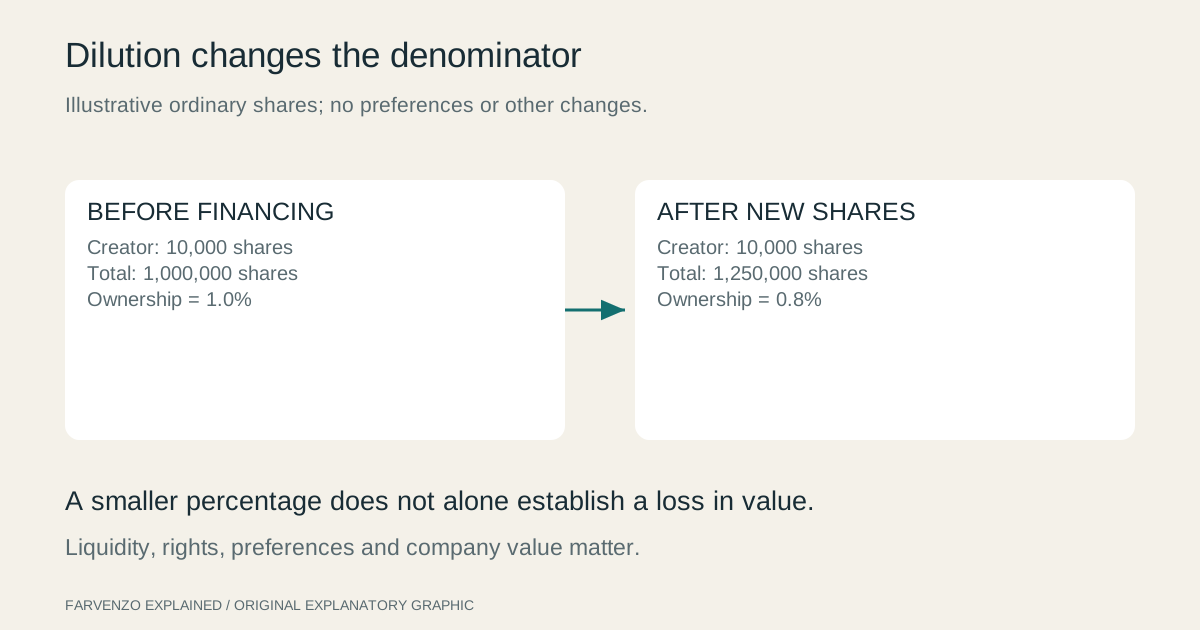
Imagine an illustrative creator receiving 10,000 ordinary shares when the relevant fully diluted total is 1 million shares. On that stated basis, the stake is one percent. A later financing issues 250,000 additional shares, with no other changes. The creator still owns 10,000 shares, but the percentage becomes 0.8 percent of 1.25 million. This calculation alone says nothing about whether the investment lost value: the new financing may add resources and increase the company's value. Percentage ownership and economic value are related but distinct measurements.
The creator also reviews what would happen under different sale prices and the actual preferences of other securities. A one-percent stake does not necessarily receive one percent of the headline sale price after debt, fees, preferences and other terms are applied. Vesting may further reduce the earned amount if obligations end early. The example is deliberately simple and is not a valuation of a real deal. It shows why a cap table, security terms and payout scenarios are more useful than treating a percentage as a complete description of ownership.
Content obligations can outlast the excitement
A deal should specify deliverables, approval rights, publication dates, performance obligations and the consequences of cancellation. Usage rights deserve particular attention: a company may want to reuse a creator's name, image or content in advertising beyond the original campaign. Exclusivity can prevent future work with competitors and impose a substantial opportunity cost. A small equity grant may become expensive compensation if it restricts the creator's main income for years. The agreement should make the duration, scope and termination process understandable before either side relies on it.
The creator should also retain appropriate boundaries around truthful claims. Ownership does not justify endorsing a product they have not evaluated or making unsupported health or financial promises. Relevant commercial connections need clear disclosure under applicable rules. FTC guidance addresses material connections and endorsements in covered US contexts, while other jurisdictions have their own requirements. The practical principle is that the audience should understand a relationship that could affect how it evaluates the recommendation. A disclosure should remain effective in the format where the endorsement is actually seen or heard.
Worked example: compare cash and mixed payment
Suppose an illustrative campaign would normally earn a creator $20,000 in cash. The company offers $5,000 plus equity it describes as worth $30,000. The creator estimates $4,000 in production expenses and significant time that could be used for other paid work. The cash component barely covers direct expense, while the equity value depends on company assumptions and terms. Comparing $35,000 with $20,000 as if both were cash ignores liquidity and risk. The creator needs enough resources to deliver the work and meet obligations even if the shares ultimately produce nothing.
The parties consider a smaller campaign, a higher cash component or a staged arrangement linked to clearly defined services. An independent adviser reviews the documents and valuation basis. The creator also considers concentration: if their audience, income and investments all depend on the same brand, a business setback can affect them in several ways at once. A mixed deal may still be attractive, but its appeal should come from an understood risk and suitable circumstances. The purpose of the comparison is informed negotiation, not a universal preference for equity or cash.
A holding company is an organizing structure
A creator can use an entity to hold ownership interests, intellectual property or operating businesses, subject to applicable law. The structure may help organize governance and records, but it does not automatically create tax savings, remove liability or make unrelated ventures profitable. Guarantees, shared contracts and poor separation can reconnect risks that appear separate on an organization chart. Professional advice should address the actual jurisdiction, activities and objectives. The name holding company describes a role; it is not a certification of sophisticated management or a shortcut around legal responsibilities.
Shared resources can help a portfolio of creator businesses, but they also create dependencies. One audience may be asked to buy several products, one team may handle all operations and one founder may approve every consequential decision. A problem with reputation, access or availability can affect the whole group. Evaluate customer overlap, cash transfers and conflicts between ventures. An investment that looks diversified because it has a different company name may still rely on the same distribution channel and person. Portfolio design requires attention to common causes, not only a count of subsidiaries.
Governance should continue after signing. Keep records of vesting, company updates, shareholder decisions, rights and deadlines. Understand which information the company is required to provide and whether the creator has any practical way to monitor the investment. If the relationship changes, separate the ongoing ownership from the endorsement arrangement. A creator may remain a shareholder after a campaign ends, which can still matter to future statements. Administrative discipline is less visible than an ownership announcement but becomes important when the company raises money, reorganizes or offers an exit.
Creator equity can align long-term incentives and open opportunities beyond campaign fees. It can also exchange reliable compensation for an uncertain, illiquid claim while adding substantial obligations. Price the service, understand the security, inspect dilution and payout terms, protect cash needs and disclose relevant relationships. Treat a holding company as a structure that needs governance rather than a business model in itself. Ownership is meaningful when the rights, responsibilities and risks are understood. A compelling announcement cannot substitute for that work, and a larger paper valuation cannot guarantee an eventual return.
Sources
Keep exploring
- Buying a Micro-SaaS: A Due-Diligence Guide Beyond the Multiple →
Evaluate a micro-SaaS purchase by reconciling revenue, normalizing owner labor, inspecting software and rights, and testing a reproducible business handover.
- Programmatic SEO With Editorial Standards →
Build programmatic SEO pages from verified records and distinct user tasks, with editorial checks, realistic maintenance budgets and responsible discovery.