Creator Economy & Digital Solopreneurship
B2B Newsletter Economics: Audience Fit Before Audience Size
A B2B newsletter earns its value by helping a specific reader make better professional decisions. Subscriber count can support that business, but it does not establish reader trust, advertiser value or profit. A small audience of relevant decision-makers may be commercially useful, while a large list of disengaged or mismatched addresses may be expensive to maintain. The economics depend on the product, distribution, measurement, sales and delivery costs. Before multiplying an audience by an attractive advertising rate, identify what readers need, what sponsors are buying and which evidence can demonstrate that the newsletter provides it. A publication is a continuing service, not simply a list that can be monetized automatically.
By Farvenzo Explained · Published · 6 min read
Define the professional job to be done
A useful audience description includes role, responsibility and recurring problem. Procurement managers evaluating suppliers need something different from founders following general technology news. Specificity helps the editor choose sources, examples, cadence and depth. It also reveals whether the information has a natural repeat cycle. A daily publication needs a reason to be daily beyond the publisher's wish for more advertising inventory. If the reader's decision changes monthly, a less frequent but more substantial product may be more valuable and easier to produce reliably.
The editorial promise should be testable through use. Readers might save time finding relevant developments, understand a technical change or discover questions for a vendor review. Those are different services. Interviews and replies can help identify needs, but stated enthusiasm is not the same as continued reading or payment. A pilot should observe what readers use, where they stop and whether the publication remains relevant after the novelty fades. The goal is to learn the actual job performed rather than force a broad content stream into a narrow audience label.
Measure the audience with appropriate limits
List size, delivered messages, opens, clicks, replies and conversions measure different stages. Open measurements can be affected by privacy features, image loading and automated activity, so they should not be treated as exact counts of attentive human readers. Clicks can also include automated scanning. A publisher should explain its measurement method and avoid presenting a dashboard metric as more precise than it is. Consistent definitions and transparent limitations are more useful to a serious sponsor than a large number whose meaning changes between proposals.
Audience composition matters as much as activity. A sponsor may value readers in particular industries, company sizes or responsibilities. Collect only appropriate information, explain its use and protect it. Survey responses can describe the responding group without establishing the profile of every subscriber. A newsletter should not invent job-title distributions or imply that each address represents a purchasing decision-maker. Where reliable evidence is unavailable, say so. Trust in the commercial product begins with honest audience claims, especially when a sponsor's buying decision depends on those claims.
Worked example: build a sponsorship forecast
Imagine an illustrative newsletter delivering an issue to 10,000 addresses. It sells one placement at $50 per thousand delivered messages, producing $500 per issue under that specific contract. Four fully sold issues would generate $2,000. That is not guaranteed monthly revenue: unsold placements, discounts, agency fees, refunds or make-good obligations can reduce receipts. A rate quoted per delivered message also cannot be compared directly with one quoted per open or qualified lead. The denominator belongs in every proposal and forecast.
Suppose writing and research cost $900 a month, production and software $250, sales support $300 and other overhead $150. These illustrative costs total $1,600, leaving $400 before the owner's additional labor and taxes if all four placements sell at the stated price. At only two sold placements, revenue is $1,000 and the same cost base produces a $600 shortfall. The exercise shows why fill rate and selling effort belong beside the advertising rate. A profitable issue at full capacity does not establish a profitable publication across ordinary months.
Distribution must match retention
Growth methods bring different readers and costs. Partnerships, recommendations, events, search and paid acquisition can each work in suitable circumstances. Evaluate subscribers by source over time rather than assume every new address has equal value. A campaign that produces cheap signups can be expensive if those readers quickly disengage or never match the editorial promise. Acquisition should be connected to retention and contribution, with an appropriate time horizon. Counting signups alone can reward distribution that makes the audience less useful to both readers and sponsors.
Permission and deliverability are operating responsibilities. Applicable email and privacy rules depend on jurisdiction, audience and practices. The FTC's CAN-SPAM guidance explains requirements for covered commercial email in the United States, but it is not a complete global compliance framework. Publishers should use relevant authoritative guidance and appropriate advice rather than assume one country's rule covers all subscribers. Clear identity, truthful presentation and a working way to stop unwanted messages also support trust. Sending to more people is not useful growth if it damages reputation or makes the service unwelcome.
Worked example: compare two acquisition sources
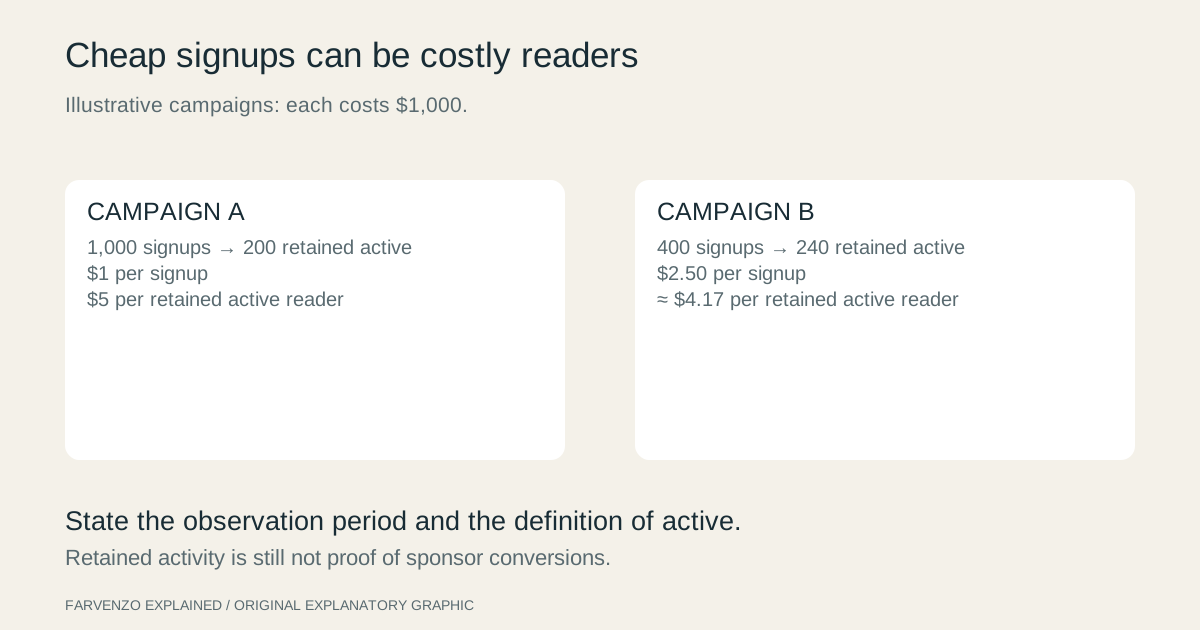
Consider an illustrative publisher spending $1,000 on each of two campaigns. Campaign A brings 1,000 subscribers, while B brings 400. After a defined observation period, 200 from A and 240 from B remain meaningfully active according to a stated measure. The initial signup cost favors A at $1 versus $2.50, but cost per retained active reader favors B at $5 versus about $4.17. These figures do not prove B is always better. They show why the evaluation period and definition of activity can change the apparent winner.
The publisher then checks whether the groups match the intended professional audience and whether their behavior produces useful outcomes. A smaller group could still be less valuable if it falls outside the editorial focus or creates unusually high support costs. The analysis also considers whether either campaign caused signups that would otherwise have occurred. Where causal measurement is limited, the publisher records uncertainty rather than present exact incremental returns. The practical response is to refine the offer and test again, not scale the cheapest signup source before learning what kind of reader it brings.
Protect the boundary between advertising and judgment
A sponsor can fund useful publishing without controlling every editorial conclusion. Readers should be able to identify advertising and understand relevant commercial relationships. The FTC's native-advertising guidance addresses deceptive presentation and clear disclosures in covered contexts. A subtle label is not automatically adequate simply because it exists. The overall impression matters. Publishers should design sponsorship formats that remain recognizable in email, web archives and shared excerpts. Editorial standards should also state how sponsored claims are checked and which content the publisher will decline.
Commercial pressure can appear indirectly. A sales team may promise a favorable article, access to subscriber details or a particular result without editorial approval. Written inventory and deliverables reduce this risk. A sponsor should know the placement, date, format, measurement and any conditions for a make-good. The publisher should avoid guaranteeing sales or leads it cannot control. If a campaign underperforms, a transparent report and agreed remedy are more sustainable than changing the metric afterward. The publication's long-term asset is reader trust, which can be damaged by one poorly defined short-term sale.
Subscription revenue, research products, events and services can diversify a newsletter business, but each adds work and potential conflicts. A paid research product needs a distinct value proposition; an event introduces logistics; consulting can bias coverage toward the client's interests. Evaluate the incremental economics and editorial implications rather than assume multiple revenue streams automatically reduce risk. A small team may be more vulnerable if every new stream depends on the same founder and consumes the time needed to maintain the core publication. Diversification should improve the business rather than merely broaden its obligations.
A sound B2B newsletter model begins with reader usefulness and follows it through retention, measurement and revenue. State denominators, include unsold inventory and sales effort, and compare acquisition sources using durable audience quality. Keep sponsorship recognizable and promises bounded. There is no universal subscriber threshold or advertising rate that guarantees success. A smaller publication with a clear professional purpose and honest economics can be more durable than a larger list assembled around a spreadsheet assumption. The relevant question is whether the service repeatedly earns attention and enough contribution to keep delivering it well.
Sources
Keep exploring
- Creator Equity Deals and Holding Companies: Ownership With Real Risk →
Examine creator equity compensation through dilution, liquidity, campaign costs, contractual rights and disclosure, with worked ownership examples.
- Buying a Micro-SaaS: A Due-Diligence Guide Beyond the Multiple →
Evaluate a micro-SaaS purchase by reconciling revenue, normalizing owner labor, inspecting software and rights, and testing a reproducible business handover.