Philosophy & Modern Stoicism
Amor Fati After a Business Setback
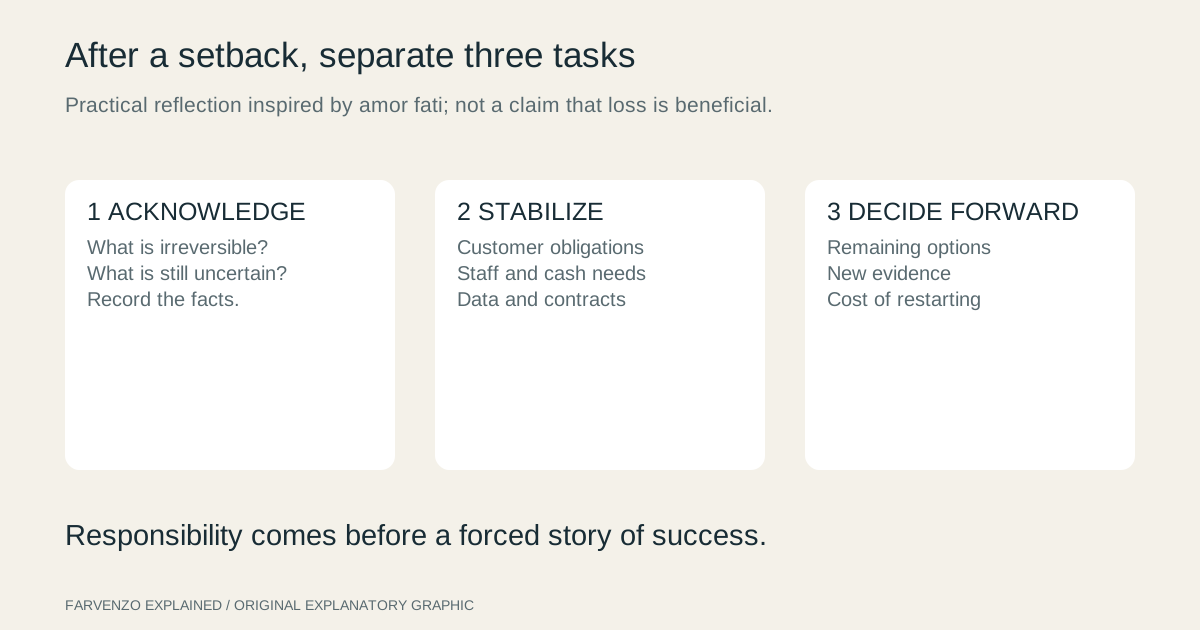
After a business setback, the past can occupy attention in two unhelpful ways. One is endless counterfactual argument about how events should have unfolded. The other is a rushed success story that insists the loss was secretly beneficial. Amor fati, associated with Nietzsche's writing, offers a more demanding philosophical question about one's relation to what has happened. Applying it to business does not require celebrating harm or pretending every failure leads to something better. A practical interpretation is to acknowledge the irreversible facts, meet present obligations and decide what can be done with the remaining situation. Acceptance can make responsibility clearer when it is kept separate from resignation and self-justification.
By Farvenzo Explained · Published · 7 min read
Distinguish the philosophy from the slogan
Nietzsche's idea of affirming fate belongs to a wider philosophical project; it is not a management technique with a measured return. A business article should be explicit when adapting it into a practical reflection rather than claiming to summarize the whole philosophy. The adaptation here concerns the present decision after an event that cannot be undone. It asks what facts must be accepted and which responses remain open. That is different from saying the event was morally right, unavoidable in advance or guaranteed to improve the future.
This distinction protects the people affected. A failed product can cost employees income, customers time and suppliers money. Telling them that everything happens for a reason can minimize those consequences. A leader's private effort to make sense of a setback does not settle another person's loss. Responsible acceptance includes acknowledging harm and pursuing appropriate remedies. It should not become a rhetorical device for avoiding refunds, hiding mistakes or demanding loyalty. The philosophy is most useful when it reduces defensiveness and increases the ability to respond honestly to the situation that actually exists.
Stabilize obligations before rewriting the story
The first business task may be operational rather than philosophical. Identify cash, payroll, customer commitments, data, contracts and safety responsibilities that need attention. Separate urgent actions from longer-term interpretation. A team that immediately announces a pivot can leave unresolved obligations from the old product behind. A team that spends weeks assigning blame can miss the same practical deadlines. An initial fact record should state what happened, what is known, what remains uncertain and who owns each immediate response. The record can be revised as evidence improves without disguising earlier uncertainty.
Communication should reflect that sequence. Explain confirmed consequences, actions and update times without filling gaps with confident speculation. Different audiences may need different details, but the accounts should remain consistent. Legal and contractual responsibilities require appropriate advice. The goal is neither a dramatic confession nor an optimistic performance. It is to give affected people the information they need and to preserve a reliable basis for the next decision. A leader can express regret and take action without claiming that the organization has already discovered the lesson or the eventual silver lining.
Worked example: close a failed product responsibly
Imagine an illustrative software company whose new product fails to attract enough paying customers. Management decides to discontinue it. Before presenting the failure as a source of innovation, the team maps active customers, prepaid subscriptions, stored data and support needs. It establishes a lawful, practical wind-down plan, including communication, export options and appropriate refunds where required. Staff receive clear responsibilities and a schedule. The company also preserves records needed to understand the failure. These actions do not reverse the loss, but they reduce the chance that disappointment becomes an avoidable breach of trust.
Only after immediate obligations are organized does the team evaluate what can be reused. A useful internal tool may survive, while a feature central to the original vision may have little value. The decision should depend on evidence, not a need to prove that the investment was worthwhile. The company can close the product and still acknowledge that some capabilities remain useful. It can also conclude that little should be retained. Acceptance does not require manufacturing a success narrative; it permits resources to move once the remaining options have been evaluated honestly.
Learn without inventing inevitability
A retrospective should distinguish decisions, outcomes and information available at the time. Some choices may have been reasonable but unlucky; others may have ignored evidence already present. Hindsight makes a failed outcome appear more predictable than it was, while defensiveness can make every error seem unforeseeable. Compare the original assumptions, forecasts and decision records with what occurred. Ask where feedback arrived, how it was interpreted and which incentives influenced action. This produces a more useful account than identifying one heroic lesson or one person to blame for a complex result.
A lesson should change a future behavior or criterion. We needed better communication is incomplete unless the team identifies what information, recipient, timing and authority were missing. We should have moved faster can be wrong if speed amplified an untested assumption. A concrete lesson might require evidence of repeat purchase before a large production order, or a named owner for customer-impact decisions. The response should be proportionate to the failure mechanism. Adding a new approval for every mistake can make the organization slower without addressing the source of risk.
Worked example: decide whether to restart
Suppose an illustrative retailer loses money on a new location. The owner believes reopening with a smaller format would redeem the original decision. A forward comparison lists the remaining lease obligation, closure costs, recoverable equipment, new investment and plausible demand. Past spending is recorded for accountability but does not become a benefit of restarting. The smaller format needs its own case. If it is attractive under realistic assumptions, restarting may be reasonable. If not, closure can be the responsible response even though it leaves the original loss visible.
The owner asks an independent reviewer to examine the assumptions and compare alternative uses of the remaining cash and time. They also define a limited test and stopping condition if more evidence is needed. This separates learning from the desire to erase embarrassment. The example is hypothetical and does not imply a universal rule about failing stores. It shows how accepting the old outcome can improve a new decision: the owner no longer needs the next project to prove that the past was right. The remaining resources can be judged according to their future possibilities and obligations.
Identity should leave room for revision
Founders often connect personal identity with a business idea. That connection can supply energy and persistence, but it can make contradictory evidence feel like a threat to the self. A setback then becomes harder to investigate because revising the plan appears to mean admitting personal worthlessness. A more workable identity concerns conduct: being truthful, meeting commitments and learning where possible. Those standards can survive the cancellation of a particular product. They do not remove grief or financial stress, but they create room to change direction without requiring a total reconstruction of the person.
Teams need the same permission. Employees may have defended a strategy because they were assigned to implement it. A retrospective that punishes every expression of past confidence can encourage future silence. The review should distinguish good-faith work, foreseeable errors, misconduct and system incentives. Serious wrongdoing still requires appropriate accountability. Psychological safety does not mean immunity from consequences; it means that relevant information can be surfaced without arbitrary punishment. Acceptance of a setback should help the organization become more truthful rather than make it easier to hide responsibility behind collective language.
Some losses take time to process, and philosophical reflection is not a substitute for practical assistance or mental-health support. A person facing debt, job loss or intense distress may need professional help and material options before a lesson feels useful. Leaders should avoid imposing a resilience narrative on someone else's timetable. The relevant question can simply be what support is needed today. A future interpretation may emerge later, or the event may remain a loss that the person would reasonably prefer had not occurred. Responsible action does not depend on declaring otherwise.
Amor fati can serve as a prompt to stop arguing with irreversible facts and reengage with present choices. Applied carefully, it supports a sequence: acknowledge what happened, meet obligations, investigate the evidence and evaluate the remaining options. It does not prove that failure was necessary or that the next chapter will succeed. A business can become more accountable and deliberate after a setback without romanticizing it. The valuable change is the quality of the response, measured through conduct and decisions rather than the elegance of the story told about the past.
Sources
Keep exploring
- One-Person Business Economics Without the Margin Fantasy →
Calculate one-person business economics with owner labor, distribution, support and continuity included, using service and digital-product examples.
- B2B Newsletter Economics: Audience Fit Before Audience Size →
Build a B2B newsletter model around reader needs, honest measurement, sold inventory and retention, with sponsorship and acquisition-cost examples.